Monday, February 6, 2012

Pumpkin-suit's Manual Preview #4

Not for those with motion sickness.
          Spacewalks
    The most common of EVAs is the spacewalk.  This type of maneuver describes any activity performed in corpus outside of a spacecraft.  This includes robotic activities; using a robot for a spacewalk simply adds an additional Teleoperation Skill Check.
    Description: “ There's no up or down anymore.  One moment, you're handing on by you hands with the hull of your ship in front of you, the next, you're feet are tucked under the hand holds and you're staring out into open space.  The view is awesome – in the original sense of the word.  Seeing nothing but the Black Desert stretching out to eternity in all directions, dwarfing you, your spacecraft, even your planet...it's both exhilarating and utterly terrifying.
    “Still, you have work to do.”

Tethered Spacewalks
    For safety reasons, nearly all spacewalks are performed while wearing a tether.  Two tethers are required at all times, so that the failure of one doesn't leave the astronaut or robot floating free.
    Tethered Spacewalks
    Classic D6:
    Skill: Spacesuit Operation: Spacesuit Type
    Difficulty: Moderate
    Special: Difficulty modifiers for spacesuit type or robot type always apply.
    Natural Failure results in loss of footing and orientation; the astronaut or robot must pull themselves back and re-orient.  This takes 1D rounds, but only requires one new Skill Check.
    A “1” on the Wild Die resulting in a failure causes a loss of one tether in addition to loss of footing and orientation.  The tether must be recovered and reattached before any other maneuver may be attempted (except in dire emergency).  This takes 2D rounds. 
    A “1” on the Wild Die resulting in a failure by more than one Difficulty Level means the loss of both tethers and leaves the astronaut or robot floating in space (see below).

Wednesday, February 1, 2012

I didn't steal this, honest!

Hmm...reminds me of something...
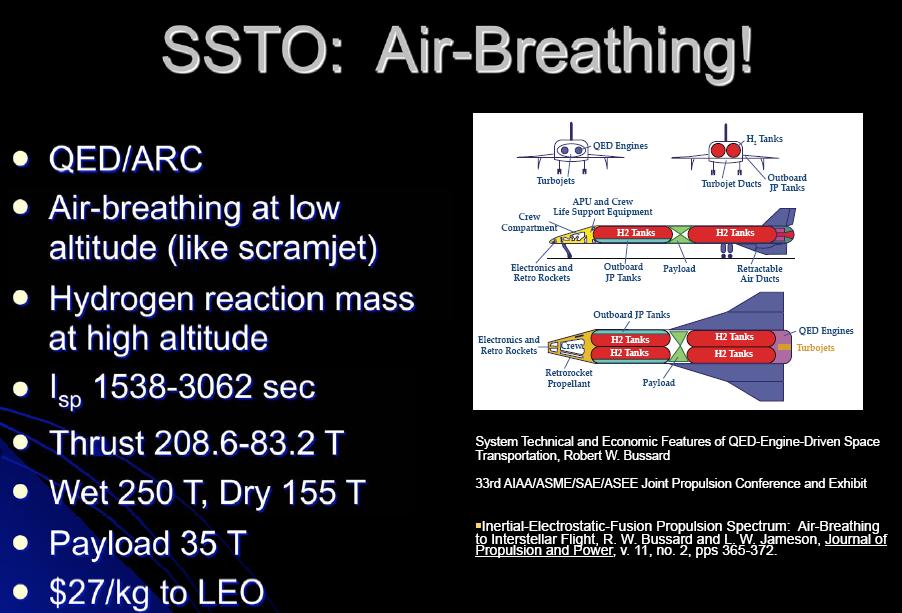
Apparantly, I'm on the right track with my spacecraft designs, as this powerpoint from the website Next Big Future.com indicates.  My costs to LEO are even close!  Oh, well, just another paper space-plane that never got funding.  If you'll excuse me, I'm in the process of getting my blood sugar above 40.  Have a pleasant evening morning.

Tuesday, January 31, 2012

Pumpkin-suit's Manual Preview #3

An Impulse Burn; also covered.
        
Orbital Maneuvers
Once free from the surface, a spacecraft must achieve a stable orbit. In truth every maneuver a spacecraft makes is an orbit of some sort, either around the moon or planet they launched from,or around the sun in an interplanetary intercept. While transfer orbits to new worlds are common enough, typical orbital maneuvers involve changing orbits around a planet or satellite in order to reach another spacecraft, station, or stable altitude for open flight.

Finite Burn Trajectories
This most difficult of orbital maneuvers are also the most common, as finite burn trajectories are required in order to achieve rendezvous for docking. The difficulty involved in finite burn trajectories comes from the incredible amount of real-time data needed to calculate such precise orbital chances. Up -to-the-second data on spacecraft mass, center of gravity, moment of inertia thrust vectors on reaction controls and propellant consumption must be gathered and calculated for moment-to-moment correction of course and speed. This kind of maneuver is, needless to say, best left to computers. Only AIs, Transhumans, and Nurillia cyborgs specializing in flight control can hope to perform such complex maneuvers without a flight computer.
Description: “The wait is monotonous and nerve-wracking as you spacecraft slowly crawls toward it's target. Everyone is strapped down, as even the motion of a floating passenger could trow off the delicate corrections necessary in order to line up for docking. The only sights are a star-field that seems to move not at all, and the only sound is the drone of the computers range slowly counting down and the occasional hiss of an RCS burn. Whoever said space travel was exciting had obviously never made a finite burn! Oh, well...best get some sleep.”

Classic D6
Skill: Spaceship Piloting: Spaceship Type
Difficulty: Heroic
Special: This maneuver is only possible with computer assistance, or by a Nurilla. Computer aid adds +2D to the Dice Pool, and Nurillas typically have extra dice in Spaceship Piloting as well as the Machine Memory Special Ability. For the purposes of these maneuvers, AI and Transhuman Characters are considered computers.
In either case, the Guidance Officer or Pilot includes the spacecraft's Sensors Dice into their Dice Pool for this roll.
A natural failure requires the maneuver be aborted. It takes a minimum of 90 minutes to reset for another trajectory.
A roll of 1 on the Wild Die that results in a failure causes an abort that requires moving to another orbit. It will take 90 minutes + 1D hours to reset for another trajectory.
A roll of 1 on the Wild Die that results in a failure by more than one Difficulty Level means that the spacecraft is in a bad trajectory that is not aborted, leading to a crash or an emergency correction (Difficult) to avoid.
 
Google+