Showing posts with label D20. Show all posts

Wednesday, February 16, 2022

Designing A TTRPG: Format


Improving page layout was a low bar.

   So in mid-1999 my friends and I were talking about making a TTPRG of our own.  I don't know how common that was back then; I knew exactly two people with internet at the time and had never heard of PDFs.  This was to be a printed book and sold in brick and mortar stores.
    I don't know if any of us thought it would actually happen.  But it was fun to imagine.

    The book was going to be beauty, too.  Not a mere hardback tome with glossy pages and color art; this was going to be a book that was actually useful.  Heavy-gauge spiral bound so the pages lay flat.  Hard plastic covers with the game's name embossed. Chapter tabs built in.  A comprehensive index.  A pocket in the front for commonly used tables and one in the back for a dozen blank character sheets.

    We were sweet summer children.  Compared to the play-focused designs of today, our book was hopelessly outclassed.

    That said, we were trying to get away from a trend that was already in full swing in the late nineties and would continue for the next fifteen years. Game books and Adventures weren't made to actually be used in those days - they were made to be read. And they were oftentimes a great read.

READABILITY VS PLAYABILITY 

  The original post for last week's blog had an entire paragraph on the splat books from the D&D 3.x years.  I still have mine.  Heck, I still read them - they are great inspiration for the imagination. The Stronghold Builder's Guidebook, the Races books - the DMG II has a section on life in a medieval setting that I practically memorized.

    But. 

    These books weren't inspiring me to, ya know, game.

    If I ever get around to writing fantasy stories, you can bet the D&D 3.x books will be used as reference. But I didn't buy them because I wanted to write.  And they didn't inspire my games very much either.

    Even if they did inspire me to game, most of the books were hard to use at the table.  They required shuffling between stacks of hardbacks, endless page flipping, and even with a DM screen it was hard to get a decent play flow going because magic.


Okay, so the spell casters are in the front of the middle book, the spells are in the back of the middle book, the magic items are in the book on the left, the monsters that cast spells are in the book on the right...
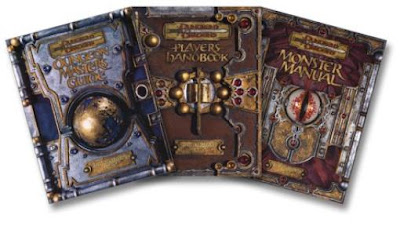
    4th Edition, for all of it's faults, was much easier to use at the table.  But I hadn't seen anything in terms of table utility until I started looking and Indie RPGs.  Mothership. Into the Odd. Maze Rats.

THE CONTROL PANEL LAYOUT AND BEYOND

    The Control Panel layout was a revelation.      

    In retrospect, it's such a simple idea: Every double-page spread is devoted to a single subject, and everything about that subject is on the double-page spread.  No flipping to another section, no checking for material in another book. 

    Brilliant.

    But Ben from Questing Beast made rather fanciful speculation on his blog about layouts that I cannot get out of my head:

"It got me wondering whether you could make an entire RPG in the form of cardstock handouts, somewhere between A4 and A5 sized."

    Could that work?

    Turns out the answer is yes.  Yes it can.

    Not only can that work, cardstock handouts have advantages other formats lack:

  • You don't have to share a book. Heck, there's no book to share!  Information that an individual player needs for their character is available in a single-page format that can used while other players have access to the rest of the cards.
  • Handouts are a solved problem: Adventure maps, as just one example, are no longer bound in the same book that the adventure's less player-facing assets are.  A map can simply be removed from the card stack and placed on the table.  Or an NPC portrait.  There's already an entire game with card-based assets available that has rave reviews. 
  • All assets are modular. References or tables from multiple books become multiple cards - much easier to handle.  The caption from the image above wouldn't exist with cards. Like Ben said, "Player wants to play a wizard? Hand him the card with the magic rules and the card with the spell list."

    These are just a few examples.

    I wondered why there weren't more games using this format until I started to try it out.  Having every rule, map, item and table on individual cards sounds good in theory, but how do you organize everything?  Color codes? Pages of Collectible Card sheets in a ring binder, like Pokemon or Magic Cards?  Utility can exist only if Accessibility is preserved. As annoying as the tables of contents or indices for some RPGs can be, at least the pages didn't change order.

    Fortunately, there is a rather, pardon the pun, old-school technique we can look into.

INDEX CARDS AND ANALOG DATABASES


As I've mentioned once or twice, I'm kinda old.  Not old enough to have used punched-card computers, but I was in collage before card catalogs were phased out.  In high school, when I had to write a term paper, I wasn't forbidden to use Wikipedia as a citation, but I was required to collect and document x number of works cited on 3x5 index cards.

    I mention this because back when people used index cards all the time they still needed a way to organize and search the data thereon.

   Enter the Edge-Notch Card Index.

   I don't recall these from my youth Back In The Day but various systems were still in use in the 1980s and are probably used privately if not commercially today.  

    The principle is fairly simple:  By punching holes in the edge of the cards, you can pick them all up on a rod or wire.  If you notch some of those holes on specific cards, then a rod or wire inserted in a stack of cards will not pick the notched cards up.  They will fall out.  You can double-punch the cards or devise codes for organizing the cards to enable searching by multiple terms or searching more terms than holes or any number of possible variations including using more than one rod in combination with the above methods.

    Here's a video found on Hackaday that demonstrates the system's utility.

    The advantages for organizing a completely card-based TTRPG are many.  Just think of possibilities:

  • The cards are just as searchable out-of-order. As long as they're all right-side up and facing the same way (a problem solved by beveling one corner) the cards are searchable no matter where they are in the stack.  This means that no matter how much you use, reuse or pass the cards around during play, you can just put them all back in the box at the end of the evening and they will be as easy to search and access next time you use them.
  • You can have as many copies of a specific card as you want/need: I'm sure everyone that's played a game has at least once wished you had another copy of the chargen rules. Or the weapons table, or the range chart, et cetera ad nauseum. Now you can, without buying a whole other book.  And you can put the copies in the main stack, anywhere you want, and they'll still be as searchable and accessible as the original.
  • You can add new information and errata without sacrificing accessibility: This alone is worth the cost of admission. With the exception of GURPS No TTRPG I've played included an index in every book or supplement.  Edge Notched cards not only eliminate the separate index, they eliminate the need for a separate index.  You can make a new adventure, a new rule set, additional classes, equipment - what ever you want, and as long as you add the right combination of holes and notches, you can stack them all together in one box. Errata does not require page references and quotations.  Just issue a new card and it can go in the stack to replace the old.
  • The stacks are fractal.  As long as you have a stack with more than one card, you can search that stack using the the system of organization you selected. You can take a huge stack, split it into multiple packets and search those separately.

     Or you can combine stacks or shuffle stacks or anything - that's the genius of the edge-notched cards. As long as you line up the beveled corners, the cards cannot be randomized. You will always be able to find the card you're looking for.

    There's so much potential In these.  A double layer of holes could allow for storing completely different games in the same stack.  If A5 doesn't provide enough space for what you need on a card, you could mirror the bevels, holes and notches top-and-bottom and fold the card in half to make it fit in a stack.  You could make multiple games or multiple categories of cards by varying the size of the cards - instead of DMG, PH and MM, you could have 5x8, 3x5 and 2.5x3.5. 

    Or anything. 

    I'd like to extend a special thank you to Mr. Winchell D. Chung Jr., aka Nyrath the Nearly-Wise.  I first discovered Edge Notched cards on his website Atomic Rockets, along with Nomograms and other goodies.  As I've said before, This website and the Blue Max Studios back catalog would not exist without Mr. Chung and Atomic Rockets.


Wednesday, February 9, 2022

How you Play is What you WIn II: Overruling Over-Rule-ing

    My wife Debra is my favorite gamer.  Obvious and unapologetic bias aside, she makes the best characters.  Once she grasped the rules for multi-classing in D&D 3rd edition (much faster than I did) she never created the same kind of character twice.  She had one, a Bard/Rogue/Fighter/One-of-the-exotic-Prestige-Classes that looked like a half-elf David Bowie and I remember them fondly. 

Half-elf is almost redundant.

    But they were all fun.  Debra played Changelings, Shaman, Classes and Races from obscure 3rd parties books and a few home-brew Races and Classes as well.

    I've mentioned before that one of the reasons I didn't enjoy playing 4th edition D&D was the difficulty in making multi-class or home-brew content.  I felt like we couldn't make the game our own.  With 3rd edition the issues were different:

  • It was hell to prep for. Every monster and NPC used the Player Character format and that format was neither simple nor short.  The stat blocks in the Monster Manual were difficult to use at the table on the fly.
  • Experience.  The XP rules - actually, I don't think I ever used the XP rules.  I just let everyone level up after each session.
  • NPC Spellcasters.  Remember NPCs used PCs format?  So I'd need the MM and DMG and the Player's Handbook unless I wanted to write out every spell discription. 

 IMPLICIT RESTRICTIONS

  These were the obvious issues.  The more insidious issues, the ones I had to have pointed out to me, are the issues implicit in the design.  Skill lists for example.

    Without spending the remainder of this post breaking down the rules for getting skills, increasing skills and using skills, let us focus instead on the affects of having a skill list at all:  

  • A skill list implies that there is a finite number of possible actions.  If as a player you've ever looked at your sheet to see what you can do, you know what I mean. If the system has more skills that favor a certain kind of play (like combat) or forces Players to spend a limited number of points on specific skills to make the character viable, then that is what the game is about. How you Play is What you Win.
  • A skill list implies that you must roll for any action in which there is a skill.  Ever play a modern/near-future campaign and fail a Drive check going to your apartment?
  • A skill list implies your character concepts are limited. This is really bad in systems that have Class-based character builds, with limited lists of skills one can gain without penalty, but it's also present in any system with skill lists.  One of the reasons I'm making Project NEPTUNE is because it's impossible to make a character that's viable in both regular and space combat.  The available skill points are spread too thinly.

    This last point is a particular peeve because it opens up the Munchkin-Min/Max-Can-Of-Worms that is Character Build Optimization.  I personally am not interested in gaming the rules for advantage when rolling dice.  I do not want to make a game that rewards or, if possible, allows that sort of meta-gaming.

    I'm Diabetic - I already can't eat without doing complex math.

Skill Chapters are 26 and 30 pages respectively.
    

SKILL ROLLS WITHOUT SKILL LISTS?

    Years ago now, I read a post from Tales to Astound that has stuck with me ever since.  The TL;DR version is that during a con-game, the author wrote the character generation rules out on-the-fly and included a game gem so lustrous it's stuck with me ever since:

"Give yourself a profession and write that on the top of the card. 
Your character can do all the things that that profession can do. 
Then add three more skills, the things you are really good at, which might tie to your profession or be something else."  

    That. Right. There.  Your character can do all the things that profession can do. 

    That simple sentence implies so much more freedom than the most comprehensive chapter on skills is able to.  Let's unpack it a bit:

  • The less you define a skill list, the more potential a Character has. Say your profession is Butcher.  This immediately conjures up images of someone who is strong and good with knives.  I'd easily believe they are intimidating as well.  But there's so much more - Butchers are business people! They would know about taxes, sales, bookkeeping, and (depending on your setting) how to Drive.
  • You don't have to roll for every action. It's baked in - your Character can do these things.  There's no risk of failure unless there's a special circumstance.
  • An undefined skill list allows for creative interpretation. You can make a case a Butcher would know how to stitch someone up. They work with knives all the time, may not have money for the village barber or may lack health insurance - A case can be made that the particular Butcher you are playing can stitch up a wound.  And if a fellow PC is bleeding out you'd make that case.  Likewise, you could make the case a Butcher that works with the public daily would know how to flirt.  The GM may not agree with either case but the implication of the system is you have permission to try a creative interpretation of your Character.
    Encouraging a character's potential and player's creativity is what I want to win when I play, so you can expect as Project NEPTUNE and other ideas are developed, Skill Lists and their minutia will not be a large part of them.


Friday, December 16, 2016

LIFTOFF!


A NEW ERA IN SCIENCE FICTION GAMING!
Now you can get new material for your science fiction game - no matter what game it is!
Welcome to LAUNCH WINDOW: A monthly digest that features new material for Cepheus Engine, Diaspora, D20, Open D6, and OSR gaming.  Stories and articles every month feature new characters, starships, equipment and rules options for your favorite science fiction games.  Every system, every item, every issue.
The Black Desert of space is a dangerous place. When a shipping rocket is endanger of being impounded by a hostile government,  takes a special kind of team to repossess spacecraft before its passengers and crew become detainees.
The Third Gleise Monarchy stood for freedom and prosperity.  When is much larger totalitarian neighbor orchestrated a palace coup, it appears that all is lost.  It’s up to one diplomat and his starcruiser to find a way to turn what few ships and troops remain into a force of resistance.
ALSO IN THIS ISSUE:
Gone in 7 km/s: When your rocket’s bills are past due, don’t fear the Repo...
Species Spotlight: Hichikars:  These vagobonds of space are a lot of fun, but keep your hand on your wallet!

Technical Readout: Pinnace: These armed interface craft are a real bargain...but you get what you pay for.

Wednesday, November 16, 2016

Point Five is Number Two! (Also another free offer!)


   Yesterday was a wild ride RocketFans! Our little half-issue of LAUNCH WINDOW proved to be more popular than I dared to imagine.  When I went to bed last night, we were at number two on RPGNow.com's Top 100 Hottest Titles!  We were still at number two on the Top Small Press Titles.  This is amazing - in a few short hours, LAUNCH WINDOW Issue 0.5 broke all sales records here at Blue Max Studios!
    I'd like to take a moment to talk to all of you RocketFans old and new about what's next.  Obviously, LAUNCH WINDOW issues every month are next.  We've also revamped our reward and goal structure on Patreon to reflect the new direction of the company.  Part of that includes the new $5.00 reward, which is a PDF download of of each month's issue, both short stories, and the isometric map at no additional charge.  And since these patron are already getting the entire PDF archive with it, it's a pretty good deal.
    But I want to give that deal to everyone.  Thanks to the survey I ran a few weeks ago (Still active, BTW, so you can still get a free book!) I discovered that enough people dislike Patreon, for whatever reason, to make me decide to publish a monthly digest in the first place.  And since this is going to be a regular thing, There is no reason not to offer subscriptions at a substantial savings to all of my RocketFans.  So There will now be an option on our RPGNow.com page to order a full year of LAUNCH WINDOW for only sixty dollars.  That is a third off of the cover price; a total of $27.00 savings over the year.  
  
 I realize that $60 is a lot at one time, especially around the holidays.  While I think that a year's worth of LAUNCH WINDOW would make a great holiday gift for the gamer in your life, I more than understand not having the scratch to make such a purchase.  Well, that's okay, because one of the nice things about the system we have here is that you at any time you want to buy the 2017 run of LAUNCH WINDOW, you can.  If it's 2020 and you want to get the first year of our Digest, it will still on the infinite virtual shelves of the Internet. And you can always go the five buck a month on Patreon route. So don't worry about it.
     I will however, sweeten the deal: Issue 1 will be included in the 2017 subscription.  That means you'll be getting thirteen issues for only sixty dollars! It makes the next year's all even that way -January to December, without any issues left out.  Issue 0.5 will always be Pay What You Want.
    We have other plans for the future as well.  There will be Quarterly and Annual extras, and I hope to have Issue 1 available for POD by the debut of Issue 2 on Jan 15th next year, and be able to continually offer print editions one month behind.  I'm not sure about offering print subscriptions - that would cost a good bit more, our net would be less, and the shipping issues are an animal I've yet to tame.  If there's enough interest, however, I'll certainly give it a shot.
    You know what I'd love to do?  Get my books in brick and mortar stores.  We've got five within a hours drive of here alone.  I may only manage to get ebooks on gift cards into stores (yeah, that's totally a thing!) but maybe - just maybe - I can see my books on the shelves of bookstores and gaming shops.
     That would really be something.
     Anyway, I've got to get back to work.  I've got to get the D20 and OSR updates ready for Tuesday and, of course, I'm already writing for Issue 1.  See you later, RocketFans! 

Monday, November 14, 2016

ISSUE 0.5 is PAY WHAT YOU WANT (T-MINUS 1)


 Here we are, RocketFans, on the eve of our inaugural issue.  I've save the best surprise for last:  Issue 0.5 will be available as a Pay What You Want download!
     It's like this:  Our traditional publication date here at Blue Max Studios has always been the 15th of the month.  This is as much because of my family's monthly schedule as it is tradition. This left me but two weeks to put together the digest, unless I wanted to wait another month and put out  only one issue this year.  So I decided to start with an "Issue 0.5" - a half-sized magazine made in half the time.  The full sized digests running about 100 pages, start with Issue 1 in December, will cost $7.50 for the PDF and be available for $12.00 in full-color print editions. This one is an experiment, one I consider to be a success.  This is the last sneak peek before go live tomorrow, so I hope you enjoy it.


Friday, November 11, 2016

Just a Few More Things to Do...(T-MINUS 4)


Goes with the isometric map... 
You know you're getting close to done when the Table of Contents
has page numbers...


Thursday, November 10, 2016

More Works in Progress (T-MINUS 5 DAYS)

    Another busy day, RocketFans, getting LAUNCH WINDOW ready for press. It's looking like we'll be finished with the issue in plenty of time, meaning I can get a jump on the rules updates for D20, OSR, and Diaspora.  Let's take a peek, shall we?


    The Gentleman Scoundrel's  bridge complex is coming along.  The problem is, the image is huge - literally five feet by three.  Needless to say, at that size a lot of detail would be lost if I reduced it to fit a size A5 page, so this iso artwork will not be in the digest.  It will however be available for download as a separate file with  the digest, so you can enjoy it at a larger size!


     I'm really pleased with how the lay is coming as well.  I hope you are as well.  Anyway, I've got some more work to do, so until then, RocketFans, enjoy!

Monday, November 7, 2016

Putting the Fiction in Science Fiction Gaming


    It’s seven days until the big reveal, RocketFans, and there’s already so much anticipation for the new secret project that I’ve decided to let the cat out of the bag.  On November 15th, Blue Max Studios will release a prototype issue of what will be a monthly digest of science fiction and gaming: LAUNCH WINDOW.
    Thanks to the overwhelming response to my survey (which I will keep going indefinitely), I finally feel like I’ve found a clear sense of direction.  There are a lot of RocketFans out there, who enjoy this blog and what Blue Max publishes for different reasons.  There are people who like the fiction, the hard science, the space opera, the game rules, and almost any combination of the above.  There are people who only play Traveller, or D6, or Diaspora, as well as a growing group of folks who swear by OSR systems.  LAUNCH WINDOW is a way that I can consistently put out quality content that gives everyone something that they want.  
    What does this mean for the blog? Obviously I’ll be putting the majority of my efforts into the digest, so the amount of fiction and gaming articles available on the blog will be limited somewhat.  Every week, there will be a preview of material that will be published in that month’s issue, whether it’s the first part of a story, an overview of an article, or work-in-progress images of up coming artwork.  That being said, I’ll still be posting nano-fic, “Five things” articles, and other goodies just on the blog.  Like this article, for example.

Do you have a favorite Fiction or Article series that we do?  Let us know in the comments!

    Back in 2010 I started Blue Max Studios with the intention of finally being able to write game material for D6.  This was just after West End Games went under and the D6 rule system was released as Open Game Content. I had been inspired by Atomic Rockets (You could tell, couldn’t you?) to create a Hard SF setting, which was the beginning of The Black Desert.  One of the things I always wanted to do with the setting is create fiction for it - but I haven’t gotten around to it for many and various reasons.  One of the big reasons is that Gaming Fiction - stories set in an established RPG setting, has received a lot of negative feelings.   I did not fully understand
that feeling when I was a young gamer, most likely because my all-time favorite RPG was the Star Wars Role-Playing Game.  The game was literally built around a fictional setting, and the game fiction released in the Galaxy Guide supplements and especially in The Star Wars Adventure Journal are among some of my favorite short fiction stories, period.  In point of fact, the WEG material was given to authors working on the Expanded Universe (Now Legends) Novels, so I could argue that the bulk of Legends material is Gaming Fiction.
    From a certain point of view.
    But I won’t make that argument, because that’s not what most gamers mean by Gaming Fiction.  Rather than make specific examples, and thereby possibly insult someone’s favorite game, I’ve made a list of some of the most common complaints I’ve heard about Gaming Fiction:
  • A Core Rule Book or major supplement has more pages devoted to fiction than to useable gaming content.
  • A published adventure is more fiction story than game module.  It seems that the adventure is devoted to a plot that revolves around NPCs, while the Players are bit actors at best and merely spectators at worst.
  • The fiction presented as being based on and showcasing a game system or campaign setting features characters doing things that cannot actually be done in a game using the rules as written.
    I honestly thought there would be more complaints than this.  In a way, there are - but many complaints can be grouped under just plain poor writing.  The above list of grievances are frustrating even if - or perhaps especially if - the Gaming Fiction is of high quality.

What’s your biggest complaint about Gaming Fiction? Leave a comment below!

    Do RPGs even need companion fiction? Is it all just a way to make money? In my opinion, the answer is no - for fantasy and modern setting games.  Science Fiction is a different animal.
    When I say, “Science Fiction”, what’s the first thing you think of?  Is it Star Trek or Star Wars?  Maybe something cyberpunk?  Classic Heinlein?  Honor Harrington? Rayguns and Rockets? Transhuman philosophy? Mass Effect?  I borrowed that last one from Omer Joel of Stellagamma Publishing.  In a recent blogpost, he praised the setting of Mass Effect as an excellent foundation for a Military SF campaign.  The post reminded me of the Rebel Operative premise from WEG Star Wars that goes all the way back to its first edition.  And that reminded me of how easy it is to run a Star Wars campaign compared to a generic science fiction game.  Everybody knows what they’re getting when they play a Star Wars game, because the movies and TV shows and media presence provides us all with a common context.  Generic Fantasy and Modern games, being based on history and the real world respectively, also provide a common context that we all share to a certain degree.  With science fiction, a genre that makes very specific assumptions that are very different from setting to setting, that common context is not present.  An easy way to see what I mean is to try to run a certain style of SF game using a system that isn’t custom made for it, like Star Trek with Traveller, or Third Imperium with WEG Star Wars, or Shadowrun with either one as written.  There are generic SF rule sets that provide a huge variety different technologies you can pick and choose from to make a unique setting, but having done so, a Game Master must explain to their players just what does or does not exist in that setting.  This requires such awkward choices as telling everyone before play, which when you include chargen may use up all the available time, or writing out a document detailing the assumptions of the setting that the Players may or may not read, and may or may not be very interesting in any case.
    Or, you could provide a work of Gaming Fiction that puts everyone on the same page, both literally and figuratively.

What are some games that get adding fiction right? Comment below!

   I’ll use my own work as an example.  I’ve developed a Stardrive/FTL system using Negative Matter that is, if not completely new, sufficiently unusual as to require custom rules and lengthy explanation  In fact, I’ve already spent several thousand words trying to explain how it works without even touching upon the game mechanics.  In contrast, the story The Gentleman Scoundrel tells you pretty much everything you need to know about not only the technology of the setting. But the flavor, the themes, the species, the government, and a host of other things.  It’s not in any detail, to be sure, but the main thing is, if you’ve read the story, and I as a Game Master say that my setting is based in that universe, you know enough as a Player to get into the game without the frustration of finding out later that the campaign is not what you expected.
   Now all this is easy for me to say:  I’m a science fiction author as well as a game designer.  I have no problem with introducing my settings with fiction, and because I’ve been game designing for a while now, I feel reasonably confident that I can do it without being too intrusive.  If you like making your own SF worlds but have no desire to write stories, there’s no reason you should.  With me, it’s different - for one thing, I’m not writing stories to fit, reasonably or unreasonably, an already established game setting.  I’m writing stories, then writing rules that will allow a group of players to tell their own stories in that setting. I think that that’s an important distinction.  A good example is Rob Garitta’s Tesla stories.  They started with the universe of Starships & Spacemen, but they are so clearly part of their own distinct setting we published a supplement for them that was longer than the S&S Core Book!  
   In my opinion, the best use of game fiction was by West End Games in their Star Wars Products.  I mentioned them at the beginning of this article for a reason - When I was in high school, I wanted to write for the Adventure Journal when I grew up.  So that’s exactly what I’m finally going to do.

    That’s what LAUNCH WINDOW is all about. It is very much based on the model of the old Star Wars Adventure Journal: Short stories that include game information like character stats, ships, and equipment, as well as articles and rule expansions to support the settings presented.  With LAUNCH WINDOW, however, I’m going a couple of steps further.  Not only will stories and game material be presented for multiple settings, but it will be presented for multiple rule systems as well.  LAUNCH WINDOW will support Open D6, the Cepheus Engine, OSR, D20, and Diaspora.  The main release of the digest will showcase one or two systems that fit most easily with the settings featured within, but throughout the month after each issue’s release there will be DLC packages updated to the ebook file.  This way, you can be assured that everything in the magazine will support your favorite system. Every item, every issue, every month.  I hope you enjoy.


Google+