Showing posts with label OSR. Show all posts

Wednesday, February 16, 2022

Designing A TTRPG: Format


Improving page layout was a low bar.

   So in mid-1999 my friends and I were talking about making a TTPRG of our own.  I don't know how common that was back then; I knew exactly two people with internet at the time and had never heard of PDFs.  This was to be a printed book and sold in brick and mortar stores.
    I don't know if any of us thought it would actually happen.  But it was fun to imagine.

    The book was going to be beauty, too.  Not a mere hardback tome with glossy pages and color art; this was going to be a book that was actually useful.  Heavy-gauge spiral bound so the pages lay flat.  Hard plastic covers with the game's name embossed. Chapter tabs built in.  A comprehensive index.  A pocket in the front for commonly used tables and one in the back for a dozen blank character sheets.

    We were sweet summer children.  Compared to the play-focused designs of today, our book was hopelessly outclassed.

    That said, we were trying to get away from a trend that was already in full swing in the late nineties and would continue for the next fifteen years. Game books and Adventures weren't made to actually be used in those days - they were made to be read. And they were oftentimes a great read.

READABILITY VS PLAYABILITY 

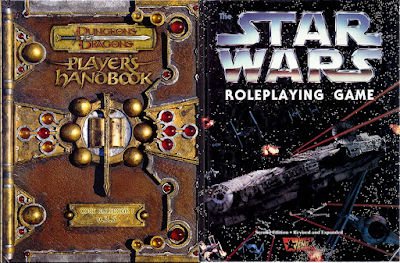
  The original post for last week's blog had an entire paragraph on the splat books from the D&D 3.x years.  I still have mine.  Heck, I still read them - they are great inspiration for the imagination. The Stronghold Builder's Guidebook, the Races books - the DMG II has a section on life in a medieval setting that I practically memorized.

    But. 

    These books weren't inspiring me to, ya know, game.

    If I ever get around to writing fantasy stories, you can bet the D&D 3.x books will be used as reference. But I didn't buy them because I wanted to write.  And they didn't inspire my games very much either.

    Even if they did inspire me to game, most of the books were hard to use at the table.  They required shuffling between stacks of hardbacks, endless page flipping, and even with a DM screen it was hard to get a decent play flow going because magic.


Okay, so the spell casters are in the front of the middle book, the spells are in the back of the middle book, the magic items are in the book on the left, the monsters that cast spells are in the book on the right...
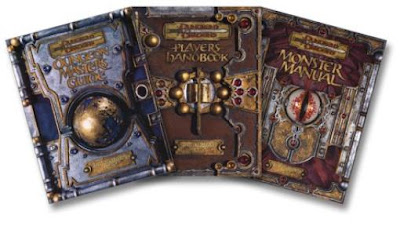
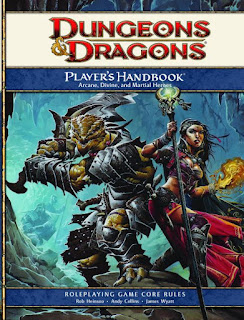
    4th Edition, for all of it's faults, was much easier to use at the table.  But I hadn't seen anything in terms of table utility until I started looking and Indie RPGs.  Mothership. Into the Odd. Maze Rats.

THE CONTROL PANEL LAYOUT AND BEYOND

    The Control Panel layout was a revelation.      

    In retrospect, it's such a simple idea: Every double-page spread is devoted to a single subject, and everything about that subject is on the double-page spread.  No flipping to another section, no checking for material in another book. 

    Brilliant.

    But Ben from Questing Beast made rather fanciful speculation on his blog about layouts that I cannot get out of my head:

"It got me wondering whether you could make an entire RPG in the form of cardstock handouts, somewhere between A4 and A5 sized."

    Could that work?

    Turns out the answer is yes.  Yes it can.

    Not only can that work, cardstock handouts have advantages other formats lack:

  • You don't have to share a book. Heck, there's no book to share!  Information that an individual player needs for their character is available in a single-page format that can used while other players have access to the rest of the cards.
  • Handouts are a solved problem: Adventure maps, as just one example, are no longer bound in the same book that the adventure's less player-facing assets are.  A map can simply be removed from the card stack and placed on the table.  Or an NPC portrait.  There's already an entire game with card-based assets available that has rave reviews. 
  • All assets are modular. References or tables from multiple books become multiple cards - much easier to handle.  The caption from the image above wouldn't exist with cards. Like Ben said, "Player wants to play a wizard? Hand him the card with the magic rules and the card with the spell list."

    These are just a few examples.

    I wondered why there weren't more games using this format until I started to try it out.  Having every rule, map, item and table on individual cards sounds good in theory, but how do you organize everything?  Color codes? Pages of Collectible Card sheets in a ring binder, like Pokemon or Magic Cards?  Utility can exist only if Accessibility is preserved. As annoying as the tables of contents or indices for some RPGs can be, at least the pages didn't change order.

    Fortunately, there is a rather, pardon the pun, old-school technique we can look into.

INDEX CARDS AND ANALOG DATABASES


As I've mentioned once or twice, I'm kinda old.  Not old enough to have used punched-card computers, but I was in collage before card catalogs were phased out.  In high school, when I had to write a term paper, I wasn't forbidden to use Wikipedia as a citation, but I was required to collect and document x number of works cited on 3x5 index cards.

    I mention this because back when people used index cards all the time they still needed a way to organize and search the data thereon.

   Enter the Edge-Notch Card Index.

   I don't recall these from my youth Back In The Day but various systems were still in use in the 1980s and are probably used privately if not commercially today.  

    The principle is fairly simple:  By punching holes in the edge of the cards, you can pick them all up on a rod or wire.  If you notch some of those holes on specific cards, then a rod or wire inserted in a stack of cards will not pick the notched cards up.  They will fall out.  You can double-punch the cards or devise codes for organizing the cards to enable searching by multiple terms or searching more terms than holes or any number of possible variations including using more than one rod in combination with the above methods.

    Here's a video found on Hackaday that demonstrates the system's utility.

    The advantages for organizing a completely card-based TTRPG are many.  Just think of possibilities:

  • The cards are just as searchable out-of-order. As long as they're all right-side up and facing the same way (a problem solved by beveling one corner) the cards are searchable no matter where they are in the stack.  This means that no matter how much you use, reuse or pass the cards around during play, you can just put them all back in the box at the end of the evening and they will be as easy to search and access next time you use them.
  • You can have as many copies of a specific card as you want/need: I'm sure everyone that's played a game has at least once wished you had another copy of the chargen rules. Or the weapons table, or the range chart, et cetera ad nauseum. Now you can, without buying a whole other book.  And you can put the copies in the main stack, anywhere you want, and they'll still be as searchable and accessible as the original.
  • You can add new information and errata without sacrificing accessibility: This alone is worth the cost of admission. With the exception of GURPS No TTRPG I've played included an index in every book or supplement.  Edge Notched cards not only eliminate the separate index, they eliminate the need for a separate index.  You can make a new adventure, a new rule set, additional classes, equipment - what ever you want, and as long as you add the right combination of holes and notches, you can stack them all together in one box. Errata does not require page references and quotations.  Just issue a new card and it can go in the stack to replace the old.
  • The stacks are fractal.  As long as you have a stack with more than one card, you can search that stack using the the system of organization you selected. You can take a huge stack, split it into multiple packets and search those separately.

     Or you can combine stacks or shuffle stacks or anything - that's the genius of the edge-notched cards. As long as you line up the beveled corners, the cards cannot be randomized. You will always be able to find the card you're looking for.

    There's so much potential In these.  A double layer of holes could allow for storing completely different games in the same stack.  If A5 doesn't provide enough space for what you need on a card, you could mirror the bevels, holes and notches top-and-bottom and fold the card in half to make it fit in a stack.  You could make multiple games or multiple categories of cards by varying the size of the cards - instead of DMG, PH and MM, you could have 5x8, 3x5 and 2.5x3.5. 

    Or anything. 

    I'd like to extend a special thank you to Mr. Winchell D. Chung Jr., aka Nyrath the Nearly-Wise.  I first discovered Edge Notched cards on his website Atomic Rockets, along with Nomograms and other goodies.  As I've said before, This website and the Blue Max Studios back catalog would not exist without Mr. Chung and Atomic Rockets.


Wednesday, February 9, 2022

How you Play is What you WIn II: Overruling Over-Rule-ing

    My wife Debra is my favorite gamer.  Obvious and unapologetic bias aside, she makes the best characters.  Once she grasped the rules for multi-classing in D&D 3rd edition (much faster than I did) she never created the same kind of character twice.  She had one, a Bard/Rogue/Fighter/One-of-the-exotic-Prestige-Classes that looked like a half-elf David Bowie and I remember them fondly. 

Half-elf is almost redundant.

    But they were all fun.  Debra played Changelings, Shaman, Classes and Races from obscure 3rd parties books and a few home-brew Races and Classes as well.

    I've mentioned before that one of the reasons I didn't enjoy playing 4th edition D&D was the difficulty in making multi-class or home-brew content.  I felt like we couldn't make the game our own.  With 3rd edition the issues were different:

  • It was hell to prep for. Every monster and NPC used the Player Character format and that format was neither simple nor short.  The stat blocks in the Monster Manual were difficult to use at the table on the fly.
  • Experience.  The XP rules - actually, I don't think I ever used the XP rules.  I just let everyone level up after each session.
  • NPC Spellcasters.  Remember NPCs used PCs format?  So I'd need the MM and DMG and the Player's Handbook unless I wanted to write out every spell discription. 

 IMPLICIT RESTRICTIONS

  These were the obvious issues.  The more insidious issues, the ones I had to have pointed out to me, are the issues implicit in the design.  Skill lists for example.

    Without spending the remainder of this post breaking down the rules for getting skills, increasing skills and using skills, let us focus instead on the affects of having a skill list at all:  

  • A skill list implies that there is a finite number of possible actions.  If as a player you've ever looked at your sheet to see what you can do, you know what I mean. If the system has more skills that favor a certain kind of play (like combat) or forces Players to spend a limited number of points on specific skills to make the character viable, then that is what the game is about. How you Play is What you Win.
  • A skill list implies that you must roll for any action in which there is a skill.  Ever play a modern/near-future campaign and fail a Drive check going to your apartment?
  • A skill list implies your character concepts are limited. This is really bad in systems that have Class-based character builds, with limited lists of skills one can gain without penalty, but it's also present in any system with skill lists.  One of the reasons I'm making Project NEPTUNE is because it's impossible to make a character that's viable in both regular and space combat.  The available skill points are spread too thinly.

    This last point is a particular peeve because it opens up the Munchkin-Min/Max-Can-Of-Worms that is Character Build Optimization.  I personally am not interested in gaming the rules for advantage when rolling dice.  I do not want to make a game that rewards or, if possible, allows that sort of meta-gaming.

    I'm Diabetic - I already can't eat without doing complex math.

Skill Chapters are 26 and 30 pages respectively.
    

SKILL ROLLS WITHOUT SKILL LISTS?

    Years ago now, I read a post from Tales to Astound that has stuck with me ever since.  The TL;DR version is that during a con-game, the author wrote the character generation rules out on-the-fly and included a game gem so lustrous it's stuck with me ever since:

"Give yourself a profession and write that on the top of the card. 
Your character can do all the things that that profession can do. 
Then add three more skills, the things you are really good at, which might tie to your profession or be something else."  

    That. Right. There.  Your character can do all the things that profession can do. 

    That simple sentence implies so much more freedom than the most comprehensive chapter on skills is able to.  Let's unpack it a bit:

  • The less you define a skill list, the more potential a Character has. Say your profession is Butcher.  This immediately conjures up images of someone who is strong and good with knives.  I'd easily believe they are intimidating as well.  But there's so much more - Butchers are business people! They would know about taxes, sales, bookkeeping, and (depending on your setting) how to Drive.
  • You don't have to roll for every action. It's baked in - your Character can do these things.  There's no risk of failure unless there's a special circumstance.
  • An undefined skill list allows for creative interpretation. You can make a case a Butcher would know how to stitch someone up. They work with knives all the time, may not have money for the village barber or may lack health insurance - A case can be made that the particular Butcher you are playing can stitch up a wound.  And if a fellow PC is bleeding out you'd make that case.  Likewise, you could make the case a Butcher that works with the public daily would know how to flirt.  The GM may not agree with either case but the implication of the system is you have permission to try a creative interpretation of your Character.
    Encouraging a character's potential and player's creativity is what I want to win when I play, so you can expect as Project NEPTUNE and other ideas are developed, Skill Lists and their minutia will not be a large part of them.


Wednesday, January 26, 2022

Project NEPTUNE Part II: Crew as Damage Control

 
Made with Daz 3d, Bryce and GIMP
  
As we said last week, space combat in RPGs is generally a pain.
This is one of the reasons I started designing my own SF RPG as soon as I discovered my favorite rules system was now OGL.

     Part of that effort, the Black Desert Project, led to my series of blog posts about Crew as Mission Control. The premise being that given the way computers have advanced, the crew of a realistic spacecraft will not be occupied by actually flying or fighting the ship - they will be there to monitor, manage, and direct the various Computer networks. It became the most popular series of posts in this blog's history and has stood as my humble contribution to Hard Science FictionTM.

    I stand by that series. I am convinced that it's the best way to include people on spacecraft in Hard Science Fiction. I would love to see the Mission Control model used in novels, television and movies.

     I'm equally convinced that as far as Role-Playing Games are concerned, the Mission Control Model does not work.

    As much as I like the idea of Crew as Mission Control, it still does not address the necessity of a Tactical Mini-game to resolve space travel and combat at the table.  The players are still locked into using a different set of rules and different skills and are still robbed of agency by putting them all in a tin can with few chances to make meaningful decisions.    

    What I’ve come to desire is a space travel and combat system that keeps the focus 100% on the Player Character scale. PCs - their goals, skills and opportunities, and most importantly agency - should always be the focus of a role-playing game. This is what inspired my take on the idea of “Starship as Dungeon”.

    Starship as Dungeon”, however, runs into problems with the types of scenarios it can support. The classic “Bug Hunt” trope exemplified in the movie Aliens is perfect for Starship as Dungeon, but what about other tropes? How can Starship as Dungeon be used in a free-trader campaign? Or what if you want to actually have space combat between Fleets- how do you keep the rules for that type of scenario from taking the focus away from the Player Characters?

    Like the title says, Crew as Damage Control.

  This is far from a new idea, as we see examples dating back at least to the 70s in stories such as Northshield’s Triumvirate. In this concept, the computers on a spacecraft do all the actual flying and fighting, since they can do so faster and more accurately that people can. Organic crews exist to maintain and repair the various systems of a spacecraft. We also see it used the classic The Mote in God's Eye.


This wasn't a game.
 In studying first-person accounts of naval battles, particularly memoirs from the Pacific theater of WWII, we see some great examples of the "player focused" perspective. The sailors, soldiers and marines who recall those iconic battles do not do so the way we're shown in films or other fiction - which is the point of view most licensed RPGs try to capture. As much as I like to watch SF media, the cinematic spectacle is not best seen from the table top.

    The people who actually fought and survived major naval actions in the bowels of their ships recall their own personal viewpoints which are focused on their immediate situation. Often, this can be just trying to keep their ship afloat. They usually didn’t know what is going on with the battle, whether they are winning or losing, or how much damage the ship had sustained. 

    In other words, the ships these people are on became a hostile environment of rupturing steam pipes, flooding compartments, shrapnel, and darkness. A Dungeon.

    This point of view, the completely personal perspective, is one that can be used in a Player Character-focused RPG.

    At first blush, this may sound like a railroad waiting to happen. Without command level decisions to make, can the Players truly be masters of their own destiny? To this as ask a question in return: Can players whose characters are optimized for non-space travel skills be said to have any more control over the ship that they are on? 

    This is a big complaint about space travel and combat systems I have heard at my tables; that there’s nothing for most characters to do. In the Crew as Damage Control concept, everyone has something to do, even if Character’s actions revolve around survival while the ship they’re on falls apart around them. Survival in a hostile environment may be stressful, but it's still PC-focused, which is the goal.

       With Crew as Damage Control, the aftermath of a space battle is where Characters really get to shine. Their ship is now a dungeon in fact, full of hazards like decompression, ruptured tanks, radiation leaks, boarding hostiles, and more. Navigating this kind of environment is challenging enough; repairing the damage is even more so. One thing I’d love to see is a party of PCs scavenging the wrecks of other spacecraft or nearby asteroids for supplies to repair their ship. 

    That's Character focused play.

    Admittedly, this perspective is still focused on combat, which is only one small facet of space travel. Other character-focused scenarios are possible. Space is full of hazards that must be overcome, from debris strikes to solar flares to mechanical failures. There can also be passengers, mysteries, and more in a space-faring location. As long as the action is focused on the Players and their Characters, the focus is where it should be.

    More to come on this topic.


Wednesday, January 19, 2022

Project NEPTUNE: or Another Stab at Integrating Space Travel and Combat into TTRPGs that Does Not Suck

Who else would hitch dolphins to a chariot?*

This will definitely be a whole series of posts.

    In the link to the right Ken Burnside articulates a problem I've struggled with since I first tried to run the West End Games classic Star Wars: The Role-Playing Game in 1992; to whit: "How can I put the spaceships I love into a game in a way that actually adds fun to the game?"

    This is far from the first time I've tried tackling this task.   Indeed, I have a Goodle Drive full of unfinished and sometimes untitled documents detailing snippets of ideas, lengthy mission statements, and pages and pages of world building and lore.

    I hope I can actually use some of it.

THE PROBLEM    

Just so we're all on the same page, the problems I refer to is as follows:

  • The play style of space travel and combat in most TTRPGs is antithetical to the core play style of most TTPRGs.
  • The space combat is resolved on a unique type of battle map that uses a different scale, different time intervals, and different rules.  It is a mini-game functionally separate from the main game.
  • In space combat, the player that flies the spaceship is the only one with actual agency.  
  • Skills required to survive space combat are not applicable in character combat, and therefore may take away from the character's focus.
  • While the Pilot is the only character with agency, space combat rules often require more than one character to successfully fly and fight a ship.  This automatically puts one character in a command dynamic over the rest (bad) or an NPC is used as the commander over the PCs on a ship (worse)

    In some games, these are non-issues.  If you are playing, for example, as pilots in a starfighter squadron most of this goes away, because the spacecraft become simply another piece of equipment; an SF version of steed, lance and armor.  But not everyone wants to play a squadron of fighter pilots.

    There are also lot of other issues with space travel and combat in TTRPGs that are outside the scope of this series.  Like how many attempt to shove a streamlined war game into an RPG, or how many attempt to recreate a cinematic experience from a movie or television franchise.  These are considerations for another time, and perhaps other people.  

 THE GOAL

    If I have any chance of making a go at this project, I have to keep my scope focused down to the essentials of the game experience I want to enable:

  •  Player Agency: If something is going into the game at all, it must be there in the support of player agency.  That means we can't enforce a command dynamic and we can't turn the players into supporting die rolls for the pilot.
  • A Meaningful Experience: The decisions Characters make aboard ship must be meaningful to the Players.  The situations aboard ship must matter to the Gaming group and provide an experience rich enough to justify the time taken away from other aspects of the game. The actions players take must have observable consequences to validate their agency.
  • Integration: I am not interested in making a mini-game to add onto a character-based TTRPG.  I am interested in making spaceship-based travel, exploration and combat as integral to the game as dungeon-based travel exploration and combat is to the OSR.

    Whether or not I can succeed in that goal remains to be seen.  I've been thinking, reading, working on the ideas for almost ten years now.

    Ten years.  

    Wish me luck!

   *The image above was commisioned by Mr.Burnside from artist Claire Peacey (instagram.com/autumnskyart/?) whose work and work ethic is highly recommended.


Wednesday, December 29, 2021

When Murdering Empires, How you Play is What you Win

     Bonus points to those who recognize the quote.

Yes, even the Skill Challenges.

     I have a confession:  The 4th edition of D&D is the only set of rules - for any rpg - that i've run Rules As Written.  The system was, as far as it intentions went, perfect.  The XP notation, monster blocs, the unified leveling mechanic, the treasure parcels, the encounter design tools - I even used skill challenges as written.  The 4e rules made it so easy to design and run an adventure that it was a pleasure to use at the table.

     So much so that it took me years to realize I didn't really like the game.

     Trying to adapt  the 3rd edition material to a 4th edition game by myself was a path down which lay madness.  The mechanics that were exquisitely simple on the front end seemed to hide furiously opaque math on the back end. This also made 4th edition terrible for those among us that like to make their own character classes or to multi-class ad infinitum.  The interlocking obligations of Balance between PC/encounter/monster/treasure level made such experiments not only difficult to develop, but impossible under the rules as written.  

Making unique classes and adapting your own material wasn't what the game was about.

     Put simply, the games I ran ended up being walks from set-piece encounter to set-piece encounter to fight monsters and grab a treasure parcel.  The "perfect" balance of the system made the encounters feel bland and much the same. Since they were balanced for your party's size and level, a fight against four goblins at first level had the same stakes and difficulty as a fight against four Sorrowsworn at twenty-fifth - but takes a lot longer because of feature creep.

    I understand that there is nothing in the rules forbidding more open and interesting play, there also nothing in the RAW rewarding different play.  You get XP from killing monsters.  You get treasure from killing monsters - either directly as loot or indirectly as quest rewards.  The special powers and class features you earn are overwhelmingly mechanics to allow Characters to kill more monsters.  The goal is to level up you Character and collect treasure to get new powers and equipment to...kill more monsters.

    Its a game about killing monsters.  How you play is what you win.

    D&D wasn't always about killing monsters.  One of the pillars of the modern OSR movement is the idea of rewarding XP for gold spent - no matter how you got it.  This opens up a lot more options for play that don't have to involve killing monsters.  It also allows one to de-emphasize balance, since you are under no obligation to tangle with a monster that in order to get XP.  Far more prolific Bloggers than I have covered the nature of OSR play and how rewarding for gold spent is important to the aesthetic of Conan-type characters who hunt treasure, spend it all on insane carousing and magic items until they're broke again and need more treasure.

    Again, how you play is what you win.

    Before I get too serious about developing Murdering Empire as a game system and associated support content, I need to decide what kind of play I want to reward.  What is a game of adventuring through a collapsing galactic empire actually about?  What do you do?

    Keeping with the philosophy of anti-cannon, I don't want to create a meta-plot.  I'm really leaning into the idea that people not only don't know what happened to the Empire, many people don't even know what the Empire was.

    I once again refer to Space Skimmer for the game's general mood:

    "The Empire itself was neither just nor unjust. It existed simply to fulfill a purpose—communication between all men; but whenever action was taken in its name, that action reflected the men directing it. If they were just, then so was the Empire. If they were unjust—"

-Gerrold, David. Space Skimmer

    GOLD.

    It's too good an idea to let go.  I want to see starships enter a new system with great caution, never knowing what they can expect. Part of this comes from Space Viking, which for all it's faults has a sense of consistent scale when discussing the plot's man-hunt: 

    "We'll hear where he was a year ago, and by the time we get there, he'll be gone for a year and a half to two years. We've been raiding the Old Federation for over three hundred years, Lord Trask. At present, I'd say there are at least two hundred Space Viking ships in operation. Why haven't we raided it bare long ago? Well, that's the answer: distance and voyage-time. You know, Dunnan could die of old age—which is not a usual cause of death among Space Vikings—before you caught up with him. And your youngest ship's-boy could die of old age before he found out about it."

-Piper, H. Beam.  Space Viking

    With these two passages as dim guide-posts, I can see I want to reward traveling into the unknown with little more than rumors third-hand accounts. I also want to play with the idea that civilization and Empire are not synonymous. 

      And I want there to be Spaceships.  I want to have travel from world to world incentivized. 

That dome? Spaceship.


         The ideas of what you reward, what you want a game to be about, and game design in general grow tangents like hydra.  In the time it's taken to write this much, I've thought of:

  • The core game loop, or what you Players can do when they don't know what to do.
  • Currency and Economic and how much I don't want a game about that.
  • How to evoke a sense of wonder in a game using such well known tropes, and
  • All the stuff about what was great about 3rd edition D&D that I had to cut for this post. 

    I don't think I'll be doing all of these in order, because I already had a few ideas for blog posts I wanted to explore.  But that's good - having ideas to write about makes me confident I will keep writing.

    Look for the How you play/What you win tag for more posts in this series.


Friday, March 24, 2017

Starships & Spacemen Examined: S&S, Triplanetary, and real Stars and Planets...

     To the left is (hopefully) the solution to my dilemma.  Rather than wax lyrical about how I came to arrive at my current notion, I'm just gonna hash it out for you.
     I'm ditching the FTL system in Starships & Spacemen and replacing it with my "Rabbithole" system.  If you don'l know what that is, I wrote a a whole article about it in LAUNCH WINDOW 0.5, so you can read about it there.  Go ahead, its Pay What You Want.
    In brief, Interstellar travel involves (will involve) seeking out naturally occurring wormholes in close orbit that link certain stars together.  These "Rabbitholes" are natural so the temporal/causal effects of using them are accounted for.  The causal effects of wormholes are fascinating and will make for cool fiction.  Currently, Dr. Luke Campbell is doing just that, and will do a better job that I ever could.
    Because we will be handling interstellar travel via wormhole, the movement rules for interstellar travel in S&S are invalidated.  This is a shame, as the Energy Point system/ Power Pile Base is one of the fun features of the game.  The solution I have to this is to Use the movement rules, modified a bit, in Interplanetary space.  This also has the advantage of letting use use Node Maps for the game and rest peacefully in the knowledge that our stars are real.
     Refining the movement system of Starships & Spacemen to work in interplanetary space will require a few extra steps and things. One, we have to account for orbital space, and gravity.  Two, some sort of Newtonian engine would be appreciated.  I mean, its hard to watch a Star Trek film where a ship loses power and stops, and sometimes even starts to sink.   Besides, I like the idea of watching starships go at in the frictionless black like a pair of hockey players with a grudge.
     Anyway, I don't fancy making my own movement system from scratch, so I plan on borrowing elements from the above shown game: GDW's Triplanetary.  As Winchell Chung put it on Project Rho, "This game has the One True way of managing vector movement in two dimensions." He's not the only person to day so, and I bow to superior mechanics. 
    Anyway, right now I'm thinking of the mechanics of S&S, and the vectors/gravity of Triplanetary for simulating orbits and stuff.  The system maps will be a lot easier to make than one would think.  Using Winch's Node Maps as a spring board, I can take the star names, pop them into Google, and see if the star has any planets and what their features are.  I will be a bit time consuming, but not especially hard...
  Anyway, that's what I've got so far, Rocketfans.  See you next week!

Wednesday, March 22, 2017

Starships & Spacemen Examined: I'm going to have to make my own setting, aren't I?


Ha!  Rhetorical question, Rocketfans - what else would I be doing?  It's not like I can leave anything alone...
      The deal breaker came with my examination of the FTL system.  It's a variation of the classic Trek/Alcubierre warp drive - which is bad enough, as warp drive has problems.  What's even more difficult for me to deal with is the speeds involved.  For an RPG it's perfect: Each warp factor is how many light years on the hex map you can travel in a day, and ships can travel between warp 1 and warp 8.  If you are a fan of The Original Series of the source material, that's between warp 7 and warp fourteen.  Needless to say, you can cover a lot of territory with that kind of drive.  At warp 8, Proxima b is only twelve hours away, and Gleise 581 is only 60.  The entirety of the Local Bubble would only take 50 days to cross - 200 light years, in less than two months.
     It's about here that I've always run into problems with SF RPGs: Maps of space. When you can travel across a wide swath of space in a short amount of time, it's easy to get to the planet of the week, but harder to maintain any sort of realism in your star mapping. While Game Design Workshop's 2300 AD is a unique exception, most games that obstensibly take place in our universe have star-maps that bare no similarities to observable reality.   S&S - like Traveller and Star Frontiers, doesn't even pretend to make accurate maps of the Milky Way and instead provide guidelines for making up star maps and even randomly generating stars and planets. That was fine in the 70s and even the 80s, when accurate star charts were hard to come by.  Since the advent of the Internet - and especially in the exoplanet discovery era of today, it becomes harder and harder for me to suspend disbelief.
Here, to be exact.
   Now, there are accurate star maps out there.  It would be a fairly easy if tedious task to add the know extra solar planets to them.  But making a star map of a large enough scale to be useful in Starships & Spacemen and shows accurate distances is nearly impossible.  Even if you projected the map onto a convienent wall or pool table or something, the sheer number of stars in a given volume of space (and the fact that they are stacked three-dimensionaly) make using the map in a game a daunting prospect and far from the relative simplicty of the S&S rules as written.  However, the movement system in the game tracks interstellar movement and gives you interplanetary for free - so it would appear that we have to have some sort of star-maps.
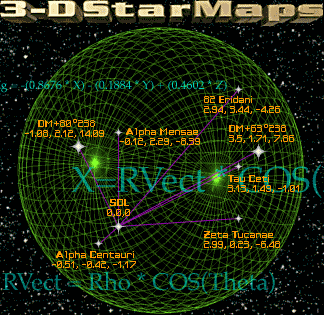
     There are, of course, star maps that reduce the nightmare of 3D or 21/2 D mapping into something that both has accurate distances and is easy to look at.  Node Maps are an easy method - it gives you the information you need without going into sensory overload.   That being said, Node Maps are also useless in the S&S game because they do not provide hexes to show interstellar movement.
    This is where I threw up my hands in despair. You can have accuracy, simplicity, or utility: Pick two.  I feel a psychological need for accuracy, and an intellectual need for simplicity, and an actual need for utility.   What am I to do.
     (sigh) Change the setting, of course.  I always seem to do that anyway.  But hey, that's what being a game designer is all about.
     Here's what I'm gonna do:  I will make a new system of starship movement and combat.  I will make deckplans for starships that use this new system.   I will also provide stats and such for Starships & Spacemen as written.  And White Star too - just to cover the whole SF OSR OGL alphabet soup.
     But stick with me on the new rules thing.  I have some ideas that may interest you.  We'll talk about them more on Friday.

Wednesday, March 15, 2017

Starships & Spacemen Examined: The Power Pile Base, Energy Units, and You

   Author's Note: The rules mentioned below, unless otherwise specified, are the hard work of Daniel Proctol et al. at Goblinoid Games on the second edition of Starships & Spacemen
Yes, I use this pic a lot.  I happen to like it.


     Let's talk about the Power Pile Base.
     I've read multiple reviews, and the general consensus is the Power Pile Base and EU system in Starships & Spacemen is elegant and balanced mechanically.  In brief, each starship has a Power Pile Base, which is the number of Energy Units (EU) it can produce in a day.  Each major activity, such as maneuvering, going to warp, firing beam weapons and raising shields, costs a certain number of EU.  Damage in space combat or from hazards is taken our of a spacecraft's EU also.  As long as a ship only uses it's Power Pile Base's worth of EU per day, it gets its full amount EU back the next day.  If the spaceship uses more than it's Power Pile Base, it counts as damage and the ship loses those EU until repaired.   If a ship uses more EU (or takes more EU worth of damage than it's Power Pile Base, the ship is considered destroyed. It's sort of like Hit points and Wound points and Manna points all rolled into one.
    This is a good system for an RPG, as I've already said, but for a guy like me, that's not quite enough.  How would an engine system (and everything else system) work in the real world with those constraints?  Through careful research at my favorite SF Destination, mixing and matching capabilities of various real-world (or theoretical, anyway) engine designs, and all that jazz, I have come up with a plausible engine/reactor combo that mimics the details of the Power Pile Base system, right down to the allocations and damage ratings.
     ...More or less.
     Anyway, lets start with basics:  power.  If we don't want radiation and find Matter/Antimatter to be passe, then we're going to want to go with fusion.  Problem is, fusion is easy to theorize about, but hard to actually get to work.  It would be even harder to sustain a fusion reaction on a moving spaceship with people shooting at you.
     If we look at the top of Atomic Rocket's Engine List page,we can find hope..  Ignore the cat's surly manners (and it's to your advantage to do so), and notice the entry for "Magneto-Inertial Fusion"      Read up.  I'll wait.
     I am a fan of pulse propulsion systems.  They are the only plausible systems of propulsion that have both high thrust and high specific impulse - Torch Ships, in other words.  While the theorized M-IF engine isn't quite the that powerful, it's within the realm of SF possibilities, especially if you mess with inertia and gravity. Bonus points, the engine can provide electrical power and does not require radiators.
Now, you can notice it, too.
     Next, I notice the magnetic nozzle. This reminds me of the "Mini-Mag Orion" which uses z-pinch fusion also, and needs a huge amount of electrical power to start a reaction.  Once the nuking has happened, a small percentage of the reaction's energy is channeled into enormous banks of capacitors, more than enough to start a new reaction.
    Capacitors.  Banks of them.  They're like these units...full of energy...
    So we have a power system that can fill up a number of capacitors, and requires the use of a number of capacitors to work, and makes clean fusion reactions and not dirty atomic ones.    Good...good...
     The next items are the weapons and shield systems.  Really, these could get their own post, but I've decided to fold them into the PPB post because they both rely on Energy Units.  The weapons - simply called in-game "beam banks" and defensive screens are going to be covered by particle beams and magnetic fields.  And excellent case has been made for particle beams already, and they have the added bonus of looking and acting more like sci-fi lasers than real lasers do.  Magnetic shields are already a good idea as protectin from cosmic background radiation, solar flares, and in an emergency, aerobraking and atmospheric re-entry.  Particle beams have one addtional advantage - if necessary, the beam can be fired directly by the fusion reaction, without needing to use capacitors.  This ability reflects the rules' entries on using more EU than your Power Pile Base.
     Damage to the spacecraft is a wee bit trickier.  How do you reflect ship damage using simple EU values?   To be honest, I accepted that upon my first reading of the rules.  My assumption then was that the ship is taking no actual damage - the shields and inertial damping system are absorbing it all. As the power consumed surges through the system suddenly, capacitors burn out and you get electrical feedback that blows circuits, fries wires, and occasionally blows out a console (which apparantly is an actual thing).
    Anyhoo, that's all for now, RocketFans tune next time when we tackle FTL, Why S&S ships are so small, and why the decks are laid out wrong.  See you then!


Monday, March 13, 2017

Blame it on Rob-o

     Specifically, Rob Garitta, friend and sometime collaborator here at Blue Max Studios.  He mentioned our previous work on the Starships& Spacemen game and I rather woefully lamented not having completed any of the projects I wanted to for that game.

  It was a rather lengthy list. I was going to make variants of all the major ship classes for the game, from Frigate to Dreadnought, make enemy spacecraft - even an adventure/setting.  I never did anything with it, in part because I got bogged down in tying to make a spacecraft design that made sense in light of the games rules on Energy Units and their distribution.

    I will respectfully decline to discuss the Shuttle Ship situation at this time.

    Once again, Ilove the game Starships & Spacemen OSR Star Trek? Sign me up!  Nevertheless, the Power Pile Base system gave me pause when trying to design spacecraft.  And so did the Teleporter.  And the way the decks are laid out like boats and not rockets.  And the dang shuttle ships.

    This was about a week ago now, when I was talking to Rob.  Since then, I've been thinking about these problems with the focus and intensity of...well, of a middle-aged autistic man who likes spaceships.  I have therefore managed, thanks to past experience, the Atomic Rockets website, and lots of graph paper, to resolve of these issues to my own satisfaction.  Over this week (at the least) I will outline my findings and developments.  Some of this takes the form of deckplans or schematics.  some will take the form on nano-fic set in my own private S&S universe.  All will be awesome.  Please stay tuned...

Wednesday, November 16, 2016

Point Five is Number Two! (Also another free offer!)


   Yesterday was a wild ride RocketFans! Our little half-issue of LAUNCH WINDOW proved to be more popular than I dared to imagine.  When I went to bed last night, we were at number two on RPGNow.com's Top 100 Hottest Titles!  We were still at number two on the Top Small Press Titles.  This is amazing - in a few short hours, LAUNCH WINDOW Issue 0.5 broke all sales records here at Blue Max Studios!
    I'd like to take a moment to talk to all of you RocketFans old and new about what's next.  Obviously, LAUNCH WINDOW issues every month are next.  We've also revamped our reward and goal structure on Patreon to reflect the new direction of the company.  Part of that includes the new $5.00 reward, which is a PDF download of of each month's issue, both short stories, and the isometric map at no additional charge.  And since these patron are already getting the entire PDF archive with it, it's a pretty good deal.
    But I want to give that deal to everyone.  Thanks to the survey I ran a few weeks ago (Still active, BTW, so you can still get a free book!) I discovered that enough people dislike Patreon, for whatever reason, to make me decide to publish a monthly digest in the first place.  And since this is going to be a regular thing, There is no reason not to offer subscriptions at a substantial savings to all of my RocketFans.  So There will now be an option on our RPGNow.com page to order a full year of LAUNCH WINDOW for only sixty dollars.  That is a third off of the cover price; a total of $27.00 savings over the year.  
  
 I realize that $60 is a lot at one time, especially around the holidays.  While I think that a year's worth of LAUNCH WINDOW would make a great holiday gift for the gamer in your life, I more than understand not having the scratch to make such a purchase.  Well, that's okay, because one of the nice things about the system we have here is that you at any time you want to buy the 2017 run of LAUNCH WINDOW, you can.  If it's 2020 and you want to get the first year of our Digest, it will still on the infinite virtual shelves of the Internet. And you can always go the five buck a month on Patreon route. So don't worry about it.
     I will however, sweeten the deal: Issue 1 will be included in the 2017 subscription.  That means you'll be getting thirteen issues for only sixty dollars! It makes the next year's all even that way -January to December, without any issues left out.  Issue 0.5 will always be Pay What You Want.
    We have other plans for the future as well.  There will be Quarterly and Annual extras, and I hope to have Issue 1 available for POD by the debut of Issue 2 on Jan 15th next year, and be able to continually offer print editions one month behind.  I'm not sure about offering print subscriptions - that would cost a good bit more, our net would be less, and the shipping issues are an animal I've yet to tame.  If there's enough interest, however, I'll certainly give it a shot.
    You know what I'd love to do?  Get my books in brick and mortar stores.  We've got five within a hours drive of here alone.  I may only manage to get ebooks on gift cards into stores (yeah, that's totally a thing!) but maybe - just maybe - I can see my books on the shelves of bookstores and gaming shops.
     That would really be something.
     Anyway, I've got to get back to work.  I've got to get the D20 and OSR updates ready for Tuesday and, of course, I'm already writing for Issue 1.  See you later, RocketFans! 

Monday, November 14, 2016

ISSUE 0.5 is PAY WHAT YOU WANT (T-MINUS 1)


 Here we are, RocketFans, on the eve of our inaugural issue.  I've save the best surprise for last:  Issue 0.5 will be available as a Pay What You Want download!
     It's like this:  Our traditional publication date here at Blue Max Studios has always been the 15th of the month.  This is as much because of my family's monthly schedule as it is tradition. This left me but two weeks to put together the digest, unless I wanted to wait another month and put out  only one issue this year.  So I decided to start with an "Issue 0.5" - a half-sized magazine made in half the time.  The full sized digests running about 100 pages, start with Issue 1 in December, will cost $7.50 for the PDF and be available for $12.00 in full-color print editions. This one is an experiment, one I consider to be a success.  This is the last sneak peek before go live tomorrow, so I hope you enjoy it.


Friday, November 11, 2016

Just a Few More Things to Do...(T-MINUS 4)


Goes with the isometric map... 
You know you're getting close to done when the Table of Contents
has page numbers...


Thursday, November 10, 2016

More Works in Progress (T-MINUS 5 DAYS)

    Another busy day, RocketFans, getting LAUNCH WINDOW ready for press. It's looking like we'll be finished with the issue in plenty of time, meaning I can get a jump on the rules updates for D20, OSR, and Diaspora.  Let's take a peek, shall we?


    The Gentleman Scoundrel's  bridge complex is coming along.  The problem is, the image is huge - literally five feet by three.  Needless to say, at that size a lot of detail would be lost if I reduced it to fit a size A5 page, so this iso artwork will not be in the digest.  It will however be available for download as a separate file with  the digest, so you can enjoy it at a larger size!


     I'm really pleased with how the lay is coming as well.  I hope you are as well.  Anyway, I've got some more work to do, so until then, RocketFans, enjoy!

Google+