Showing posts with label Real Spaceflight. Show all posts

Friday, March 24, 2017

Starships & Spacemen Examined: S&S, Triplanetary, and real Stars and Planets...

     To the left is (hopefully) the solution to my dilemma.  Rather than wax lyrical about how I came to arrive at my current notion, I'm just gonna hash it out for you.
     I'm ditching the FTL system in Starships & Spacemen and replacing it with my "Rabbithole" system.  If you don'l know what that is, I wrote a a whole article about it in LAUNCH WINDOW 0.5, so you can read about it there.  Go ahead, its Pay What You Want.
    In brief, Interstellar travel involves (will involve) seeking out naturally occurring wormholes in close orbit that link certain stars together.  These "Rabbitholes" are natural so the temporal/causal effects of using them are accounted for.  The causal effects of wormholes are fascinating and will make for cool fiction.  Currently, Dr. Luke Campbell is doing just that, and will do a better job that I ever could.
    Because we will be handling interstellar travel via wormhole, the movement rules for interstellar travel in S&S are invalidated.  This is a shame, as the Energy Point system/ Power Pile Base is one of the fun features of the game.  The solution I have to this is to Use the movement rules, modified a bit, in Interplanetary space.  This also has the advantage of letting use use Node Maps for the game and rest peacefully in the knowledge that our stars are real.
     Refining the movement system of Starships & Spacemen to work in interplanetary space will require a few extra steps and things. One, we have to account for orbital space, and gravity.  Two, some sort of Newtonian engine would be appreciated.  I mean, its hard to watch a Star Trek film where a ship loses power and stops, and sometimes even starts to sink.   Besides, I like the idea of watching starships go at in the frictionless black like a pair of hockey players with a grudge.
     Anyway, I don't fancy making my own movement system from scratch, so I plan on borrowing elements from the above shown game: GDW's Triplanetary.  As Winchell Chung put it on Project Rho, "This game has the One True way of managing vector movement in two dimensions." He's not the only person to day so, and I bow to superior mechanics. 
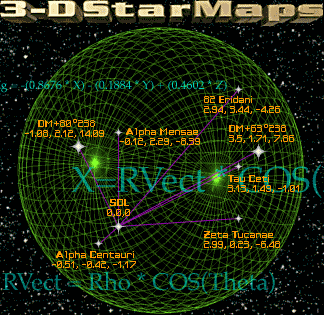
    Anyway, right now I'm thinking of the mechanics of S&S, and the vectors/gravity of Triplanetary for simulating orbits and stuff.  The system maps will be a lot easier to make than one would think.  Using Winch's Node Maps as a spring board, I can take the star names, pop them into Google, and see if the star has any planets and what their features are.  I will be a bit time consuming, but not especially hard...
  Anyway, that's what I've got so far, Rocketfans.  See you next week!

Wednesday, March 22, 2017

Starships & Spacemen Examined: I'm going to have to make my own setting, aren't I?


Ha!  Rhetorical question, Rocketfans - what else would I be doing?  It's not like I can leave anything alone...
      The deal breaker came with my examination of the FTL system.  It's a variation of the classic Trek/Alcubierre warp drive - which is bad enough, as warp drive has problems.  What's even more difficult for me to deal with is the speeds involved.  For an RPG it's perfect: Each warp factor is how many light years on the hex map you can travel in a day, and ships can travel between warp 1 and warp 8.  If you are a fan of The Original Series of the source material, that's between warp 7 and warp fourteen.  Needless to say, you can cover a lot of territory with that kind of drive.  At warp 8, Proxima b is only twelve hours away, and Gleise 581 is only 60.  The entirety of the Local Bubble would only take 50 days to cross - 200 light years, in less than two months.
     It's about here that I've always run into problems with SF RPGs: Maps of space. When you can travel across a wide swath of space in a short amount of time, it's easy to get to the planet of the week, but harder to maintain any sort of realism in your star mapping. While Game Design Workshop's 2300 AD is a unique exception, most games that obstensibly take place in our universe have star-maps that bare no similarities to observable reality.   S&S - like Traveller and Star Frontiers, doesn't even pretend to make accurate maps of the Milky Way and instead provide guidelines for making up star maps and even randomly generating stars and planets. That was fine in the 70s and even the 80s, when accurate star charts were hard to come by.  Since the advent of the Internet - and especially in the exoplanet discovery era of today, it becomes harder and harder for me to suspend disbelief.
Here, to be exact.
   Now, there are accurate star maps out there.  It would be a fairly easy if tedious task to add the know extra solar planets to them.  But making a star map of a large enough scale to be useful in Starships & Spacemen and shows accurate distances is nearly impossible.  Even if you projected the map onto a convienent wall or pool table or something, the sheer number of stars in a given volume of space (and the fact that they are stacked three-dimensionaly) make using the map in a game a daunting prospect and far from the relative simplicty of the S&S rules as written.  However, the movement system in the game tracks interstellar movement and gives you interplanetary for free - so it would appear that we have to have some sort of star-maps.
     There are, of course, star maps that reduce the nightmare of 3D or 21/2 D mapping into something that both has accurate distances and is easy to look at.  Node Maps are an easy method - it gives you the information you need without going into sensory overload.   That being said, Node Maps are also useless in the S&S game because they do not provide hexes to show interstellar movement.
    This is where I threw up my hands in despair. You can have accuracy, simplicity, or utility: Pick two.  I feel a psychological need for accuracy, and an intellectual need for simplicity, and an actual need for utility.   What am I to do.
     (sigh) Change the setting, of course.  I always seem to do that anyway.  But hey, that's what being a game designer is all about.
     Here's what I'm gonna do:  I will make a new system of starship movement and combat.  I will make deckplans for starships that use this new system.   I will also provide stats and such for Starships & Spacemen as written.  And White Star too - just to cover the whole SF OSR OGL alphabet soup.
     But stick with me on the new rules thing.  I have some ideas that may interest you.  We'll talk about them more on Friday.

Sunday, September 25, 2016

Intra-Fleet Tugs and why Rocket Science is as hard as Rocket Science

     So four days agoor there abouts, I put a poll up on Google+ with a selection of spacecraft I was thinking about making isometric cutaways of. The frontrunner is the Intra-Fleet Space Tug. That means, RocketFans, that we’ve got ourselves a project!
This is not the tug.

     The context for this particular spacecraft, like the Cygnus capsule I also put in the poll, is the care and feeding of the distributed-network fortification that is a deployed UN Constellation in the Conjunctionsetting. In summary, the fleet’s configuration is a tetrahedron in space with a single control ship at the apex, patrol craft making up the other three vertices, and edges three hundred thousand kilometers long. Just how do you supply ships that are as far out as the Moon is from LEO?
 
Cygnus docking with a Class A Patrol Craft
   In the article about how fleets work, I stated that the crews on the patrol craft could be swapped out by ferrying fresh people out via the Cygnus. While this would certainly work for crew transfers, you’d also have to detail additional craft for cargo transfers, of consumables and (if armed with rail guns) ammunition. As versatile as the Cygnus is, it cannot not re-supply that most important consumable resource in terms of tactical movement, propellant.
     To put the problem into perspective, a Cygnus stack is a rough cylinder 4.5 meters in diameter and about ten meters long. The propellant tanks on a Type A Patrol Cutter are 8 meters in diameter and total thirty meters long. And there are two stacks. Clearly, to refuel a patrol ship, we need a real tanker.
I’ve said it before RocketFans, and I’ll surely say it again: AtomicRockets is an invaluable resource for the budding rocketeer. The “Realistic Designs” sections are a veritable clearinghouse of old NASA designs that were pretty good but never got a decent budget. These oldies make for a great library of inspiration when designing any spacecraft that is meant to work with real-world physics. For our Intra-Fleet Tug, I was inspired by the Johnson Space Center’sTug study, who’s image I used in the Poll. This beauty is a two-stage ferry to get from LEO to GEO where NASA was going to build a solar power station.
Yeah, we could have had that...
    Anyway, a light-second is good deal further than the LEO/ GEO distance, right? In kilometers, yes, but in Delta-V, not even close. It takes a whopping 4.33 km/s to go from LEO to GEO, but a paltry 2.74 km/s to get from LEO to Lunar orbit...a little over a light-second away.
     Gravity is funny like that.
     So our tug only needs about 75% the range of the JSC version. Since that design was staged and the first staged carried the spacecraft 85% of the way to GEO we could just lop of Stage I and call it a day. But where’s the fun in that?
     The problem with just ripping of the JSC design is that it isn’t a tanker. We need to be able to deliver a large amount of propellant, so we’re going to need a large spacecraft. Something that could haul at least a quarter or half of the Delta-V needed to completely refuel a Patrol craft. What follows is an experiment: I’m thinking of just taking an entire rocket stack from a Patrol craft and slapping a command module on the front for our Tug. Let’s see how that would work, shall we?
     First of all, we need to dust off our rocketry equations so we know what variables we need to consider. We’re going to need to know the Tugs dry mass, wet mass, and engine details such as propellant flow, thrust, and exhaust velocity. Since we’re using the dimensions of the propellant tanks from the Class A Patrol Craft, and possibly one of its main engines, that gives us a great place to start. In fact, lets crunch the numbers for the Patrol rocket’s main engine and an alternate, say something along the lines of the J-2 from the Saturn V’s SIV-B stage.
     First, let’s establish the tonnage for the Tug without it’s engines. We’ll want a decent sized crew module, because gaming, and also so we can have cadets aboard during all flights. In Conjunction, like in Heinlein’s Space Cadet, every UN convoy and spacecraft has a group of peacekeeper candidates learning how to work in space by working in space. I see an actual crew of about four: a Flight Commander (F-Com), Guidance Procedures Officer (GPO), Maintenance, Mechanical Arms, and Crew Systems Officer (MACS), and a Payload Officer (Payload). Add as many again of Candy-Cruisers, and you’ve got eight people in the command module. That’s a bit crowded for a Tug, but we can use hot-bunking with to limit the sleeping berths to four. The CM must also have at least a pair of robotic arms, and a sturdy docking module for carrying passenger capsules and cargo pods. Behind the CM will sit a flared-out service module, with avionics, life support, and computer systems. The SM will be mated to a 30 x 10 meter saddle truss, which is what will actually hold our propellant tanks and provide a mount for the rocket stack. But in addition to all of that, we will also need a passenger module and cargo pods, so we need to know the mass for all of those as well.
     Here’s how it breaks down:

System
Mass (kg)
CM
12671
SM
3000
Saddle Truss
24119
Propellant tanks
24119
Passenger Module
7540
Crew Avg. Mass
2400
Cargo/consumables
392883
Total Dry Mass
466732
LH
71204
LOX
305788
Propellant Mass
376992
Total Wet Mass
843724
     I arrived at some of these number dubiously, so take them with a grain of salt. The CM mass is from the Trans Hab Calculator on the AR website, the SM is from the JSC Tug, the truss is simply repeating the mass of the propellant tanks, since I couldn’t find any reliable numbers for that. The Passenger module is also from the JSC tug, while the consumables and cargo masses are calculated for the tugs trip out and back, as well as 30 days of supplies for the 20-person crew of a Patrol craft. And of course, we can’t forget the mass of the crew and passengers themselves, plus what ever possessions they can carry inside their regulation 100 kg mass-limit. Finally, the propellant tank mass is 6% of the propellant mass, as per Dr. Rob Zubrin, and the propellant masses came from the Useful Tables appendix from Atomic Rockets. But the most important thing to remember is that we have no engine yet.
     The Class A Patrol craft uses an easy to maintain in freefall analog of the SSME so I could simply steal copy the vital statistics. Engine List on Atomic Rockets has these available. Just below that entry is the stats for the Tug engine we will also use. These are not exactly the J-2 stats, but they are for a NASA tug, and they have the information I need to calculate with, whereas sources on the J-2 did not.
     What we want to know is, assuming a 100-hour flight time, is how much propellant will be left in the big tanks at the end? We need to have spend no more than 1/3 of our propellant mass in transit. That way, we can refuel with another third (plus a bit extra) and use the remaining less-than-a-third to take our much less massive tug home.
     This means math. So, so much math.
     Well, not so much, perhaps. We know all the vital statistics for our engines, our mass numbers, our Delta-V budget, and our distances. By establishing an arbitrary travel time of 100 hours, we also provided a much-needed value for equations, and more important, the mass of needed consumables.
   An Intra-Fleet Tug that uses a “F-2b” SSME-analog will have a wet mass of 846,901 kg, or 847 tons. Let’s see if we can get from point A to B while only burning through 125,664 kg of propellant.
     Simple, right?
     If only using 125.6 tons of our propellant, we will be operating with a mass ratio of only 1.8 By using the Delta-V equation of Delta-V = Exhaust Velocity x ln(Mass Ratio). This results in a Delta-V of 2621.96 m/s, or 2.62 km/s. We need 2.74 km/s to get to our destination, so it’s close, but no cigar.
If we attempt the same thing with our J-2 analog, we have a wet mass of 845,512 kg. This gives us a mass ratio of 1.8 again. However, the exhaust velocity is 4159.4 (I had to calculate it using the specific impulse, but that’s why we have algerbra in the first place). With the mass ratio and a lover exhaust velocity, the Delta-V is 2.45 km/s. Both engines are pretty comparable, but neither will get us out a light second and back.
     Or will they?
     The moon averages 384,000 kilometers from Earth. A light-second is only 300,000 kilometers. We actually have less distance to travel, and hopefully less Delta-V, than the 2.74 km/s we’ve been using. Possibly a lot less.
     I forgot that moving around a fleet formation like this is not remotely the same as moving around orbits. Moving from LEO to Luna is a Hohmann trajectory, which is a change between orbits from around one body moving at one speed to another body moving at a very different speed. When deployed, our constellation is all moving at a constant speed along a constant orbit/vector. This means that all spacecraft in the formation are at rest relative to one another. So we need to go from a starting velocity of (relatively) zero to a certain speed, coast, flip, and then decelerate back to zero. This is just a simple physics problem.
     This is also where our arbitrary 100-hour travel time comes in. With time and distance known, as well as acceleration (Thanks to the engine stats) we can solve for velocity and begin to figure out what we need to know.
Solving the displacement equation gives us an average velocity of 833.333 m/s to travel a light-second in four days and change. This means we need a final velocity of 1666.666 m/s. Our SSME engine will take only 721 seconds to boost our monster tug to speed, and the same to decelerate at the other end. Now for the biggie – mileage. By which I mean, just how much propellant did we use up in those 1442 seconds?
     Turns out that’s an easy one, because we know the mass flow. A single SSME tosses 409 kilos out the back every second, so our Tug will have to burn 589,778 kg. This is more than the entire wet mass of the tug, so say nothing of the “one-third” we wanted to get by with.
     As for the J-2, we need to re-do our acceleration calculation so we can figure our burn duration. Unfortunately, with a burn duration of 1282 seconds one way, the performance is even worse.
     What went wrong? This tug has half the power or a patrol rocket – it should have at least comparable performance.

* * *

 
Its right there in black and white.
Literally.
   Having gone back over my notes I discovered my problem, and it’s an embarrassing one.
The Class A Patrol Craft I just mentioned, the one that’s over twice as large as this tug? It has a dead weight tonnage of 70 tons. That’s it. The Tug has a dry massof 466 tons. Well, there’s our problem!
     I designed the Patrol Craft to take into account the likely progression of materials science toward ever lighter and stronger materials. It was built out something that has the same strength of titanium, and half the mass. Add to that it’s outer skin is mostly carbon and aerogel – literally the least dence substance there is – and its easy to see that simply cribbing numbers from a design made when aluminum was the lightest thing you could build spacecraft of is a problem.
     Let’s try this again shall we?

System
Mass (kg)
Total Structure Mass
24119
Crew Avg. Mass
2400
Cargo/consumables
4245
Total Dry Mass
30764
LH
71204
LOX
305788
Propellant Mass
376992
Total Wet Mass
407756
With SSME
409337
With J-2
409544

     I not only went back and recalculated the structure mass using 22nd century materials, I also hand-calculated the mass of the consumables and cargo, using NASA rations. Much better results. With these stats, the Tug can pull 4.43 m/s, and only has to burn for a total of 376, instead of 1442. This means we only burn 141,514 kg of propellant. With less thrust and more mass, I don’t feel a need to calculate for the J-2. 141.5 tons of propellant is 37% of our propellant mass. For the return trip, we’ll need less propellant, say, 25%? The Tug would only mass 126 at that propellant fraction, and accelerate at a whopping 14.4 m/s, or 1.4 gs. It will only have to accelerate for 115 seconds and burn only 43 tons of propellant, while carrying 96 tons. This is over a 100% reserve, enough that we could add another 20 tons or so to the 124 tons our Tug is pumping into the Patrol craft.
     So, there you have it, RocketFans, a glimpse into the hair-tearing-out, thankless job of designing a realistic spacecraft. I’m glad I just have to make these look good on paper. But the important part is, I can now draw a spacecraft with all the particulars I wanted to, and it will not only look realistic, it will be realistic. It’s capabilities and limitation will suggest numerous plot points and story ideas, and I can be assured that each and every one of them will pass the litmus test of plausibility, because I did the math up front.

     Next time I hope to actually have an image or two of new art to show you...

Friday, August 26, 2016

Memes and Ma'at, and Magical Thinking, Part I

     As an assurance to all who are waiting patiently, The 026 Deck of the Starphin-class Frigate will post this weekend.


  Once again, RocektFans, I am succumbing to the siren call of Trans-sophont world-building and thinking about the universe from my
Stargosy series of stories.  The trigger this time was discovering my nano-fic O'Neil Cylindehad been included on the Atomic Rockets website.  So I re-read it, and then had to re-read all the other ones because I really like my stories and will read them over and over again.     Part of the process of getting back into that universe's frame of mind has been exploring the reasons that adding Egyptian mythological elements felt so right. It's not just that Egyptian mythology was badass and cool, I kept finding parallels between life on the River Nile and life inside a space habitat.  And of course, the Khemetic divisions of the soul were quite useful...
     But a lot of what follows is influenced by the (insert neutral adjective or noun here) that is the 2016 election cycle - specifically the antics of Donald Trump.  Trump is an excellent example of the emergence of what is being called the post-fact society.  The disconnection between the veracity of  a statement and the amount of time, discussion, and respect the statement gains has possibly been wider - I just have no idea when, exactly. We live in a time when the Presidential nominee of the party of Lincoln was able to garner widespread support by making untrue statements that his supporters know to be untrue.
     Why?  Because memes.  I'll explain.
     Memetics has been much on my mind recently, both because of the election coverage and because of my former academic work in biology, microbiology, and the emergency medical protocols for disease outbreaks.  For those rare few reading this that only know of  memes as witticisms added to photos of cats or the Minions, a meme is an idea that spreads like genes in a life-form or a virus.  Ideas are infectious, contagious, and capable of spreading along the same vectors as biological pathogens.  This is why you used to see Hari Krishnas in airports; like the flu, fringe ideology spreads more easily to tired travelers with weakened immune systems.
    What does this have to do with post-fact society?  It's really quite simple: facts are also memes.   Now, part of the paradigm shift in our culture as the internet went from PC, to laptop, to tablet to phone, as that mass exposure has come to dominate and supersede all other vectors for meme transmission.  And the communicability of a meme has nothing to do with its factual content - often, it seems, facts are at a distinct disadvantage compared to other memes.  Facts just aren't catchy.  In the world of the Internet, a meme seems to be most communicable when seen on Facebook in a single image with some words, like the aforementioned Minions, In a world where the problems facing us are increasingly complex and difficult to resolve, the facts are presented as they've always been, in papers published in academic journals presented by people who have a hard time being understood It's as if the rhetoric of factual discourse and the comprehension of the meme-infected population are presenting a language barrier.   Compared to scientists that often leave the public cold, the simple, easy meme is far more appealing - and contagious.  Build a wall. Leave the EU, Drill, baby drill.
They'll like you, anyway...
        Those among us who are into hard SF, or hard science, or science in general, are predisposed to give weight to memes that have basis in fact.  I cannot speak for everyone, but the reason I like Hard SF is that the more the factual the "sciencey" parts are, the easier it is for me to suspend disbelief.  So, I look favorably on factual memes.  But if I try to communicate this to people I know who are not as enamored of fact as I am, I can usually see the point where they turn off and stop listening.  Or perhaps worse, stop listening because they think they know what I'm talking about, when they so obviously don't.
     And worst of all, my wife catches me doing the same thing from time to time.
     The point of all this is not that I'm getting sick of seeing facts be treated like opinions by people who can no longer tell the difference.   Nor is it how I'm becoming more and more convinced that we who respect facts on their own merits are going to lose the memetic war as long as we continue to treat it as a conflict between fact and fiction, instead of a conflict between opposing memes.
     If we evolve into a post-fact society, how the hell will we survive living in space?
     One can handily ignore that question by simply pointing out the depressing likelihood that we will not live in space, not in any significant numbers. That's a story for another post; what I'm interested in is how the decedents our Internet culture will handle living in such an unforgiving environment, and how they'll raise kids out there.  That's a big one - how do you pass on the essential knowledge any person needs to survive in a hostile environment to kids that even read yet, much less understand the ins-and-out of CELSS, pressure differentials, radiation levels and breathing mixes?  I propose we will educate these future toddlers the same way we as humans always have, the way Bedoins, Nomads of the Gobi, the Inuit, and the suburban tribes of WASPs teach their children even now.
    We'll lie to them.
    Now, when I say "lie" I am thinking along the lines of what the late Sir Terry Pratchett, with help of Jack Cohen and Ian Stewart, refereed to as " lies to children", the simplified explanation of complex subjects.  As memes go, these no-quite-facts are among the most enduring and resilient.  For example, I know that the Vikings established settlements in New Foundland and further south, because the archaeological evidence is there and I believe facts. That being said, I can still hear the old rhyme, "In fourteen hundred ninety-two, Columbus sailed the ocean blue." in my head when ever the european age of exploration is mentioned.  Most people imagine atoms as having at least some passing similarity in style and substance to the atomic symbols we've all grown up with since the late Forties even though such a model is wrong in every particular.
But it's usefully wrong!
   These lies to children are only some of the most recent, ones we can still see the effects of today.  Another branch of meme that would qualify as a simplistic explanation to a complex concept is that branch of explanatory mythology.  The idea that the myth of the Minotaur, who lived in a labyrinth under the palace of Knossos caused all the earthquakes in the area, is an example.
     I mention this because, for some reason, we often seem to assume in science fiction that we as a species will leave religion behind when we move into space.  Part of this, I believe, is practical - if you don't mention religion, you won't piss off religious people as badly - and part of this is surely the growing secularization of cultures in the industrialized world.  But religions, and the myths, parables and revelations they are founded upon, evolved for a reason.  Any of you who have children have probably noticed that explaining to them why doing something is insanely dangerous does not necessarily convince them to avoid doing said thing.  In fact, at certain developmental ages, it almost guarantees the little...darlings will try to do that very thing.  Sometimes, the only way to actually get a kid to avoid doing something dangerous is to, well, put the fear of God into them.
     In space, there are a lot of insanely dangerous things you can do...

     In Part II of this post, we'll discuss how the society of the Third Gleise Monarchy came to adopt the Gods of Khemet as their mythological framework, why they did so, and how cool I think it is.  For now, however, I've gotta go draw some deckplans...
       

Friday, October 2, 2015

Tall Ships and Trading Posts: Economics and MacGuffinite

Apologies for such a long pause between post, RocketFans, but I have had an appalling number of Doctor's appointments in the last week.  Next week is just as bad, but that doesn't mean I can't squeeze in a post about our lovely Tall Ships in between long waits without wi-fi.
 
My week.
Anyways, to return to the topic at hand, I have played with the specs of my Tall Ships and Spacecoaches a little bit more, in order to get numbers I like better.  Mainly, I've manipulated mass ratios, altered the number of thrusters, and other minor tweeks in order to get designs I, as a writer, would like for an interplanetary wagon train to Mars:

Tall Ship with Star Destroyer for scale.  Just to put thing into perspective...


Tall Ship:
Dry Mass: 2164 tons
Wet Mass: 6656 tons
Mass Ratio: 4
Delta V: 13600 m/s
Acceleration: 0.005 m/s^2
Travel Time to Mars: 7.1 Months

Spacecoach:
Dry Mass: 794 tons
Wet Mass: 3176 tons
Mass Ratio: 4
Delta V: 13600 m/s
Acceleration: 0.007 m/s^2
Travel Time to Mars: 13.6 Months

Yes, the Spacecoaches take twice as long to travel despite having a higher acceleration.  These are just basic figures; the burn duration on the Tall Ship, for example, is almost three times that of the Spacecoach.  I justify the excess this way:  The Tall Ships trim their burns to keep pace with the Spacecoaches, and use the extra propellant for emergency burns, space taxi service from the fleet to the showboat, and emergency remassing of damaged craft.

They are perfect for my needs.  We have a wagon train to Mars, that will get there in a bit over a year, allowing for stories in SPAAACE! about life in a constellation to Mars and whatnot, and having a central Tall Ship that is the center of all the action, like a Miss Kitty's in the Dodge City of space. 

But. I am a writer of Hard science fiction, and therefore need more justification for my spacecraft designs that "it fits the story I want to tell"  Let's all remember Ray's Rule of Science Fiction:  "Soft Science Fiction tries to make technology fit the imagination, and Hard Science Fiction tries to imagine what fits the technology."  So, If I want to keep my Hard SF street cred, I must justify such robust spacecraft in the hands of middle-class starry-eyed pioneers who sold off their meager assets to Go To Mars.  If you'll bear with me, I'll provide just such a justification, and as a bonus give you those L5 colonies they talked about in the 70s free of charge.

Okay, as a first step in our journey to make Tall Ships realistic, let's put them into context by reviewing our basic assumptions:

1. The cost of natural gas from Saturn's moon Titan is less than the cost of oil drilling on Earth, when you factor in the cost of wars over oil bearing territory.
2. A future war between China and the United States will result in Kessler's Syndrome from the  destruction of the US satellite network.
3. Nuclear Pulse Propulsion vehicles will be the best equipped to go into space and establish a manned communications network of heavily armored space stations.
4. A NPP Spacecraft has enough Delta V to go to Saturn.
5. An NPP expedition will be dispatched to Titan by nations that cannot afford to fight for oil sands but can afford a spacecraft.
6.Once Kessler's Syndrome thins out enough to allow regular space travel, there will be a demand for it from the general public.

That last is an assumption based on the idea that we really want what we can't have.  This seems like a decent bet - just look at the current furor over the defunding of the commercial crew program.

So, how do we translate those assumptions into a wagon train to Mars?

First of all, the cost of the spacecraft must be reasonable.  The most likely method of obtaining a reasonably priced spacecraft, for my money, is to obtain them second-hand.  There's ample precedent for this; the 747, $300 million per aircraft new, goes for about the cost of a new Ferrari right now.  At that kind of price schedule, a family could easily afford to replace their house with a Spacecoach and fly off to Mars.  Unfortunately, In order to have Spacecoaches' price drop as dramatically as the 747, They would have to make as many Spacecoaches as Boeing did the 747.  Optimist that I am, I don't see the Martian Run ever needing that many Spacecoaches.

So I consulted the numbers for my two ships, both written on their own index cards, hoping for inspiration.  I thought about their Delta V, they could go all the way to Ceres if you had the patience.  I figure the demand for single-family spacecraft to the Belt will be even less than the same to Mars, so that was no help.  Next, I concentrated on the engine type I chose, the Microwave Electrical Thruster.  I love these engines!  They are perfect for the mission of a Spacecoach - no moving parts, the ability to double as mining drills, and an absurdly small mass flow.  Seriously, the mass flow for a 400 engine array is only one kilo per second - an infinitesimal 2.5 grams per thruster.  I had to check these numbers more than once before I believed them.  Because the output is low pressure steam, not liquid water, the entire array can get away with small mass flows.  With the propellant mass of the modest Spacecoach design 2.3 million kilos, you can have a burn duration of over a million seconds before flip-and-brake.  That's a burn for days...

That's when I realized, for a trip to Mars the Spacecoach may use a long, slow burn, but for a trip to the Moon, it would be a constant boost rocket.

The Bachristochrone Duration for a trip from LEO to Luna's orbit at the Spacecoach's acceleration is only 414,039 seconds - well under half the maximum burn duration of our example. Our example also has a massive payload capacity, as a pioneer's wagon, so we can convert some into passenger accommodation. So, the Spacecoaches I'll use for my theoretical trips to Mars were originally meant Luna Express ships, carrying passengers cheaply into lunar orbit.

As cool as a second-hand Lunar Express sounds, we're only half-way done, RocketFans.  We've made our ships economical, but only if there's something really important in Lunar orbit that requires a substantial human presence.  In other words, we need MacGuffinite.

Remember when I said you could have the L5 colonies of old as a bonus?  I meant it.  If you followed the link above, then you may have noticed that "Petroleum Mining" is already listed.  See, the megatons of Titanian methane have to end up somewhere. The most logical place would be the two stable LaGrange points in lunar orbit, because anything at those points will stay there until you're good and ready to go fetch them.  You could try to put the methane shipments directly into Earth orbit, but after having suffered through Kessler's Syndrome once,  I doubt anyone will be willing to try.  So that's the "really important stuff in lunar orbit" part.

 And while Saturn is far enough away to be nearly imaginary to some people, you can see the Moon, and just knowing that all the oil you would ever need is right there will be more than enough incentive to go get it.  But not everyone will want to pay the Titan Oil Co. for the privilege of getting orbital oil.  There will be nations that just want to take it. Which means the oil will be defended.  There will be nations trying to sabotage the oil recovery of their rivals; they must be stopped. The powers that be on Terra that stand to lose billions as their petroleum becomes too expensive to compete may also try to interfere. And the UN, whose Security Council has two of the original sponsors of Titan Oil as members, will be on hand to make sure everyone plays nice.

That's the "substantial human presence" part.

So Spacecoaches were the cheap express ships to L5 and Luna, and Tall Ships were the overpowered, over remassed versions on hand for search and rescue, mass transits and charters.  As power stations were built to support the colonies, beam-riders replaced the gigantic solar sailers, which became less economical to run. These were bought up second-hand by settlers moving rimward, toward Cape Dread, Mars, and the beyond.  With colonies from L5 to around Saturn already, anything in between seems possible.


Wednesday, September 23, 2015

Tall Ships and Trading Posts: Tall Ships verses Spacecoaches

Welcome back, RocketFans, to another installment of Tall Ships and Trading Posts.  This time we're dealing with the specific design issues of Spacecoaches and Tall Ships, and what they are meant to do.

First of all, you may have noticed I wrote Spacecoaches and Tall Ships.  I'm beginning to see these as two different types of solar electric spacecraft.  Just as you have Piper Cubs or Lears on one end of the aviation spectrum, with A380s and 787s on the other, there will be "small" Spacecoaches for Ma and Pa immigrants and larger Tall Ships for commercial purposes.
In SPAAAAAAACE!

"Small" - bit of a misnomer, as the engines and solar sail systems must be of a certain size to work at all.  I've been working on the larger Tall Ship version for the time being, and the numbers are humbling.  It will take 1200 MET units, arranged in a 900 square meter array to push the habs, propellant and eight hundred thousand square meters of thin solar film, carbon composite masts and yardarms, and automated rigging for same.  These  Solar Sailers have masts that are kilometers long, with hab sections that are almost too small to see when the Ships are shown in scale.

"But Ray", I hear no one ask, "if the number of passengers is smaller, and the payload is smaller, why can't the sails and engines be smaller?"  Ah, my hypothetical straw man, you must understand that in this case, it is not about payload, or even about mass.  It is about travel time.  If you make a smaller MET array, the thrust is lower, therefore the acceleration is lower, therefore the travel time is longer.

But still, lets look at some numbers.  Consider the following a real-time look at the creative process, meaning I'm making it up as I go along.

A full-sized Tall Ship has a MET array that pumps out 48000N of thrust and takes 240 Mw of electricity to run.  In order to power that system in the orbit of Mars, and assuming a SFnal PV efficiency of 50%, you'll need about 800,000 square meters of sail. That will be arranged on two masts, each a kilometer long, and about four hundred meters wide.  With all the stuff I mentioned above in terms of mast and rigging, that's about 900 tons for the power train.  You'll need 3000  tons of propellant, but that's okay, because it's water and can be drunk, bathed in, flushed, then used as propellant in a model of combined utility.  Habitats run you 270 tons, payload about seventy-two for a two-year mission.  This Tall Ship is more like Rick Robinson's gossamer winged spacecraft, with about 36 passengers and crew, two big habs, and a 400-ton lander/ transfer craft.
Also in SPAAAAACE!

A more conventional Spacecoach design will lose the lander, have a hab suitable for about six or so, cargo for a family of pioneers, and that's about it.  If we try to quarter the power train, we get 400 METs, 60 Mw of power, 12000, and a sail array 200,000 square meters.  That would be a pair of masts about five hundred meters by two hundred along the yardarms.  But, the mass will still be 450 tons, because while you quarter the area, you can only halve the mass. Still, try a thousand tons of water propellant, and habs at only 135 tons  you'll keep the same payload reqruirements, because these folks are moving to stay.

So, Tall Ship: Total "wet" Mass of 4672 Tons, and a Mass Ratio of 2.8 (wow!).  With a Delta V of 10.1 kps.  The Space coach will have a wet mass of 1657 tons, a mass ratio of  2.5 and a Delta V of 8.9 kps.  So our Spacecoach has shorter legs than a Tall Ship, but not overly so - especially with such a significant reduction in cost (assuming you measure cost by x-thousand dollars a ton).

So now we can figure travel time. All the current figures assume enough supplies for a two year mission, so if the Spacecoach can't make it to it's destination in that time, you have a problem.  Tall Ships are golden - they accelerate at a blistering 0.01 m/s.  They also have a long burn duration, on the order of four days (750000 seconds) and can zoom out to Mars in 16 months.  That may sound slow, but you can make the trip in gravity, with showers everyday, so it ain't all bad.

Spacecoaches, however, have the following numbers:  Acceleration is only 0.007m/s, so they are slower and their burn durations is only a quarter of a million seconds (69 hours) before coast-and-flip.  The average velocity will also be only be half that of a Tall Ship. With those numbers, it will take our Spacecoach thirty-three months to travel to Mars.  Having enough supplies is not a problem, fortunately, because we kept the 72 ton payload of the Tall Ship.  It will mean that you can carry less pioneer stuff, however...

But how much do you need?  Look at your ship:  You have enough solar sails to run your hab's power systems and your propulsion.  Another thing, your propulsion system doubles as a mining system, with the MET thrusters making handy drills on the surface of, say, Deimos or Mars herself.  The habs you already live in?  They have structure, bracing, and plumbing for use in gravity already.  So it sounds to me, for the cost of an aerobraking transport to the surface that the folks at Cape Dread would be happy to charge you for, you could turn that Spacecoach from a slow boat from Terra to a instant homestead/mining outpost.  Convenient.

These numbers are very much back-of-the-envelope, so take them with a grain of salt.  What the number do show is that you can have small slow Spacecoaches for individual families that cost less and provide an instant homestead on the other side.  You can also have larger commercial Tall Ships that economically yet quickly ferry dozens of people from here to the Red Planet.  And what's more, these numbers are scaleable - you can add more cargo to a Tall Ship if you don't mind going slower, and you can get a Spacecoach to go faster with the addition of more METs and studding sails on the existing mast.

What I'd like to have is Spacecoaches and Tall Ships move at closer to the same travel times. I have definate ideas brewing in my fevered brain, and they involve not only these majestic sail ships of space, but their successors, Microwave beam-riders. Those  however, are a topic for another post. 

Friday, September 18, 2015

Of Tall Ships and Trading Posts: Setting the Stage...

One of the most important design aspects when trying to create a plausible Hard SFnal space craft is context.  When every gram counts, and performance has to reach into the theoretical just to be possible, you're not going to design a spacecraft with more....anything than necessary.  It would be nice to have a starship that only needed to be told to "thattaway" and let you cruise at the speed of plot until you find your next adventure.

But in real life, or at least the approximation used for Hard SF, you're lucky if the cold equations let you make it to your destination with enough life support, and luckier still if the hot equations let you do so without melting in your own waste heat.

So. Context...

Starting with the future history I began discussing last time, we have a war between China and 'Merrica over oil sometime in the next twenty years.  Because China invested in cruise missiles, the world's largest Air Force, and ASATS instead of Carriers and other weapons designed to win WWII, they destroy the US satellite system and Navy surface fleet in relatively short order. This is a wake-up call for "the greatest nation on Earth" that leads to separatist movements as the Federal government in the US loses what little credibility and authority it still had.

Even better, the destruction of all of America's satellite constellations is the tipping point for a nasty case of Kessler's Syndrome, so now international communications, Internet and even television is knocked out.  Oh, and weather prediction, so the increasingly frisky weather causes much more loss of life than it does now.

Meanwhile, across the pond, the UK and France decide to take matters into their own national hands in regards to the oil crisis.  Since even together they can't fight China over the dregs of Middle Eastern oil, they decide to use their nuclear arsenal to launch heavily armored Orions into orbit, which can weather the debris storms by virtue of not having to worry about mass.  By selling space on said Orion stations, they can earn money and influence to become major players again, and also enough to not get into trouble with the UN.  In fact, with the world pretty much pissed at China and the US, They are invited to retire from the UN Security Council and their Veto powers are revoked.

That's just the beginning - with the worlds atomic powers giving the ESA their nukes in exchange for payloads on their Orions, A mission is sent to Saturn with the goal of starting an unending stream of megaton oil tanker from Titan to Earth.  It's an enormous gamble, but the investment isn't as bad it could have been  - Orions are in regular, if not frequent use at this point in time, and outfitting a ten kiloton trans-chronian is just a matter of packing enough biscuits, bombs and barrels for the oil.

It will take about twenty years to get the steam of oil from Saturn to Earth.  Once started, it come in regular like - which is good, because earth is just about dry.  All those Orion flights have heated things up a bit as well - the sea levels have displaced or drowned about a billion of the world's nine billion people.   Russia and China are at one an other's throats, but China lack's the resources (after taking out America) to mount an offensive, and Russia lacks the resources to sustain one.  They just...grind away, losing their military power more and more each year.

As for the US, if occurs to the rising military powers of  Mexica and South America that we have quite a bit of oil in our national territory.  Karma is an ugly thing.  What's left of CONUS is not the United States of America.  It's maybe three or four  smaller, weaker countries that dislike one another as much if not more than their neighbors to the south.

By the time the first mega-tankers with their endless supply of methane reach Terra, the Kessler syndrome has just about faded out.  You know how people really really want something when they're told they can't have it? That's how the Terran public feels about space.  And with the enormous amounts of methane making for a petroleum boom that makes frakking look like a backyard well, there's enough money in economy to invest in things like solar power stations in space, and laser launch facilities.  People lived through some lean times, not unlike the period between 1930 and 1950, and they want reliable power and lots of plastic feedstocks.
I didn't have a picture...

It's the late 21st century.  Orions go to Saturn.  Oil goes to Terra, and Mars - the idea of terraforming the red planet is a lot less ridiculous when you have an unlimited amount of greenhouse gasses and fertilizer.  Cape Dread is become a going concern.  Ceres is as well, and planes to visit Jupiter, just to round things out are in the making.
More than anything though, people want into space.  Maybe for a suborbital hop, just to say they did it, maybe for longer.  Space infrastructure builds up.  The numbers I put up for a single Gateway station are about right for the amount of cargo going up into space at this point.  There's a veritable monsoon of oil coming down in ships like the Liberty Bells I've shown here before.  And with interst in older ideas like the Spacecoach leading to actual corporate funding and construction, the Solar System on the verge of it's first bona fide diaspora.

The Kessler Era has ended.  The Conjunction War won't start for another hundred years.

It's Age of the Tall Ship.   

Friday, September 11, 2015

Of Tall Ships and Trading Posts

You know what, RocketFans?  It's been entirely to long since we've had some honest-to-Heinlein speculative worldbuilding around this blog.  Let's fix that, shall we?

So I was perusing that clearing house for all things Hard SF, Atomic Rockets, and came across a wonderful design for a cheap, reusable interplanetary spacecraft with the romantic name of Spacecoach.  It's an exciting idea - the ship's structure is primarily water ice and kevlar strands, a mixture known as Pykrete.  The habs are inflatable, the engines double as mining drils, and the propellant is grey water from the crew's life support.  It's a genius mixture of innovation, simplicity, and safety that would allow the average mortal to reach for the stars.

Part of the design that drew my curiousity was the large solar arrays needed to power the Microwave Electrical Thrusters.  Nothing wrong with solar - its the oldest and most mature form of In-Situ Resource Utilization used in orbit and, as they say, the sun is always shining in space.  The thing that concerned me was that the sun may always be shining, but its only half as strong around Mars, and a mere 4% of it's NEO intensity once you reach the Jovian system.  The excellent nano-fic Spaceward Ho! suggests that microwave rectennae could be utilized beyond Mars, but the price of such a system is dependance (and financial obligation) to whomever turns on the microwave beam.

Call me a recluse, but I didn't like that.

So I posed a question to the modern virtual agora that is Google+, in which I proposed the use of regenerative fuel cells to make the Spacecoach energy independant past Mars.  My reasoning was that 4% power on the solar array may not be enough to power the ship, but it could power the regenerative cycle on a fuel cell.  Since fuel cells crack water for hydrogen and oxygen, and the Spacecoach is pretty much made of water...you see my logic, right?

Alas, Robert Davidoff, who is to the untrained writer/artist like myself what the Logisician is to Generals (Read the first entry in Logistic Quotations and know that it's a compliment) points out that you can add hectares of solar arrays for the same mass that the regenerative fuel cell and enough solar panels to run them.  I wondered if it would make sense to stow the extra panels when in the inner system, or just leave them out all the time.  Like modern Muse of Hard SF, Rob posted a quote that seved as great inspiration:

"Well, there's the potential justification of protection from micrometeors and other debris, like you said, plus just general rule of cool". Maybe something like a roller-furling jib, with a fixed "boom" and retracting flexible solar array "sail" would do? The boom could be very light, and rigged inboard when not necessary to avoid docking issues, and it'd be easy to swing it out and unfurl the array to and start making watts when necessary."

...Masts?  Jibs? SAILS!?  That sounds like... a TALL SHIP!

So my fevered brain had to design one, of course.

Here we see her shaping an orbit from Cape Dread to points beyond in the Belt.  There's a family aboard, who will use their ship's MET thruster as a mining drill to tease volatiles out of the cold rock.  They'll trade surplus water for phosphorus and other necessities. I may be hard life, but there's freedom and opportunities in the Black.


See?  Inspired!

But I'm not just interested in making fun art pieces out of these ideas; I've been crunching numbers just as feverishly as I have been drawing pictures and sculpting pixels.  And while it is only a matter of many maths to come up with the essential specs of such a spacecraft, justifying its existance is another matter entirely.  Sure, you could build one, but who's gonna buy it?  It can go from here to Marse, or even Ceres, maybe, but what will it do once it gets there?

In future posts we will start seeing what this Tall Ship can do, and why it should do it.


Google+