Showing posts with label Isometrics. Show all posts

Wednesday, March 9, 2022

More on Anti-Canon: Ways to Imply a Setting

    The other day on Twitter the question was asked: "When world building, what do you start with?"  My answer was probably obvious to anyone who has read my blog.

    I start with a spaceship. I am a spaceship nerd. 

Pictured: My Spirit animal


   Then I start thinking about how it would work, the technology it'd need and what that implies for population and education and what else that technology would be used for beside spaceships and how many people must live in space for spaceships to be this common or rare and how long it'd take to develop that technology -

    Spaceships may operate in a vacuum but they aren't designed, built or maintained in one. Even if they were, every aspect of their being is dependent on a cascade of technological assumptions.  Last week we discussed how this makes designing rules for more than one franchise difficult. This week, we'll take advantage of this to imply setting in an anti-canonical game.

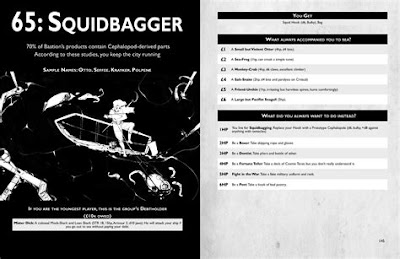
    One idea I'm using to imply my idea of a setting but not making it canon is stolen borrowed once again from Electric Bastionland. A large section of that game involves Failed Careers - what your character was doing before losing it all, getting in debt and becoming a treasure hunter.


What does "Squidbagger" say about a setting?
     

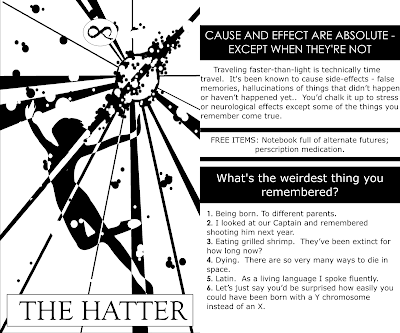
    I am not including d100 failed careers but I am using a similar concept in Character Pasts.  In our Project NEPTUNE rules set a Character Past will be include a Character card (3x5) a resource card (2.5x3.5 trading card) and condition card (also trading card).  Let's look at one of the cards and see how it helps imply a setting:


Front and back, with room for notches.

      If you'll open the image above and read the card, you'll find quite a bit of implied setting:

  • There's the name itself: This is a setting that includes Earth and Alice's Adventures in Wonderland is still a known IP.
  • The setting is Hard SF. FTL = Time travel is the understanding of current physics.  Actually using that as a potential plot point says that implications normally ignored in science fiction will be explored - or at least played with.
  • The setting is going to deal with mental issues. And they are still somewhat stigmatized. False memories, hallucinations, or actual memories?  You get prescription meds either way. 
  • This setting can get dark. Remembering killing someone? Remembering dying? Shrimp are extinct?

     Some of the other Pasts I'm working on include:

  • THE RELATOR: Psychiatrists for Artificial Intelligences.
  • THE CHRONOI: People from Saturn - complete with wind chimes. 
  • SANTA'S HELPER: means the setting has Santa Claus Machines
  • THE WALKER: The Rainbow Road of Mars is marked with the multi-colored spacesuits of those that died walking it.  It's become something of a religion.


   So there are a lot of setting elements here, but only if they interest you.  This is all on a single index card.  Use it if you want and if not, put it back into the stack and forget about it.  And even if you choose to use a Past card, it's not a wall-of-text info-dump because there's a finite amount of space on the card, and that's all I get to sell you on the concept.

    Using spaceships to imply a setting is a bit different.  Space travel and combat is the sin qua non of Project NEPTUNE and the kind of spacecraft available will have an impact that cannot be ignored.  Fortunately, our use of Causal Influence Diagrams let us take the technology of a spaceship can be mixed-and matched to a certain extent. And again, you the tech you don't want to use can go in the stack and be safely ignored.

    I'm not sure if of the reason I feel compelled to use a rule or item that's in a game's rules or setting is because I can see it on the page when I open the book, but the edge-notched card will keep them safely out of sight and out of mind either way.

Wednesday, October 12, 2016

Intra-Fleet Tug Update:

     While I've certainly had fun working on my Hard SF Rec Room, I haven't forgotten about my main task of working on the Intra-Fleet Tug.  Things are moving forward.  As I hinted at in a previous post, I have decided on five major pictures for this series: Assembly, Boost, Life on board, Docking, Cargo Transfer, and then orthos and conventional deckplans.  Already, this is a job of work that will take a fair amount of time.  Add to that, however, that each of these images will be a composite of multiple elements that have to be drawn, assembled, colored and laid out.  The Assembly image, which will show the tug inside an assembly hangar being mated to it's rocket motor and fuel tanks, which are towed into place by Cygnus rockets fitted with manipulator arms.
      In order to make that one image, I need the following:

  • The exterior cageworks of the hangar, which is multiple elements all on its own,
  • The habitat modules, which are also made up of multiple elements,
  • The empty Tug, which is itself made up of command module, saddle truss, cargo pods, and manipulators,
  • The fuel tank stack,
  • The rocket motor,
  • The Cygnus with arms, which will probably be repeated a couple of times
     For one image.
     But its not all bad, RocketFans.  I've gotten the tanks, and motor done already and just today, finished the empty Tug composite. First I sketched out and inked the individual elements:

     I claened it up, which required replacing the rings on the top and bottom of the truss and on the command module as well.  I also took that tiny cargo pot and duplicated it, placing it around the CM:
     Once that task was done, I took the manipulator arm and used some cut-and-paste and re-sizing to add it to the CM.  Once that was done, all that was left was to assemble the composite:
    And there we have it, RocketFans, the assembled empty Tug with its attendant Cygnus.  Now I just have to finish the base elements, put it all together, color, and voila! All finished!   
      On the first picture. Of five...
     Anyway, I'm also working on more of the Common Compartments images, because they are much faster.  I will probably finish up the Keel Segment image I started with, I've got a Wardroom compartment started, and a couple of other ideas.  I'll probably do a Tug image and Common Compartment image and alternate, to have some variety.
     Next time I hope to have at least the assembled uncolored image finished.  See you then!


Saturday, October 8, 2016

Here we are: a Rec Room....in...SPAAAACE

    I finished coloring this very very detailed little compartment today.  I even added a little person keeping fit in micro gravity.  I hope some of the details are more apparant now - like the ping-pong table!  I will be releasing an annotated version (without the watermark) for may Patreons probably Monday.  Anyway, I hope you enjoy!


Thursday, October 6, 2016

Common Compartments: A "Rec Room" in Space (WIP)

     I had this idea, inspired by the incredible artwork of spacecraft interiors in the Jovian Chronicles RPG books, to do some isometric spacecraft interiors.  Not full spacecraft, not part of Conjunction, or The Black Desert or anything, just spacecraft interiors.  This first one was actually a dare suggestion of +Rob Garitta: a Rec Room on a spaceship.  The clincher was when he said I must add a ping-pong table.  I thought to myself, "Impossible!  A ping-pong table in zero-gee!?"  But the idea had been planted, and I couldn't leave it alone until this happened:

You have no idea how hard it was to draw all those tiny little logos...

     I've also started on the first of the Intra-Fleet Tug isos - which is a bear.  Just the shot of the tug being assembled, from the upper left of the sketch I showed the other day, will take six different fully inked and colored images assembled into a composite picture for me to achieve the effect I want.
    Fortunately, I really really love working on isos.
    Anyway, enjoy, and if you like the compartment above and want to see more, let me know in the comments.  See you later!

Tuesday, October 4, 2016

Deciding what to Draw...

     Thought you might like a look at some of the (very) rough sketches I've been making to help decide which views of which parts of the Intra-Fleet Tug I want to draw and show off.
Behold! (sub)Genius at Work!

Wednesday, September 28, 2016

Intra-Fleet Tug WIP

     Got some work our the ole' GIMP last night, and the beginnings of our Intra-Fleet Tug can be seen.  Let me assure all of you who have practice designing spacecraft: This is not remotely an optimized design.  This is a Frankenstein rocket, built out of available components for a unique purpose that became a de facto design more or less by default.  The story behind this craft's inception is part of the story of the Conjunction War, and by exploring its design, we will learn more about the fateful last voyage of the Mekong and the Jovian Blockade.
     Interested?


Sunday, September 25, 2016

Intra-Fleet Tugs and why Rocket Science is as hard as Rocket Science

     So four days agoor there abouts, I put a poll up on Google+ with a selection of spacecraft I was thinking about making isometric cutaways of. The frontrunner is the Intra-Fleet Space Tug. That means, RocketFans, that we’ve got ourselves a project!
This is not the tug.

     The context for this particular spacecraft, like the Cygnus capsule I also put in the poll, is the care and feeding of the distributed-network fortification that is a deployed UN Constellation in the Conjunctionsetting. In summary, the fleet’s configuration is a tetrahedron in space with a single control ship at the apex, patrol craft making up the other three vertices, and edges three hundred thousand kilometers long. Just how do you supply ships that are as far out as the Moon is from LEO?
 
Cygnus docking with a Class A Patrol Craft
   In the article about how fleets work, I stated that the crews on the patrol craft could be swapped out by ferrying fresh people out via the Cygnus. While this would certainly work for crew transfers, you’d also have to detail additional craft for cargo transfers, of consumables and (if armed with rail guns) ammunition. As versatile as the Cygnus is, it cannot not re-supply that most important consumable resource in terms of tactical movement, propellant.
     To put the problem into perspective, a Cygnus stack is a rough cylinder 4.5 meters in diameter and about ten meters long. The propellant tanks on a Type A Patrol Cutter are 8 meters in diameter and total thirty meters long. And there are two stacks. Clearly, to refuel a patrol ship, we need a real tanker.
I’ve said it before RocketFans, and I’ll surely say it again: AtomicRockets is an invaluable resource for the budding rocketeer. The “Realistic Designs” sections are a veritable clearinghouse of old NASA designs that were pretty good but never got a decent budget. These oldies make for a great library of inspiration when designing any spacecraft that is meant to work with real-world physics. For our Intra-Fleet Tug, I was inspired by the Johnson Space Center’sTug study, who’s image I used in the Poll. This beauty is a two-stage ferry to get from LEO to GEO where NASA was going to build a solar power station.
Yeah, we could have had that...
    Anyway, a light-second is good deal further than the LEO/ GEO distance, right? In kilometers, yes, but in Delta-V, not even close. It takes a whopping 4.33 km/s to go from LEO to GEO, but a paltry 2.74 km/s to get from LEO to Lunar orbit...a little over a light-second away.
     Gravity is funny like that.
     So our tug only needs about 75% the range of the JSC version. Since that design was staged and the first staged carried the spacecraft 85% of the way to GEO we could just lop of Stage I and call it a day. But where’s the fun in that?
     The problem with just ripping of the JSC design is that it isn’t a tanker. We need to be able to deliver a large amount of propellant, so we’re going to need a large spacecraft. Something that could haul at least a quarter or half of the Delta-V needed to completely refuel a Patrol craft. What follows is an experiment: I’m thinking of just taking an entire rocket stack from a Patrol craft and slapping a command module on the front for our Tug. Let’s see how that would work, shall we?
     First of all, we need to dust off our rocketry equations so we know what variables we need to consider. We’re going to need to know the Tugs dry mass, wet mass, and engine details such as propellant flow, thrust, and exhaust velocity. Since we’re using the dimensions of the propellant tanks from the Class A Patrol Craft, and possibly one of its main engines, that gives us a great place to start. In fact, lets crunch the numbers for the Patrol rocket’s main engine and an alternate, say something along the lines of the J-2 from the Saturn V’s SIV-B stage.
     First, let’s establish the tonnage for the Tug without it’s engines. We’ll want a decent sized crew module, because gaming, and also so we can have cadets aboard during all flights. In Conjunction, like in Heinlein’s Space Cadet, every UN convoy and spacecraft has a group of peacekeeper candidates learning how to work in space by working in space. I see an actual crew of about four: a Flight Commander (F-Com), Guidance Procedures Officer (GPO), Maintenance, Mechanical Arms, and Crew Systems Officer (MACS), and a Payload Officer (Payload). Add as many again of Candy-Cruisers, and you’ve got eight people in the command module. That’s a bit crowded for a Tug, but we can use hot-bunking with to limit the sleeping berths to four. The CM must also have at least a pair of robotic arms, and a sturdy docking module for carrying passenger capsules and cargo pods. Behind the CM will sit a flared-out service module, with avionics, life support, and computer systems. The SM will be mated to a 30 x 10 meter saddle truss, which is what will actually hold our propellant tanks and provide a mount for the rocket stack. But in addition to all of that, we will also need a passenger module and cargo pods, so we need to know the mass for all of those as well.
     Here’s how it breaks down:

System
Mass (kg)
CM
12671
SM
3000
Saddle Truss
24119
Propellant tanks
24119
Passenger Module
7540
Crew Avg. Mass
2400
Cargo/consumables
392883
Total Dry Mass
466732
LH
71204
LOX
305788
Propellant Mass
376992
Total Wet Mass
843724
     I arrived at some of these number dubiously, so take them with a grain of salt. The CM mass is from the Trans Hab Calculator on the AR website, the SM is from the JSC Tug, the truss is simply repeating the mass of the propellant tanks, since I couldn’t find any reliable numbers for that. The Passenger module is also from the JSC tug, while the consumables and cargo masses are calculated for the tugs trip out and back, as well as 30 days of supplies for the 20-person crew of a Patrol craft. And of course, we can’t forget the mass of the crew and passengers themselves, plus what ever possessions they can carry inside their regulation 100 kg mass-limit. Finally, the propellant tank mass is 6% of the propellant mass, as per Dr. Rob Zubrin, and the propellant masses came from the Useful Tables appendix from Atomic Rockets. But the most important thing to remember is that we have no engine yet.
     The Class A Patrol craft uses an easy to maintain in freefall analog of the SSME so I could simply steal copy the vital statistics. Engine List on Atomic Rockets has these available. Just below that entry is the stats for the Tug engine we will also use. These are not exactly the J-2 stats, but they are for a NASA tug, and they have the information I need to calculate with, whereas sources on the J-2 did not.
     What we want to know is, assuming a 100-hour flight time, is how much propellant will be left in the big tanks at the end? We need to have spend no more than 1/3 of our propellant mass in transit. That way, we can refuel with another third (plus a bit extra) and use the remaining less-than-a-third to take our much less massive tug home.
     This means math. So, so much math.
     Well, not so much, perhaps. We know all the vital statistics for our engines, our mass numbers, our Delta-V budget, and our distances. By establishing an arbitrary travel time of 100 hours, we also provided a much-needed value for equations, and more important, the mass of needed consumables.
   An Intra-Fleet Tug that uses a “F-2b” SSME-analog will have a wet mass of 846,901 kg, or 847 tons. Let’s see if we can get from point A to B while only burning through 125,664 kg of propellant.
     Simple, right?
     If only using 125.6 tons of our propellant, we will be operating with a mass ratio of only 1.8 By using the Delta-V equation of Delta-V = Exhaust Velocity x ln(Mass Ratio). This results in a Delta-V of 2621.96 m/s, or 2.62 km/s. We need 2.74 km/s to get to our destination, so it’s close, but no cigar.
If we attempt the same thing with our J-2 analog, we have a wet mass of 845,512 kg. This gives us a mass ratio of 1.8 again. However, the exhaust velocity is 4159.4 (I had to calculate it using the specific impulse, but that’s why we have algerbra in the first place). With the mass ratio and a lover exhaust velocity, the Delta-V is 2.45 km/s. Both engines are pretty comparable, but neither will get us out a light second and back.
     Or will they?
     The moon averages 384,000 kilometers from Earth. A light-second is only 300,000 kilometers. We actually have less distance to travel, and hopefully less Delta-V, than the 2.74 km/s we’ve been using. Possibly a lot less.
     I forgot that moving around a fleet formation like this is not remotely the same as moving around orbits. Moving from LEO to Luna is a Hohmann trajectory, which is a change between orbits from around one body moving at one speed to another body moving at a very different speed. When deployed, our constellation is all moving at a constant speed along a constant orbit/vector. This means that all spacecraft in the formation are at rest relative to one another. So we need to go from a starting velocity of (relatively) zero to a certain speed, coast, flip, and then decelerate back to zero. This is just a simple physics problem.
     This is also where our arbitrary 100-hour travel time comes in. With time and distance known, as well as acceleration (Thanks to the engine stats) we can solve for velocity and begin to figure out what we need to know.
Solving the displacement equation gives us an average velocity of 833.333 m/s to travel a light-second in four days and change. This means we need a final velocity of 1666.666 m/s. Our SSME engine will take only 721 seconds to boost our monster tug to speed, and the same to decelerate at the other end. Now for the biggie – mileage. By which I mean, just how much propellant did we use up in those 1442 seconds?
     Turns out that’s an easy one, because we know the mass flow. A single SSME tosses 409 kilos out the back every second, so our Tug will have to burn 589,778 kg. This is more than the entire wet mass of the tug, so say nothing of the “one-third” we wanted to get by with.
     As for the J-2, we need to re-do our acceleration calculation so we can figure our burn duration. Unfortunately, with a burn duration of 1282 seconds one way, the performance is even worse.
     What went wrong? This tug has half the power or a patrol rocket – it should have at least comparable performance.

* * *

 
Its right there in black and white.
Literally.
   Having gone back over my notes I discovered my problem, and it’s an embarrassing one.
The Class A Patrol Craft I just mentioned, the one that’s over twice as large as this tug? It has a dead weight tonnage of 70 tons. That’s it. The Tug has a dry massof 466 tons. Well, there’s our problem!
     I designed the Patrol Craft to take into account the likely progression of materials science toward ever lighter and stronger materials. It was built out something that has the same strength of titanium, and half the mass. Add to that it’s outer skin is mostly carbon and aerogel – literally the least dence substance there is – and its easy to see that simply cribbing numbers from a design made when aluminum was the lightest thing you could build spacecraft of is a problem.
     Let’s try this again shall we?

System
Mass (kg)
Total Structure Mass
24119
Crew Avg. Mass
2400
Cargo/consumables
4245
Total Dry Mass
30764
LH
71204
LOX
305788
Propellant Mass
376992
Total Wet Mass
407756
With SSME
409337
With J-2
409544

     I not only went back and recalculated the structure mass using 22nd century materials, I also hand-calculated the mass of the consumables and cargo, using NASA rations. Much better results. With these stats, the Tug can pull 4.43 m/s, and only has to burn for a total of 376, instead of 1442. This means we only burn 141,514 kg of propellant. With less thrust and more mass, I don’t feel a need to calculate for the J-2. 141.5 tons of propellant is 37% of our propellant mass. For the return trip, we’ll need less propellant, say, 25%? The Tug would only mass 126 at that propellant fraction, and accelerate at a whopping 14.4 m/s, or 1.4 gs. It will only have to accelerate for 115 seconds and burn only 43 tons of propellant, while carrying 96 tons. This is over a 100% reserve, enough that we could add another 20 tons or so to the 124 tons our Tug is pumping into the Patrol craft.
     So, there you have it, RocketFans, a glimpse into the hair-tearing-out, thankless job of designing a realistic spacecraft. I’m glad I just have to make these look good on paper. But the important part is, I can now draw a spacecraft with all the particulars I wanted to, and it will not only look realistic, it will be realistic. It’s capabilities and limitation will suggest numerous plot points and story ideas, and I can be assured that each and every one of them will pass the litmus test of plausibility, because I did the math up front.

     Next time I hope to actually have an image or two of new art to show you...

Tuesday, September 20, 2016

Drawing Spaceships Crooked (Isometric Projection)

     Just to be different, RocketFans, I thought I'd actually make a post.
     Kidding aside, I've been working at a day job of late and dealing with getting myself back into the groove of time management, scheduling, and all the things I haven't had to think about since comas and brain damage removed me from the conventional labor force.  I'm not sure how to describe the experience.  Imagine having to re-learn not only the moves and routines of something you've done all of your adult life, but have to re-learn some of the concepts behind the routines and moves.  Only a strict regimen of bi-hourly doses of insulin and daily doses of anti-depressants and anxiety meds.
    I only mention this to explain my sometimes (okay, often) erratic postings and tendency to tail of in mid-series.  I'll put it this way:  Normal blood sugar is between 70 and 90.  Mine has gone from 461 to 39 in the space of six hours.  At least once a week.
    Moving along...
    As the title suggests, I've been playing with isometric projections and cutaways.  If you're not 100% familiar with the concept,  It's like this:
Tantive IV FTW
     I love these kinds of images.  I've got all of the Incredible Cross Sections books and I've dreamed of being able to make my ships into art like this.  After all, I taught myself how to make the deckplans, the orthos, the CG models, and everything else you've seen in my previous work, what's one more technique?
     To start with, I got some iso-grid paper.  This wonderful stuff is great for folks who do not have drafting tables and 3 degree triangles in their inventories and better still, it takes a lot less time to use than blank paper.  After watching a brief YouTube tutorial on how to draw isometric circles, I was off and running!
     Here is an image of what could be a variation of the Heinlein Rocket's Keel:

     Rather than try to ink this little sketch, I did what I think is the smart thing and scanned it into the computer and printed it out at three times the original size:

     This is the version I inked.  I used pens and did it by hand, because I'm old school.  And because it's faster...

 
     But after that, I put the inked imaged back into the computer, fired up the GIMP, and cleaned it up.  I not only scrubbed out the blue guide lines, I fixed mistakes and added some details that were just too fiddly for me to work in with a hand pen.  Thank goodness for a computers extreme zoom!


A drawing like this can still be confusing if left in un-shaded black-and-white.  Besides, I wanted to capture the style of the ICS books, so I colorized the image and added some additional details.  This is the latest iteration:

     I did not add any shading or people to the image, because this is only a test.  Now that I've managed to create a workflow and get some practice in, I'm going to start working on making some real spaceship art.  I will naturally be posting the results regularly on Patreon and here, and once I've finished a collection for a particular spacecraft, a published volume would not be out of order.  I look forward to it.
     I just want to take a moment and sing the praises of the Patreon system.  Back before the advent of monthly crowd-funding, I would never have felt like I had the time to work on this kind of art.  I had to stay within the bounds of the admittedly narrow style I had already developed for making deckplans and churn out books monthly if I was to expect to see any decent money from the enterprise.  Even then, the money wasn't that decent, but for a family of five living on $17,000 a year, it meant the difference between a real birthday party for the kids or just a present and box cake.  With Patreon, however, I'm at the level I of monthly income slightly above that of when I had to get a thirty-page book out every thirty days.  That means I can actually explore new ideas, like the nano-fic, the maps, and these isometric drawings.  Now I know I can take my time and work on a single, long-term project because I not only have a venue with which to share the progress, I have the support it takes to finish it.  So thank you to all my Patrons out there, for making this possible.
   Got a little sentimental.  It happens.  Anyway, soon-ish, I'll be talking about my next major project and what books Debra and I are working on, as well as whatever Rob Garitta has cooked up in his devious little mind.  See you then!


Google+