Showing posts with label Spacecraft design. Show all posts

Wednesday, March 2, 2022

Project NEPTUNE: Making the Procedures Universal

Faci-NOPE.
    More than any other genre I'm aware of, Science Fiction is defined by it's technology.  For example, the difference between Clash of the Titans and Lord of the Rings is to my mind less than the difference between Star Trek and Star Wars.  And both of those have almost nothing in common with The Expanse.

    This is relevant to game design because I could run a game set in Middle Earth or Mythic Greece using D&D with no real problems.  I could not run Star Wars using Star Trek RPG rules or vice versa. Warp Drive, Transporters, Lightsabers, The Force - I would spend enough time in conversions from one system to the other that I may as well just get both games.

    While there are more universal SF RPGs out there (and GURPS, of course) this usually puts the problem on the GM.  Systems such as STAR HERO for example make it possible to build virtually anything you can imagine - at the expense of having to build everything you imagine.  This kind of time sink can be more intensive than actually learning multiple game systems and encourage GMs to purchase multiple games.

    I intend to address both problems.

Yes, I know what it means.
  

    The inspiration for this part of Project NEPTUNE comes from the same place I get most of my inspiration: Winchell Chung's Project Rho.  While most famous among SF aficionados for Atomic Rockets,  Chung's Project Rho has other treasures for those who seek them.  Two of those treasures are going to be the key to making space travel and combat interesting, full of player agency, easy for GMs to prep and run, and useful across multiple franchises.

INFLUENCE DIAGRAMS

    Project Rho has a whole section on cool game mechanics that bares careful study. Among them is a single article by Neel Krishnaswami that can, as of 2022, only be found on Project Rho.  I'll give a high pass of what's important for us here, but the full article is excellent and I lament there was no follow up.

    Seriously, go read it.

    The example in the article addresses Star Trek in particular but the core idea applies to any technology. By breaking down a SF tech like warp drive or what have you into individual systems or components, you can build a causal influence diagram that gives the player details that actually matter.  This can be presented as a handout (or card) to the players and used by character to repair tech, work with tech and generally make the tech more real at the table.

    Since I'm working on the idea of Crew as Damage Control, I'm naturally drawn to this notion.
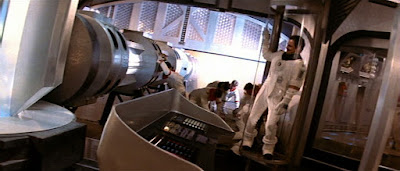
The rules for this -

    What makes this work across multiple franchises is that the procedure of using the Causal Influence Diagram is universal while the tech itself is modular.  For example, If I were playing a Star Trek style game, I'd want a CID of a warp drive.  It would have bubbles like Matter/Antimatter containment, Warp Core, Plasma Conduits and Warp Coils.  My Engineer character would use that to troubleshoot damage and tell the captain that She cannae take much more o' this.
- are the same as the rules for this.
    If I'm playing a smuggler in a Star Wars style game, I'd want my CID to have Hypermatter Coaxium Magic bottles, a Fusion Reactor, Hyperdrive Motivator and Field Guides.  I may not know what any of that stuff means but they're on the diagram and I can use them because the procedure of using the diagram is the same no matter what SF tech I'm modelling.

    So when folks on Twitter ask me if the work I'm doing on space travel and combat can apply to their favorite game, I can say with confidence that yes, yes it will. 

    Using the Analog Database makes this work even better.   Any ship system, from any franchise can not only be diagrammed, but the cards stored in the same stacks and simply filtered by search term.  Packaged and sold individually, a deckof cards inspired by a given franshise could contain the tech, character backgrounds, and unique rules required to fully use the setting without needing an entirely new game.

BEYOND TECH

    I found another article on Project Rho that brings home to me the potential of this idea.  Ron Edward's The Sorcerer's Soul was also praised for it's use of relationship maps.   I got a copy of the book and perused that section - it didn't take me long to realize that Relationship Maps and Causal Influence Diagrams can be considered the same thing.

    So if CIDs can be used for physical objects and networks, and also for social relationships and people, could it also be used for ideas or intellectual pursuits?  Justin Alexander has pretty much proven it can - and provided excellent advice on how to use them as well.

    For me this means that not only can the conflict rules in SACRIFICES be used for physical, mental and social conflicts, CIDs can be used for physical, mental and social networks as well

    The system would be unified across all three attributes - which means it's unified across the entire game.  Across any game I want to make.

Still know what it means.
    More to come next week.


Wednesday, January 19, 2022

Project NEPTUNE: or Another Stab at Integrating Space Travel and Combat into TTRPGs that Does Not Suck

Who else would hitch dolphins to a chariot?*

This will definitely be a whole series of posts.

    In the link to the right Ken Burnside articulates a problem I've struggled with since I first tried to run the West End Games classic Star Wars: The Role-Playing Game in 1992; to whit: "How can I put the spaceships I love into a game in a way that actually adds fun to the game?"

    This is far from the first time I've tried tackling this task.   Indeed, I have a Goodle Drive full of unfinished and sometimes untitled documents detailing snippets of ideas, lengthy mission statements, and pages and pages of world building and lore.

    I hope I can actually use some of it.

THE PROBLEM    

Just so we're all on the same page, the problems I refer to is as follows:

  • The play style of space travel and combat in most TTRPGs is antithetical to the core play style of most TTPRGs.
  • The space combat is resolved on a unique type of battle map that uses a different scale, different time intervals, and different rules.  It is a mini-game functionally separate from the main game.
  • In space combat, the player that flies the spaceship is the only one with actual agency.  
  • Skills required to survive space combat are not applicable in character combat, and therefore may take away from the character's focus.
  • While the Pilot is the only character with agency, space combat rules often require more than one character to successfully fly and fight a ship.  This automatically puts one character in a command dynamic over the rest (bad) or an NPC is used as the commander over the PCs on a ship (worse)

    In some games, these are non-issues.  If you are playing, for example, as pilots in a starfighter squadron most of this goes away, because the spacecraft become simply another piece of equipment; an SF version of steed, lance and armor.  But not everyone wants to play a squadron of fighter pilots.

    There are also lot of other issues with space travel and combat in TTRPGs that are outside the scope of this series.  Like how many attempt to shove a streamlined war game into an RPG, or how many attempt to recreate a cinematic experience from a movie or television franchise.  These are considerations for another time, and perhaps other people.  

 THE GOAL

    If I have any chance of making a go at this project, I have to keep my scope focused down to the essentials of the game experience I want to enable:

  •  Player Agency: If something is going into the game at all, it must be there in the support of player agency.  That means we can't enforce a command dynamic and we can't turn the players into supporting die rolls for the pilot.
  • A Meaningful Experience: The decisions Characters make aboard ship must be meaningful to the Players.  The situations aboard ship must matter to the Gaming group and provide an experience rich enough to justify the time taken away from other aspects of the game. The actions players take must have observable consequences to validate their agency.
  • Integration: I am not interested in making a mini-game to add onto a character-based TTRPG.  I am interested in making spaceship-based travel, exploration and combat as integral to the game as dungeon-based travel exploration and combat is to the OSR.

    Whether or not I can succeed in that goal remains to be seen.  I've been thinking, reading, working on the ideas for almost ten years now.

    Ten years.  

    Wish me luck!

   *The image above was commisioned by Mr.Burnside from artist Claire Peacey (instagram.com/autumnskyart/?) whose work and work ethic is highly recommended.


Wednesday, March 22, 2017

Starships & Spacemen Examined: I'm going to have to make my own setting, aren't I?


Ha!  Rhetorical question, Rocketfans - what else would I be doing?  It's not like I can leave anything alone...
      The deal breaker came with my examination of the FTL system.  It's a variation of the classic Trek/Alcubierre warp drive - which is bad enough, as warp drive has problems.  What's even more difficult for me to deal with is the speeds involved.  For an RPG it's perfect: Each warp factor is how many light years on the hex map you can travel in a day, and ships can travel between warp 1 and warp 8.  If you are a fan of The Original Series of the source material, that's between warp 7 and warp fourteen.  Needless to say, you can cover a lot of territory with that kind of drive.  At warp 8, Proxima b is only twelve hours away, and Gleise 581 is only 60.  The entirety of the Local Bubble would only take 50 days to cross - 200 light years, in less than two months.
     It's about here that I've always run into problems with SF RPGs: Maps of space. When you can travel across a wide swath of space in a short amount of time, it's easy to get to the planet of the week, but harder to maintain any sort of realism in your star mapping. While Game Design Workshop's 2300 AD is a unique exception, most games that obstensibly take place in our universe have star-maps that bare no similarities to observable reality.   S&S - like Traveller and Star Frontiers, doesn't even pretend to make accurate maps of the Milky Way and instead provide guidelines for making up star maps and even randomly generating stars and planets. That was fine in the 70s and even the 80s, when accurate star charts were hard to come by.  Since the advent of the Internet - and especially in the exoplanet discovery era of today, it becomes harder and harder for me to suspend disbelief.
Here, to be exact.
   Now, there are accurate star maps out there.  It would be a fairly easy if tedious task to add the know extra solar planets to them.  But making a star map of a large enough scale to be useful in Starships & Spacemen and shows accurate distances is nearly impossible.  Even if you projected the map onto a convienent wall or pool table or something, the sheer number of stars in a given volume of space (and the fact that they are stacked three-dimensionaly) make using the map in a game a daunting prospect and far from the relative simplicty of the S&S rules as written.  However, the movement system in the game tracks interstellar movement and gives you interplanetary for free - so it would appear that we have to have some sort of star-maps.
     There are, of course, star maps that reduce the nightmare of 3D or 21/2 D mapping into something that both has accurate distances and is easy to look at.  Node Maps are an easy method - it gives you the information you need without going into sensory overload.   That being said, Node Maps are also useless in the S&S game because they do not provide hexes to show interstellar movement.
    This is where I threw up my hands in despair. You can have accuracy, simplicity, or utility: Pick two.  I feel a psychological need for accuracy, and an intellectual need for simplicity, and an actual need for utility.   What am I to do.
     (sigh) Change the setting, of course.  I always seem to do that anyway.  But hey, that's what being a game designer is all about.
     Here's what I'm gonna do:  I will make a new system of starship movement and combat.  I will make deckplans for starships that use this new system.   I will also provide stats and such for Starships & Spacemen as written.  And White Star too - just to cover the whole SF OSR OGL alphabet soup.
     But stick with me on the new rules thing.  I have some ideas that may interest you.  We'll talk about them more on Friday.

Monday, March 13, 2017

Blame it on Rob-o

     Specifically, Rob Garitta, friend and sometime collaborator here at Blue Max Studios.  He mentioned our previous work on the Starships& Spacemen game and I rather woefully lamented not having completed any of the projects I wanted to for that game.

  It was a rather lengthy list. I was going to make variants of all the major ship classes for the game, from Frigate to Dreadnought, make enemy spacecraft - even an adventure/setting.  I never did anything with it, in part because I got bogged down in tying to make a spacecraft design that made sense in light of the games rules on Energy Units and their distribution.

    I will respectfully decline to discuss the Shuttle Ship situation at this time.

    Once again, Ilove the game Starships & Spacemen OSR Star Trek? Sign me up!  Nevertheless, the Power Pile Base system gave me pause when trying to design spacecraft.  And so did the Teleporter.  And the way the decks are laid out like boats and not rockets.  And the dang shuttle ships.

    This was about a week ago now, when I was talking to Rob.  Since then, I've been thinking about these problems with the focus and intensity of...well, of a middle-aged autistic man who likes spaceships.  I have therefore managed, thanks to past experience, the Atomic Rockets website, and lots of graph paper, to resolve of these issues to my own satisfaction.  Over this week (at the least) I will outline my findings and developments.  Some of this takes the form of deckplans or schematics.  some will take the form on nano-fic set in my own private S&S universe.  All will be awesome.  Please stay tuned...

Friday, March 10, 2017

A Town on the Road to Nowhere

     The River- class transports are big.
     At four hundred and fifty meters in length, these colossal spacecraft can carry a lot of folks from here to Titan, some of which are actual passengers.  Most of the company and crew of a River, however, are part of the civilian or UN crew.  In order to make sense of what we needed in terms of staff and whatnot, we must first make a couple of assumptions about how the crew will be composed, selected, and distributed.
     First, the crew of the Rivers follow the Mission Control model. The individuals are not actually running the spacecraft, they are the managers of computers and automation and robotic drones.
     Second, the River- class is a civilian owned and operated spacecraft.  The UN pays the transport company a subsidy to insure regular service and to pay for transporting UN spacecraft and crew.  Also, naturally, the UN are present to provide the inspection team required on all spacecraft boasting a nuclear-powered drive.
      Third, There are not only three watches on the crew, there are two entire crews for each spacecraft and associated vessel.  Once the River leaves orbit, the people aboard won't see open skies again for a minimum of 2 years.  So, like submarines in today's American Navy, there are two crews for each spacecraft.
     With all of that in mind, here is a preliminary table of crew and passenger positions on a River-class transport.  The numbers in bold are the total number for that given division:

Crew Division
Crew Section
Number
Total
UN Command
Mission Support
10
(Dept Heads x2)
10

Mission Commanders
4
MCOM/DMCOM x2
14
UN Patrol
Patrol Craft Crews
62
(5 positions x 3 watches +1 Flight x2 crews/craft x2 craft)
76
Espaciers
Shipboard
5
(1 Captain, 1 Leutentant, 3 Staff)
81

Patrol
24
(6/squad x2 squads/craft x2 craft)
105
Civ Crew
Command Crew
31
(15 Mission Control x2 Crews +1 CIVMCOM
31
(136)

Stewards
38
(1/Pod x3 watches +1 Chief x2 crews)
69
(174)

Life Support
72
(2/Pod x3 watches x2 crews
141
(246)

Hangar Crew
16
(8x 2 crews)
157
(262)

Small craft Pilots
26
(3/Cygnus x 4 Cygnus + 4/Tug +1 AUXCOM x 2 crews)
183
(288)
Candidate Training
Candidates
60
60
(348)

Faculty
5
(1 Commandant + Class Supervisor x1/year)
65
(353)
Passengers

100
100
(453)

Tuesday, March 7, 2017

Ezekiel's Wheel: The Escher of Habitats

     I described the type of centrifuge habitat used by the River-class transports as being a species of Winchell Chung's Ezekiel's Wheel.  I also described it as a maintenance nightmare, as anything that must hold pressure and spin is already a nightmare, and anything that spins on two axes is a nightmare squared.  Be that as it may, I also posited that when shaping an orbit that takes two years to reach your destination, high maintenance is not necessarily a bad thing - it gives your intrepid Astros and Espos something to do during that long trip in the black besides stare at the wall and go mad.
    Besides, It looks cool.
Observe the coolness.,
    The twin hab rings float in a gigantic globe of water.  This is for a few reasons.  First, the water is the "Fleet Reserve" tank of propellant for the Patrol Rockets, tugs, service modules and any other spaceraft requiring chemfuels.  Second, the water is a cracker-jack protection against ionizing radiation, including the cosmic rays that vex long-term space travel.  Now, this diagram shows that the globular water tank provides excellent protection fore and aft, but is lacking in the lateral direction.  We'll have to supplement the water tanks with some magnetic shielding - which is fine, as the forward hanger, conning tower and command module need such shielding anyway.  Still, it is to our benefit to put the habs in the water tank, for even more reasons.  How about thermal insulation?  The water tank will act as an enormous heat sink that provides even temperatures to the habitat sections throughout the long voyage to Saturn.  Then there's vacuum insulation.  Let's face it, RocketFans, while John Campbell was wrong about using the Dean drive to turn subs into spaceships, he was right about one thing - we know a heck of a lot more about building subs for long-term habitation than space habitats. And the habs we have on the River are actually easier to design than subs - they don't have to be insulated against sound, since in space, no one can hear you scream.  But in all seriousness, it is easier to plug a leak in a water vessel with a wedge of soft wood than it is in a rocket with a specially designed polymer that won't boil off or become brittle when exposed to vacuum.
     There is one other thing I wanted to speculate upon with the design of the Zekes for a space habitat.  I am, for various reasons, in favor of hub-less torus centrifuges - or at the very least, a torus that does not derive its spin from the hub.  The sheer size of these habitats, for example, would put enormous torque on the hub and whatever spokes connect the hub with the torus.  My usual dodge is to put wheels on the torus and have it trundle along some sort of track - As I've mentioned here and here.  But the Ezekiel's Wheel design, alas, makes this impossible, as the pods rotate in two axes.  My solution, I am happy to say, involves the clever use of another piece of nautical tech:  Azmuth thrusters.
 
IN SPAAAACE!
The simple inclusion of these thrusters solves the torque issue by giving each pod its own propulsion.  The advantages don't stop there, however.  The propellers will stir up the water in the tank so as to keep the temperature even.  The propellers can generate thrust using only electricity, and lack the mass penalty of a flywheel. The direction of the thrust can be easily changed, which means that the Azmuth units may be useful in changing the orientation of the hab pods during the transition from rocket thrust to freefall.  And again, there is a certain cool factor.
     Speaking of cool factors, just what kind of crew would such a habitat benefit from? Astronauts, or Submariners?  The question is moot, as you'd need a little of both, but some of the culture of Submariners is sure to become part of the Astros' traditions in service among the River -class spacecraft and their militarized equivalents.
    But back to spaceships and deckplans.
    To the right are a couple of views of the habitat pods that will be inside our globe of water in our spaceship going to Saturn.  These are not small pods, as you can see - each deck is over twenty-five meters long and the smallest is twelve meters wide.  That is a lot of habitable volume.  And there are twelve of these pods; six per wheel, arranged in two counter-rotating wheels.  There are flexible tubular walkways connecting the pods to their rotating hubs, which in turn connect to the central hub.
     Even postulating that half the volume (six pods) will be taken up by hydroponics and plant gardens, There is a lot of space for a lot of people.  But who are they?  What do they do?  That, my dear RocketFans, will be the topic of Friday's post.

Friday, March 3, 2017

Rolling Down the River

      Good Monday, RocketFans!  By the time you're reading this, I'll have been through the first phase of getting tested for autism.  Yes, autism.  I was surprised too.  Until I studied up on autism - now it seems rather obvious in retrospect.
      Anyway.
     I want to work on the River-class interplanetary vehicles some more.  I've been tweaking, modifying, and finagling the stats and sizes and other variables of the ship for going on three years now, so I've decided that it's about time to put some firm statistics to the work in progress in order to move forward.
     And of course, art.
Very much a work in progress, lacking in detail.
The beast is about four hundred and fifty meters long.  From left to right, we see the business end, a Magneto-Inertial Fusion rocket, and it's large rack of pulse units and capacitors.  There are the obligatory angled radiators that lead into the massive globe structure that dominates the craft.  this sphere is full of water and electrolysis equipment to turn that water into propellants.  The water also provide insulation against CBR to the two Ezekiel's Wheels that make up the main habitat section of the spacecraft.  For from the globe is a cargo bloc, carrying goods from Terra to Titan and back again, and to the right of that is the hangar space.  This allows for docking two of our Class A patrol craft on either side, and drydock space for one below.  The Cygnus rockets and any intra-fleet tugs also dock and are serviced here.  Above the hanger is a sensor mast that contains the forward phased arrays and the communication antennae.  The forward-most area is a command module that is partly command spaces, but mostly RCS thrusters.
     I've also been trying to get a handle on the crew compliment of this spacecraft.  I've got a few ideas already, which have to do with the spacecraft's function and other design considerations,
     That's all I have at the moment.  I'm working on details for the habitat pods, which are very complex and require a lot of thought.  Before that, I'll probably make a post about the crew compliment and more about the River's mission. Anyway, I hope you enjoy!


Monday, December 5, 2016

A Hard (SF) look at Star Trek: Starships!

    Work continues, RocketFans, on the next issue of LAUNCH WINDOW, so my space time is limited.  I'm still climbing the learning curve of making a full sized issue, so you'll have to be patient with me.
    I did want to show some work I did on re-imagined Federation starships as Alcubierre drive spacecraft.  It was a fun, albeit frustrating at times, exercise.  Hope you enjoy.
Exploration Cruiser Colombia (XCC-1701)  


Clockwise from top left: Hubble - class Sensor Frigate, Lee - class
Combat Frigate, Gali - Class Diplomatic cruiser, Argye - class Battle cruiser,
(cernter) Luna - class Destroyer 

Wednesday, October 12, 2016

Intra-Fleet Tug Update:

     While I've certainly had fun working on my Hard SF Rec Room, I haven't forgotten about my main task of working on the Intra-Fleet Tug.  Things are moving forward.  As I hinted at in a previous post, I have decided on five major pictures for this series: Assembly, Boost, Life on board, Docking, Cargo Transfer, and then orthos and conventional deckplans.  Already, this is a job of work that will take a fair amount of time.  Add to that, however, that each of these images will be a composite of multiple elements that have to be drawn, assembled, colored and laid out.  The Assembly image, which will show the tug inside an assembly hangar being mated to it's rocket motor and fuel tanks, which are towed into place by Cygnus rockets fitted with manipulator arms.
      In order to make that one image, I need the following:

  • The exterior cageworks of the hangar, which is multiple elements all on its own,
  • The habitat modules, which are also made up of multiple elements,
  • The empty Tug, which is itself made up of command module, saddle truss, cargo pods, and manipulators,
  • The fuel tank stack,
  • The rocket motor,
  • The Cygnus with arms, which will probably be repeated a couple of times
     For one image.
     But its not all bad, RocketFans.  I've gotten the tanks, and motor done already and just today, finished the empty Tug composite. First I sketched out and inked the individual elements:

     I claened it up, which required replacing the rings on the top and bottom of the truss and on the command module as well.  I also took that tiny cargo pot and duplicated it, placing it around the CM:
     Once that task was done, I took the manipulator arm and used some cut-and-paste and re-sizing to add it to the CM.  Once that was done, all that was left was to assemble the composite:
    And there we have it, RocketFans, the assembled empty Tug with its attendant Cygnus.  Now I just have to finish the base elements, put it all together, color, and voila! All finished!   
      On the first picture. Of five...
     Anyway, I'm also working on more of the Common Compartments images, because they are much faster.  I will probably finish up the Keel Segment image I started with, I've got a Wardroom compartment started, and a couple of other ideas.  I'll probably do a Tug image and Common Compartment image and alternate, to have some variety.
     Next time I hope to have at least the assembled uncolored image finished.  See you then!


Saturday, October 8, 2016

Here we are: a Rec Room....in...SPAAAACE

    I finished coloring this very very detailed little compartment today.  I even added a little person keeping fit in micro gravity.  I hope some of the details are more apparant now - like the ping-pong table!  I will be releasing an annotated version (without the watermark) for may Patreons probably Monday.  Anyway, I hope you enjoy!


Thursday, October 6, 2016

Common Compartments: A "Rec Room" in Space (WIP)

     I had this idea, inspired by the incredible artwork of spacecraft interiors in the Jovian Chronicles RPG books, to do some isometric spacecraft interiors.  Not full spacecraft, not part of Conjunction, or The Black Desert or anything, just spacecraft interiors.  This first one was actually a dare suggestion of +Rob Garitta: a Rec Room on a spaceship.  The clincher was when he said I must add a ping-pong table.  I thought to myself, "Impossible!  A ping-pong table in zero-gee!?"  But the idea had been planted, and I couldn't leave it alone until this happened:

You have no idea how hard it was to draw all those tiny little logos...

     I've also started on the first of the Intra-Fleet Tug isos - which is a bear.  Just the shot of the tug being assembled, from the upper left of the sketch I showed the other day, will take six different fully inked and colored images assembled into a composite picture for me to achieve the effect I want.
    Fortunately, I really really love working on isos.
    Anyway, enjoy, and if you like the compartment above and want to see more, let me know in the comments.  See you later!

Tuesday, October 4, 2016

Deciding what to Draw...

     Thought you might like a look at some of the (very) rough sketches I've been making to help decide which views of which parts of the Intra-Fleet Tug I want to draw and show off.
Behold! (sub)Genius at Work!

Thursday, September 29, 2016

Holographic Neural Interface Protocol (A Rampant Speculation)

WARNING: WHAT FOLLOWS IS COMPLETE AND TOTAL SPECULATION.
ANY RELATION TO ACTUAL NEROLOGY, COMPUTER SCIENCE, AND ECONOMICS IS HOPED FOR BUT UNEXPECTED.
YOU HAVE BEEN WARNED.

     I can hear it now: “Another post? Really?”
 
Available now!
   As I continue work on the
Conjunction setting, RocketFans, I must continue to refine my future history to account for observable reality. For example, My A Class PatrolRockets are in the process of getting a weapons upgrade as information from the ultimate space combat sim, Childrenof a Dead Earth, becomes available. Apparently, railguns will be the weapon of choice in space, and even old-fashioned gun powder cannon will have a place. That’s something that’s been discounted since Malcolm Jameson’s articleSpaceWar Tactics appeared in Astounding in November 1939. This proved Heinlein’s axiom that all the theory in the universe doesn’t compare to one instance of getting in there and finding out.
     Or something.
 
Well, rock me to sleep tonight...
   Anyway, one of the major things I’m going to have to account for in my future history is the growing inevitability of what is coming to be known as the Economic Singularity. Basically, with the advent of reliable, easy to build and above all
cheap AI, the Luddite Fallacy is becoming less fallacy and more “oh crap, there are going to be no jobs no matter your education level in a few decades”. Idealists site this as the perfect opportunity for us to switch to Universal Basic Income economies so we can all relax and let the machines run things, and every person can be part of the aristocracy of the independently well-off. I’d like to think that would happen. I really would. But since AI security is going to be just as cheap as AI everything else, it will be more likely that the 1% who now literally own everything will invest in private armies to protect them and theirs from the starving masses that no longer have any use to them.
     Cynical? Moi?
     Joking aside, the future doesn’t look very sweetness-and-light when your future livelihood depends on the altruism of your average billionaire. I imagine many will either insulate themselves in ivory towers that soar behind thick walls, or...leave. Elon Musk, James Cameron etal. And who knows how many others that can afford it may pack up and go to Mars, mine asteroids, or something else. In fact, I’m depending on it, as one of these billionaires, the ficticious Walter Hopkins, will set up the Destiny Foundation by-and-by. I used to think that asteroid mining would be another development bubble, but if automation and AI really will run everything in a decade or so, then the demand for resources will increase exponentially. This includes metals, of course, but even moreso hydrocarbons...which is what Conjunction is all about.
     But what of us? The 99% who will be left behind, with no available employment, no government dole, and no value to the 1%?
 
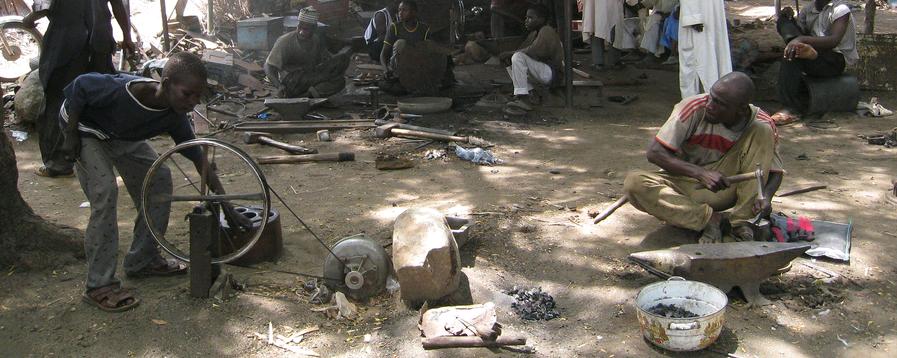
Pictured: Maroua, Cameroon, 2016 or
Detroit, Former United States, 2036
   Realistically, a secondary economy will spout up in the cracks, turning out products by hand for people with no money to by robot-built stuff. This could be as low tech as turning spring steel from scrapped cars into tools, to running a 3D printer out of melted down shopping bags and stolen electricity. Money, now electronic and used to monitor everything you
purchase, will be replace by poker chips and other makeshift tokens. I see this kind of scenario as one of the only possibilities: if the mainstream economy excludes practically everybody, then everybody will have to make a new economy that exists outside the mainsteam.
And then there’s the hackers.
We already see lots of fun and games in the news from hackers doing everything from violating the sanctity of crypto-currency to potentially influencing rival nations’ elections. If this becomes the only way for non-billionaires to have any way to get manufactured products or legal tender, you can bet everyone with a computer is going to try their hand at hacking if they think they can get away with it. And everyone will have a computer.
     What are the powers-that-be going to do about it? Sure, sure, they have all those AI programs that do everything and many will be anti-virus-sooper-dooper-security-programs, but let us not forget, so will everyone else. With AI kernals being release open source and lots of tech sector professionals made redundant by said AI, the hackers will have AI of their own, and what with the open source movements of today and the very real need to do something in the future to put food on the table, there will be a run-away arms race between corporate AI and the disenfranchised. It may very well end up that there will be some form of Basic Income implemented to curb the desire to hack the system, at least among the folks who would be hacking just to survive, as a “cost of doing business” expense. But the desire to make a truly “hack-proof” system will be strong, and much, much more money will be spend on preventing security breeches than on bribing the masses to with Basic and Social Media.
This is were the real wild speculation starts.
     Cognitive improvements are considered an almost taboo subject among people. Of course, many people didn’t want to sell the farm and move to the city when the work dried up. Just like then, people are afraid of losing their familiar way of life. The Economic Singularity will eliminate the familiar way of life quite thoroughly, which will probably make many people cling to the familiar all the more. In the end, that won’t matter for many people. Just like working on Sundays (or Fridays or Saturdays, if you’re Muslim or Jewish respectively), people desperate for income will submit to things they normally would rather not.
     
...only in your head.
Now im
agine a set of cognitive upgrades that make it easier to direct-interface with computers. They let you actually “see” your social media feeds and YouTube videos without having to use an actual computer! Computers are now owned centrally; you just get the signal, but you have instant access to your favorite computer stuff! The best part is, the upgrades are free! Anyone receiving any kind of Basic Income will find that keeping their benefits will actually depend on getting said upgrades. Conspiracy buffs will moan that were are now monitored 24/7 – not only by camera and monitoring our computer usage, but now your very thoughts as well!
     The fact that this is to a certain degree true will make such conspiracy buffs even less well received than normal conspiracy buffs.
     Just what is the purpose of boosting the brainpower of the average citizen? Holographic Neural-Interface Protocol.

 
HNIP is a new programming language that allows data to be stored directly in the memories of humans with cognitive upgrades. What makes such an elaborate systems worth the time and effort is that the data is stored holographically – as in “brain holographically”, not “computer holographically”.  The entirety of a given network’s data is stored across the memories of all of the people in the network. While each individual brain theoretically has all of the data, the data lacks the resolution to be accessed – the a holographic image of a rose that’s cut in to tiny pieces each have the full image of the rose but it’s really fuzzy. It takes at least five people with the same data stored in their heads logged in at the same time to allow access to the data.
     What’s the point, you probably didn’t ask? Brains being what they are, it’s impossible to access the data by someone outside the network. Basically, unless you have the data stored in your head already, "remember” it. So any hackers would already have to be part of the HNIP network they’re hacking, and because the computers are accessed by direct neural interface, it will difficult if not impossible to hide the fact that a certain individual is the hacker.
     Now for the fun part: For most people, they can’t function as part node in a HNIP network unless they are unconscious. It just takes too much brainpower. But that’s okay, right? In exchange for Basic Income and an unlimited data plan, the average citizen rents out their brain while they sleep. Each night they take a pill, konk out, get a lenghthy update of all the new data in their network, and for the next eight to ten hours they are a node in a system that lets AI and automation run the world without bothersome hackers planting malware and trying to steal bitcoins and emails. There will still be hackers, of course.  Some will work hard to penetrate systems anonymously, while others will try to beat the resolution problem and get data out of their own heads.
     So I said “most” people have to be unconscious in order for their memory to be used by the HNIP system. Some people function as a node while awake. It can seriously degrade their waking performance of tasks -any thing from full-on zombie impersonator to narcolepsy to only moderately distracted. A very rare few can function more or less normally, while an ultra-rare minority have full cognitive functioning and full node functioning at the same time.
     Naturally, the folks that can crunch data while awake have an advantage. They can stay interfaced to the network for longer, which means more income. Some can qualify for special jobs as systems administrators – or become super-hackers. The rarest, the ones that can be interfaced 24/7 without significant loss of functioning, are highly sought out in situations where you need the most computer power for the least amount of dependent human brains in the network.
     For example, as spacers.
* * *
     Okay, whimsical and somewhat flimsy storytelling aside, I’m trying to make a science fiction setting that takes into account the current trends but still have humans be relevant and act more or less like people now. The rest is working out the consequences so that when I make plots, my characters don’t have to act stupid and their technology doesn’t have to be ignored.
     I’m looking at you, StarTrek.
So to recap for clarity, what I’m proposing is:
  • Humans have cognitive upgrades that allow them to directly access information stored in the Holographic Neural-Interface Protocol language. They do not need personal computers (or tablets, or smartphones) to access this information, but a central computer must be available to translate unconscious data stored across multiple minds into conscious data that can be accessed by people.
  • Holographic Neural-Interface Protocol (HNIP) is a programming language that allows data to be stored directly in the brains of augmented humans In a way similar to normal memories.
  • The memories stored in an individual brain are complete, but of a resolution too low to be directly accessed without the most sophisticated of systems, and even then, the amount of errors creeping into the data make it highly suspect.
  • It takes at least five people with the same data stored in their heads to increase resolution enough to allow reliable access to that data.
  • The more people in a network, the higher the data resolution, the easier it is to access and the more efficient the network is.
  • The data stored on such a network is only accessible by people within that network. You can’t remember something that not stored in your own head.
  • You can be part of multiple networks, but that doesn’t mean that the people from one network (like a public one) can access data from a network they themselves are not a part of (like a classified military one) just because they're in a network with someone that has classified data in their head. Sorry...
  • People in a HNIP network function in two ways: as users, when they access the data, and as nodes, when they act as data storage. Typically, people must be unconscious in order to function as nodes.
  • About 20% of the population can function as nodes while conscious (for a given value of conscious).
  • About 5% of the population can function as nodes and users simultaneously. They are rated on a special scale that measures how well they can function as users while operating as a node.
  • Those who have at least a 70% rating are considered good enough to be spacers, and many are then drafted as spacers (colonists) or offered special incentives to become spacers (Terrans).
     Like I said upfront, I have no idea of how possible this actually is; I’ve just been trying to make it as consistent as possible and to work out the consequences. I’d like some of you out there with actual computer programming experience to weigh in on the subject.
After a round of two of debate on the efficacy of this idea, we can move forward with the Intra-Fleet Tug’s internal design (like, its computers) and get back to work on Conjuction 2.0. So, I hope you enjoy,and I’ll see you next time!


Google+