Showing posts with label Starships & Spacemen. Show all posts

Wednesday, February 2, 2022

Crew as Damage Conrol II: Acronyms & Anarchy

    Last week we started to address the problem with space travel and combat in RPGs by addressing the "tactical mini-game" sequence most TTPRGs seem to use.   The reasons for the mini-game approach as I see it are as follows: 


  • First you have the hobby’s wargame origins, which can be exacerbated by RPGs with board game tie-ins. 
  • SF games that are licensed from or inspired by movies and television. These games attempt to model the epic eye-candy of space battles on the macro-scale. 
  • A simulationist approach to the game that requires specialized rules to resolve a spacecraft in a vacuum (or any vehicle) as a different system from characters in a dungeon (or whatever).

    I have a hard time avoiding those last two as I am very much inspired by SF media and am a spaceship nerd that wants to show off.  I resist these urges by keeping in mind that RPGs are Different. 


A Unicorn, if you will.

   
RPGs are a special animal in ways that are hard to define. After years of playing (and decades of not playing),  I can't say that I'm any closer to determining what set of traits make specific games or campaigns fun in general,but I remember the legendary ones I've run or played in.  The ones that I still think about. They had two things in common:
 

  • The plot was a situation - either by design or as the supposed plot disintegrated. 
  • Players' were allowed to plan, discuss and engage with the world and one another.
  • Player's took initiative.

    That's what I want in Project NEPTUNE.  My friends, family and fellow players gathered around discussing the situation and what they can do about it. I have seen genius there, and engagement. I wanna encourage that.

    In my proposal that all characters are Damage Control on a starship creates that situation. The anticipation of an upcoming combat or hazard provides opportunities for planning and engagement, even if the characters don’t have space-faring skills. Player Characters have an entire spacecraft's worth of resources to utilize in their planning.  

    Now we have to get organized.

ACRONYMS & ANARCHY

    In my Damage control model, I'm using a few arbitrary assumptions:

  • Consideration for a game group's average size of 2-4 players
  • Finally finally dealing with my unresolved love-hate relationship with the Frigate design in Starships & Spacemen 2nd Edition which assigns a crew of ten to a starship.
  • No built-in Hierarchy that puts one PC or NPC in charge. 
     The first two are the easy ones.
 
    The first starship officially designed for Project NEPTUNE is the Ultra Light Cruiser.  It has a crew of twelve and is the smallest (reusable) starship fitted with a warp drive.  
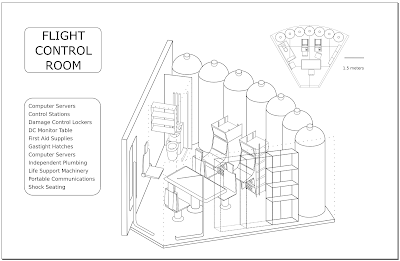
    

    The crew is divided into three Damage control parties, each with three crew assigned.  These DC parties operate out of three Flight Control Rooms (FCRs) dispersed around the spacecraft. These are called FCRs instead of DC central(s) because they also house the computers that fly and fight the ship in the same armored compartment. I chose three at first as an arbitrary reference back to Northshield's Triumvirate but kept it when I realized that with three FCRs, no single shot from an enemy could take out all three.

    Now, this only accounts for nine crew.  The other three are two are pilots for the ship's auxiliary craft and a Medic.  There are jump seats in the FCRs for these three, bringing their normal capacity to four crew.

   This arraignment was chosen to maximize choices.  Do the PCs all occupy a single FCR, or should they spread out?  Part of the procedures I'm developing will make where you are on the ship as its attacked important. All PC eggs in one basket may not be a good idea.
     
   So, that's the first two down, now for the hard part.  How do you run a starship unless someone's in charge?

    Turns out we have a template for this in the way pirate crews in the Caribbean operated during the 'golden age' of piracy.

    Before we move forward, lets set fire to some strawman arguments and get them out of the way:

  • I am fully aware that actually pirates were ruthless and amoral at best and sadistic psychopaths at worst.  They were declared hostis humani generis for a reason. That said, I figure that any system of governance that can keep The Enemies of All Mankind organized and effective will work even better for regular people.
  • Forget what you've seen in Pirates of the CaribbeanA Pirate Captain served at the sufferance of their crew and could be replaced at any time by a vote of no-confidence - no mutiny required.  The only time a Pirate Captain had absolute authority was during an actual battle. This is clearly laid out in the Ship's Articles.
    The 'Pirate' Model in Practice


What follows is a flight of fancy to give an idea of what I'm thinking of; a setting that supports the play style of TTRPGs, is functionally plausible, and keeps the focus of the Player Characters. 
 
    A group of starting PCs are on Mars.  They don't have a ship but may want one someday.  There's lots to do on Mars but our PCs want to get into space - there are other star systems out there and in the aftermath of the Alien Invasion and the Devastation of Earth we want our PCs to go out there and Aventure.
 
    There is no Academy or Government program for training spacers because there is no government per se - The Martian Consensus doesn't work that way.  That's fine though, because anyone who can live on Mars can live in space.  That's rapidly becoming Humanity's niche/stereotype in the galactic community - the people who live in space as opposed to a habitable planet.
 
    Anyway, there are ships in port and looking for crew and our PCs are at least marginally qualified.  The ships needing spacers will post their Articles for perusal online. These Articles may look similar but the devil is in the details.  The PCs choose which ships they want to consider based on these details.  

    Getting on a ship will involve some sort of interview and the signing of the Articles. This is a time when Friends can help, Favors can be called in, and all sorts of social interactions ensue. If a given ship is between cruises, the Articles may be up for amendment by the ship's company and any new crew, with all the back-and-forth, negotiations and intrigue that can entail.
 
    Once the PCs sign the Articles and are accepted as part of the ship's company, they would go through a process of learning similar to what NUBs on submarines go through earning their Dolphins.  The PCs will need to learn how the systems work and get qualified on each and every system before being fully accepted into the ship's company.  This doesn't have to be role-played or necessarily even rolled - in can be represented by learning the game's procedures for space travel, combat and damage control.
 
    As member's of the ship's company, the PCs have all the rights and responsibilities thereof. They can vote on all 'matters of the moment', get shares of profits, be consulted on what improvements to the ship they want, and what sort of jobs and missions the ship undertakes.  

    Perhaps most importantly to this topic of this post, the PCs will have the following rights as well:
  • They may call for a vote of no-confidence in the Captain's leadership at anytime the ship is not in direct or immanent danger.
  • They have a Mission Abort option, where the PCs my at anytime elect to call for a bug-out in battle to save the ship.  They may have to answer to the ship's company for using this option, but that will be after the fact.
  • They may stand for election to Caption or Quartermaster at any time the incumbents lose a vote of no-confidence. 
    I see these three rights as what will preserve player agency during space travel and combat.  
 
    The above Pirate Model relies heavily on social interactions at all levels by  adding NPC crew and removing the command hierarchy present in most if not all other models of space travel. Now persuasion, negotiation, and other social interactions are options for getting the ship to do what the PCs want. Railroading becomes a less viable option when the Captain can be voted out and a PC party forms a third of the crew.
 
    For a model that uses so many social interactions, we'll need a robust set of rules or procedures to accommodate them.  We'll discuss options for that in our next How you Play is What you Win post. 
 
    After that, we'll get down to some concrete game design.  Stay tuned.
 

Friday, March 24, 2017

Starships & Spacemen Examined: S&S, Triplanetary, and real Stars and Planets...

     To the left is (hopefully) the solution to my dilemma.  Rather than wax lyrical about how I came to arrive at my current notion, I'm just gonna hash it out for you.
     I'm ditching the FTL system in Starships & Spacemen and replacing it with my "Rabbithole" system.  If you don'l know what that is, I wrote a a whole article about it in LAUNCH WINDOW 0.5, so you can read about it there.  Go ahead, its Pay What You Want.
    In brief, Interstellar travel involves (will involve) seeking out naturally occurring wormholes in close orbit that link certain stars together.  These "Rabbitholes" are natural so the temporal/causal effects of using them are accounted for.  The causal effects of wormholes are fascinating and will make for cool fiction.  Currently, Dr. Luke Campbell is doing just that, and will do a better job that I ever could.
    Because we will be handling interstellar travel via wormhole, the movement rules for interstellar travel in S&S are invalidated.  This is a shame, as the Energy Point system/ Power Pile Base is one of the fun features of the game.  The solution I have to this is to Use the movement rules, modified a bit, in Interplanetary space.  This also has the advantage of letting use use Node Maps for the game and rest peacefully in the knowledge that our stars are real.
     Refining the movement system of Starships & Spacemen to work in interplanetary space will require a few extra steps and things. One, we have to account for orbital space, and gravity.  Two, some sort of Newtonian engine would be appreciated.  I mean, its hard to watch a Star Trek film where a ship loses power and stops, and sometimes even starts to sink.   Besides, I like the idea of watching starships go at in the frictionless black like a pair of hockey players with a grudge.
     Anyway, I don't fancy making my own movement system from scratch, so I plan on borrowing elements from the above shown game: GDW's Triplanetary.  As Winchell Chung put it on Project Rho, "This game has the One True way of managing vector movement in two dimensions." He's not the only person to day so, and I bow to superior mechanics. 
    Anyway, right now I'm thinking of the mechanics of S&S, and the vectors/gravity of Triplanetary for simulating orbits and stuff.  The system maps will be a lot easier to make than one would think.  Using Winch's Node Maps as a spring board, I can take the star names, pop them into Google, and see if the star has any planets and what their features are.  I will be a bit time consuming, but not especially hard...
  Anyway, that's what I've got so far, Rocketfans.  See you next week!

Wednesday, March 22, 2017

Starships & Spacemen Examined: I'm going to have to make my own setting, aren't I?


Ha!  Rhetorical question, Rocketfans - what else would I be doing?  It's not like I can leave anything alone...
      The deal breaker came with my examination of the FTL system.  It's a variation of the classic Trek/Alcubierre warp drive - which is bad enough, as warp drive has problems.  What's even more difficult for me to deal with is the speeds involved.  For an RPG it's perfect: Each warp factor is how many light years on the hex map you can travel in a day, and ships can travel between warp 1 and warp 8.  If you are a fan of The Original Series of the source material, that's between warp 7 and warp fourteen.  Needless to say, you can cover a lot of territory with that kind of drive.  At warp 8, Proxima b is only twelve hours away, and Gleise 581 is only 60.  The entirety of the Local Bubble would only take 50 days to cross - 200 light years, in less than two months.
     It's about here that I've always run into problems with SF RPGs: Maps of space. When you can travel across a wide swath of space in a short amount of time, it's easy to get to the planet of the week, but harder to maintain any sort of realism in your star mapping. While Game Design Workshop's 2300 AD is a unique exception, most games that obstensibly take place in our universe have star-maps that bare no similarities to observable reality.   S&S - like Traveller and Star Frontiers, doesn't even pretend to make accurate maps of the Milky Way and instead provide guidelines for making up star maps and even randomly generating stars and planets. That was fine in the 70s and even the 80s, when accurate star charts were hard to come by.  Since the advent of the Internet - and especially in the exoplanet discovery era of today, it becomes harder and harder for me to suspend disbelief.
Here, to be exact.
   Now, there are accurate star maps out there.  It would be a fairly easy if tedious task to add the know extra solar planets to them.  But making a star map of a large enough scale to be useful in Starships & Spacemen and shows accurate distances is nearly impossible.  Even if you projected the map onto a convienent wall or pool table or something, the sheer number of stars in a given volume of space (and the fact that they are stacked three-dimensionaly) make using the map in a game a daunting prospect and far from the relative simplicty of the S&S rules as written.  However, the movement system in the game tracks interstellar movement and gives you interplanetary for free - so it would appear that we have to have some sort of star-maps.
     There are, of course, star maps that reduce the nightmare of 3D or 21/2 D mapping into something that both has accurate distances and is easy to look at.  Node Maps are an easy method - it gives you the information you need without going into sensory overload.   That being said, Node Maps are also useless in the S&S game because they do not provide hexes to show interstellar movement.
    This is where I threw up my hands in despair. You can have accuracy, simplicity, or utility: Pick two.  I feel a psychological need for accuracy, and an intellectual need for simplicity, and an actual need for utility.   What am I to do.
     (sigh) Change the setting, of course.  I always seem to do that anyway.  But hey, that's what being a game designer is all about.
     Here's what I'm gonna do:  I will make a new system of starship movement and combat.  I will make deckplans for starships that use this new system.   I will also provide stats and such for Starships & Spacemen as written.  And White Star too - just to cover the whole SF OSR OGL alphabet soup.
     But stick with me on the new rules thing.  I have some ideas that may interest you.  We'll talk about them more on Friday.

Monday, March 20, 2017

Notes on an Alternate Starships & Spacemen/ White Star Setting...

     Working on some some for  the FTL post today...here are some notes for a new setting I've been working on:

The path of an officer in the Patrol Fleet begins at the Academy.  We will only discuss officers because there are no enlisted ratings in the Astronaut Corp.  An Astro begins their career at a Patrol Base nearest their homeworld or system.  This is often in orbit over their homeworld - or in the same orbit as their home station.  It is meant that no citizen of the League of Planets be too far from a Base and it’s attached Academy.
The Academy is a rather nebulous institution.  There is no main campus nor branches that may compete for the prestige of being The Academy - The Academy is an idea, spread among the stars along with the League and the Patrol Fleet itself.  There is no faculty, as a dedicated and separate group, that sit in their offices and ponder theory.  The underclasses are taught by the upperclasses, when not taught by computer, and the upperclasses by officers stationed at the Patrol Base or on the many, many ships in the Fleet.  The job of the Patrol and it’s Astronaut Corp is learned very much on the job.  It is different with Espos - the Espacier Corp learn at planetary and space based training camps the skills of soldiering.  Their officers - for there are enlisted ranks in the Espos - are taught what they cannot learn from Drill Instructors in the Patrol’s Academy system.
A cadet of the Patrol Fleet starts at the Base nearest home but will not stay there.  After two years of training and instructions often by other, more senior cadets, the underclass will transfer to a different Patrol Base, around another world as far from home as feasible.  This is part of the the most important training of the Patrol’s Astronauts in the view of the Planetary League: the cultivation of that cosmopolitan outlook that makes an Asto or Espo feel they are citizens of the League itself, not of an individual world, or even species.
The time in space transferring to a new Base Academy is far from idle.  The cadets travel by Battle Cruiser and Dreadnought and are given their first taste of life on a working ship of the Fleet.  These starships are not express liners - the Cadets may be months aboard ship, helping execute missions, do scientific research, and cross training in new specialities.  It is not unknown for a cadet on such a cruise to be breveted an officer by the end - especially during the War.  But even if the cadet arrives an Ensign to their new Base, they must finish their higher level training and help to educate the raw recruits that themselves are beginning their careers in the Patrol Fleet.
Another year or so of training and instruction by officers of the Patrol Base sees all Cadets commissioned or dismissed.  By now, the graduates have served with or at least met every major species in the League, learned at least one of their languages, and probably developed a taste for some other world’s music or food.  The Patrol encourages this - it is always easier to get leave on a world you’ve never visited than it is to one’s homeworld, barring family matters of course.
The newly minted Ensigns are then assigned to the Base’s staff - which includes the Base’s own flotilla of Frigates.  The Cruiser/Tender, rarely a front-line vessel anymore, becomes their first posting followed shortly by a stint on a Frigate.  Frigates may be commanded by Ensigns - the ones breveted during their Underclass cruise, anyway - and are nearly always crewed by officers no higher than rank than Sub-Lieutenant with perhaps a Lieutenant as Skipper while they wait for a Destroyer billet.  More often, the greenest Ensigns are stationed on the Cruiser, the more experienced and Sub-Lieutenants on the Frigates, and the Lieutenants serve as department heads on the Cruiser before moving on to the Destroyers or a true Cruiser of the Fleet.

The organization of the PATROL FLEET is telling. There are six major planetary civilizations (seven, counting Humans) and each of these are host to a Planetary Fleet.  Each of these fleets are made up predominantly of the native species.  The Martian Fleet is made up of Humans, the Banlishkoa Fleet of Talmachi, the Dramassi Fleet of Sloaak, and so on.  “Predominantly” means roughly 80% of each craft’s crew is made up of the natives .  
A Planetary Fleet is made up of a Dreadnought Squadron, two Battlecruiser Squadrons, four Cruiser Squadrons, and Eight Destroyer Squadrons.  It is based, predictably enough, at the largest Patrol Base in the home system of the fleet.
The Planetary Fleets are far from idle, however.  Not even the Batlecruisers or Dreadnoughts spend much time in port - the Fleets are almost constantly on the move between the major planets of the League.  The fleets make courtesy calls on the other founders’ planets, visit the colonies in their sphere of influence, and in general try to expose as many citizens of the Northern Lobe to as many different sophonts as possible.  And they, of course, patrol.
There are, in addition to the “big seven” fleets, Sixteen Numbered Fleets scattered around the four Quadrants of League space.  These are attached to the various numbered Patrol Bases, and are charged with patrolling and exploring the empty space within the Treaty Boundary.  Unlike the Planetary Fleets, the Numbered Fleets are fully integrated. Some ships in the Fleet have a predominant species, but this is a consideration of environment (it is easier to make an entire ship with consistent gravity and atmosphere).   In general, each six-vessel squadron has a ship featuring the ideal environment of one of the major species.
A Numbered Fleet consists of a Battlecruiser squadron, two Cruiser squadrons, four Destroyer Squadrons and eight Frigate squadrons.
In addition to these assets, the individual Patrol Bases have extra Frigates, organized into a Patrol squadron.  A Patrol Squadron includes two divisions of Frigates and a Cruiser/Tender.  Typically, one Division stays (relatively) close to the Patrol Base and engages in search and rescue work, fast response, and the routine transfer of personnel.  The tended division ranges farther afield, conducting planetary surveys, engaging in longer patrols, and conducting more specialized scientific research.

Wednesday, March 15, 2017

Starships & Spacemen Examined: The Power Pile Base, Energy Units, and You

   Author's Note: The rules mentioned below, unless otherwise specified, are the hard work of Daniel Proctol et al. at Goblinoid Games on the second edition of Starships & Spacemen
Yes, I use this pic a lot.  I happen to like it.


     Let's talk about the Power Pile Base.
     I've read multiple reviews, and the general consensus is the Power Pile Base and EU system in Starships & Spacemen is elegant and balanced mechanically.  In brief, each starship has a Power Pile Base, which is the number of Energy Units (EU) it can produce in a day.  Each major activity, such as maneuvering, going to warp, firing beam weapons and raising shields, costs a certain number of EU.  Damage in space combat or from hazards is taken our of a spacecraft's EU also.  As long as a ship only uses it's Power Pile Base's worth of EU per day, it gets its full amount EU back the next day.  If the spaceship uses more than it's Power Pile Base, it counts as damage and the ship loses those EU until repaired.   If a ship uses more EU (or takes more EU worth of damage than it's Power Pile Base, the ship is considered destroyed. It's sort of like Hit points and Wound points and Manna points all rolled into one.
    This is a good system for an RPG, as I've already said, but for a guy like me, that's not quite enough.  How would an engine system (and everything else system) work in the real world with those constraints?  Through careful research at my favorite SF Destination, mixing and matching capabilities of various real-world (or theoretical, anyway) engine designs, and all that jazz, I have come up with a plausible engine/reactor combo that mimics the details of the Power Pile Base system, right down to the allocations and damage ratings.
     ...More or less.
     Anyway, lets start with basics:  power.  If we don't want radiation and find Matter/Antimatter to be passe, then we're going to want to go with fusion.  Problem is, fusion is easy to theorize about, but hard to actually get to work.  It would be even harder to sustain a fusion reaction on a moving spaceship with people shooting at you.
     If we look at the top of Atomic Rocket's Engine List page,we can find hope..  Ignore the cat's surly manners (and it's to your advantage to do so), and notice the entry for "Magneto-Inertial Fusion"      Read up.  I'll wait.
     I am a fan of pulse propulsion systems.  They are the only plausible systems of propulsion that have both high thrust and high specific impulse - Torch Ships, in other words.  While the theorized M-IF engine isn't quite the that powerful, it's within the realm of SF possibilities, especially if you mess with inertia and gravity. Bonus points, the engine can provide electrical power and does not require radiators.
Now, you can notice it, too.
     Next, I notice the magnetic nozzle. This reminds me of the "Mini-Mag Orion" which uses z-pinch fusion also, and needs a huge amount of electrical power to start a reaction.  Once the nuking has happened, a small percentage of the reaction's energy is channeled into enormous banks of capacitors, more than enough to start a new reaction.
    Capacitors.  Banks of them.  They're like these units...full of energy...
    So we have a power system that can fill up a number of capacitors, and requires the use of a number of capacitors to work, and makes clean fusion reactions and not dirty atomic ones.    Good...good...
     The next items are the weapons and shield systems.  Really, these could get their own post, but I've decided to fold them into the PPB post because they both rely on Energy Units.  The weapons - simply called in-game "beam banks" and defensive screens are going to be covered by particle beams and magnetic fields.  And excellent case has been made for particle beams already, and they have the added bonus of looking and acting more like sci-fi lasers than real lasers do.  Magnetic shields are already a good idea as protectin from cosmic background radiation, solar flares, and in an emergency, aerobraking and atmospheric re-entry.  Particle beams have one addtional advantage - if necessary, the beam can be fired directly by the fusion reaction, without needing to use capacitors.  This ability reflects the rules' entries on using more EU than your Power Pile Base.
     Damage to the spacecraft is a wee bit trickier.  How do you reflect ship damage using simple EU values?   To be honest, I accepted that upon my first reading of the rules.  My assumption then was that the ship is taking no actual damage - the shields and inertial damping system are absorbing it all. As the power consumed surges through the system suddenly, capacitors burn out and you get electrical feedback that blows circuits, fries wires, and occasionally blows out a console (which apparantly is an actual thing).
    Anyhoo, that's all for now, RocketFans tune next time when we tackle FTL, Why S&S ships are so small, and why the decks are laid out wrong.  See you then!


Monday, March 13, 2017

Blame it on Rob-o

     Specifically, Rob Garitta, friend and sometime collaborator here at Blue Max Studios.  He mentioned our previous work on the Starships& Spacemen game and I rather woefully lamented not having completed any of the projects I wanted to for that game.

  It was a rather lengthy list. I was going to make variants of all the major ship classes for the game, from Frigate to Dreadnought, make enemy spacecraft - even an adventure/setting.  I never did anything with it, in part because I got bogged down in tying to make a spacecraft design that made sense in light of the games rules on Energy Units and their distribution.

    I will respectfully decline to discuss the Shuttle Ship situation at this time.

    Once again, Ilove the game Starships & Spacemen OSR Star Trek? Sign me up!  Nevertheless, the Power Pile Base system gave me pause when trying to design spacecraft.  And so did the Teleporter.  And the way the decks are laid out like boats and not rockets.  And the dang shuttle ships.

    This was about a week ago now, when I was talking to Rob.  Since then, I've been thinking about these problems with the focus and intensity of...well, of a middle-aged autistic man who likes spaceships.  I have therefore managed, thanks to past experience, the Atomic Rockets website, and lots of graph paper, to resolve of these issues to my own satisfaction.  Over this week (at the least) I will outline my findings and developments.  Some of this takes the form of deckplans or schematics.  some will take the form on nano-fic set in my own private S&S universe.  All will be awesome.  Please stay tuned...

Friday, June 24, 2016

Mini Maps: Ceres Class Frigate

This is a collection of maps and designs I've shown off here and there, but never, I think, all in one place.  The Ceres-class Frigate is designed to fit the stats published in Starships &Spacemen 2e, pg. 45.  So here we are: spaceship.  Enjoy!

Exterior orthos
Perspective of the landed Ceres
The gravity is a little odd: it uses the artificial gravity field as an inertal compensator.  That's why it lands upside down.


The larger of the two decks houses the Bridge, torpedo room, beam bank control, shuttle bay, arboretums, and the crew quarters, teleporter, sickbay, main airlock, galley, brig...just about everything, really.

The second deck contains the water tanks,life support, labs, computer core, fabricators, escape pods, and of course, the landing legs and machinery.


Friday, May 27, 2016

5 Ways you can Add Factions to your Starship Campaign

     And now for something completely different, an article that is actually on Science Fiction Gaming!

     One of my dreams is to be able to run a mega-dungeon based on a gigantic starship, such as the classic mile-long dreadnought .  The allure is obvious - Starships are inherently awesome, and mega-dungeons IN SPAAACE! are even more so.  What's not to love, right?

     In practice, running an adventure that takes place inside a starship for more than a session or to can get monotonous in a hurry.  There are many reasons for this.  The compartments can be too similar to provide exciting exploration, for one thing.  A look at the standing set for the original starship Enterprise is a perfect example - the entire ship could shown by building a single stateroom, corridor, and briefing room. Another problem with Starship-as-Dungeon is the enemy-to-ally ratio.  Basically, either you're an invading force on the ship, in which case everyone is against you, or you're part of the ship's crew, in which case everyone is on your side.  Many of the classic scenarios for big-ship dungeon crawls involve boarding actions, with results ranging from the heroically unrealistic to the suicidally plausible.  And neither add that secret ingredient to the dungeon that spices up multi-session play:  Factions.

     From the Caves of Chaos in one of the earliest B/X modules to the most recent mega-delves of the OSR, big dungeons have multiple factions for the players to interact with.  These faction are often uneasy allies at best, and openly at war often enough for enterprising parties to pit against one another.  the concept of factions breathes life into a dungeon by introducing multiple agendas, points of view, and - most importantly - multiple varieties of reactions to strangers.

An example:  Say you're playing a fantasy game and are ass-deep in some dungeon and run into a pair of Orcs.  If you're playing in a dynamic setting with multiple factions you don't know what the Orcs will do. Sure, they'll probably attack, but it's possible you can bargain with them, bribe them, trade with them make a deal to gang up on the Drow in the next level - much, much more than just hit-with-sword and repeat.  When you run into a pair of Stormtroopers on Deck forty-seven, they will probably react the same way as the troopers on deck twelve.

For obvious reasons...

    With all this in mind, I have assembled a list of five suggestions to add extra factions to an otherwise monotonous starship crawl:

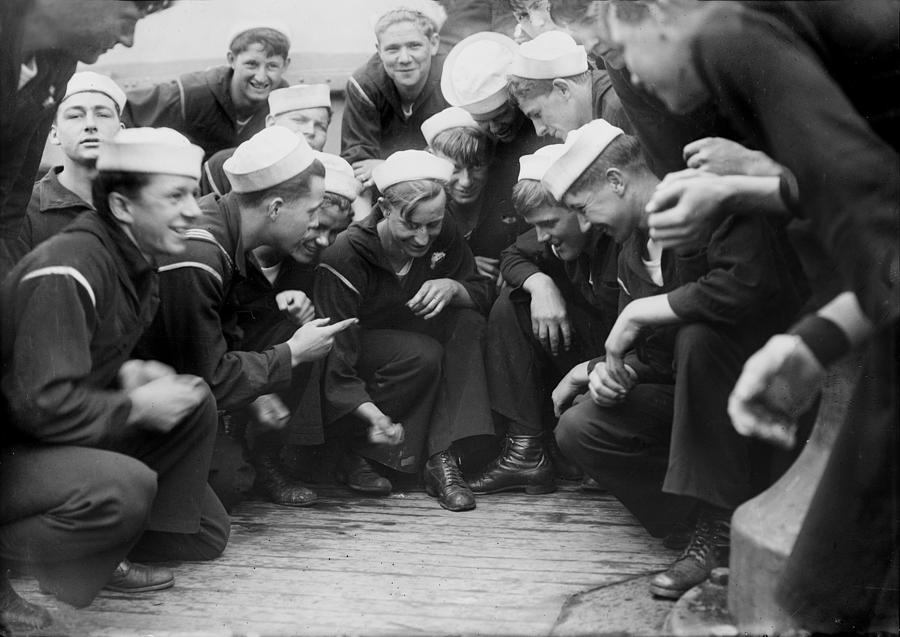
How much extra duty for beating the XO at craps?
1. "Criminal" Elements: This could be as benign as a floating craps game played by lowly ratings, to the production of engine room hooch, to the guy on deck nine that can get anything you need, even after months in space.  This faction is not anti-establishment per se, but  they are motivated by a strong desire to not get caught, and this can be use to a party's advantage.  The criminal element are also useful for getting one's hands on illicit items - anything form pin-up holos to the contents of the captain's safe, depending on how corrupt the system is.  Likewise, the criminal element may be restricted to that one rating that get busted down to able spacer for smuggling contraband every time they get a promotion , to the ships supply officer, to the CO.


Clockwise from top: plain-crazy actor, diplomat/assassin,
military-hating scientist family member, military-hating scientist
space hippy, and rescued con-man.
2. Passengers: Star Trek has used this faction to great effect since the first season of the Original series.  Actors, foreign dignitaries, scientist that despise the military, and space hippies all give GMs an opportunity to introduce conflict on their otherwise well running starships. Such visitors outside of the chain of command allow for interactions not normally permitted in military or quasi-military organizations, namely fraternization.  If your party is more into violence than sex, the introduction of any unknown group allows for the injection of spies, saboteurs, assassins and the just plain crazy.  Family members of the crew - especially PCs, make for interesting visitors.  Finally, rescued spacers have any of a number of different backgrounds, from honest folks to con men.  The nice thing about bringing groups of new people aboard your ship is that the PCs never know what they're going to get.  The disadvantage is that the PCs will automatically assume - quite reasonably - that the new people are where the plot/adventure is. 


Pictured:  The Death Star's
Political Officer
3. The Political Officer:  The Political Officer is a real-world crew position used in the naval forces of totalitarian forces to insure that the military is firmly under civilian control.  They make sure that the captain toes the party line, the officers are shining examples of party orthodoxy, and the crew isn't poisoned by such toxic memes as "sense of adventure" and "fun".  Obviously, the Political Officer is almost universally hated by all aboard.  Many depictions of Polits show the frustration of Naval personnel with advanced tactical training having to justify their actions to a bureaucrat with little or no military training.  This is not always the case, however.
    The advantage of there being a Political Officer on a ship you're infiltrating is that pretty much everyone hate them, from the Captain on down. Their fear of the Political Officer is probably strong enough to counteract that hate.  A well connected Political Officer can have you arrested court-marshaled, imprisoned, executed, and could even go after your family.  The biggest obstacle for a party when faced with a Political Officer is that they are pretty much exactly the people the Polit is trying to ferret out.  They are as a general rule as suspicious as they are arrogant, and when you have one like the guy on the left, they may be able to read the treason in your mind.


But IN SPAAACE!
4.Mutineers: This is arguably the easiest way to introduce different factions into a starship-based campaign, because it...introduces factions into a starship.  It kinda really is that simple - a faction of the crew, often led by a senior officer but not always, is engaged in a conspiracy to take over the ship.  They may wish to kill or maroon the loyalists, they may be switching side in a civil war, taking sides in a coup, or turning pirate or privateer.       Campaigns have already been built out of the idea of having mutineers aboard ship, but the sheer variety of ways you can use this idea in new ways warrants inclusion on this list.  For example, what if a part of the crew were possessed by alien parasites? A religious conversion of a senior officer to a sect that is against the established political system could lead to a mutiny.  The instability of the commanding officer, who is a high-ranking noble, could require drastic measure to contain.  I could go on, but I'm sure all of you could too.  A mutiny could lead the ship dead in space, unable to call for help - and then the game become one of survival as the warring factions fight over the engineers need to repair the ship, even going so far was to kill them and sabotage the repairs in order to prevent the vessel from falling into the wrong hands.
     One final thought about mutinies.  In setting where many if not most of the crew are conscripts, expect a third faction of spacers who will sit out the mutiny, waiting to see who prevails.  While they may not enjoy life in the Navy, the punishment for mutiny - death - is enough of a deterrent to prevent many from joining the mutineers.  Getting the support of this "swing vote" could be the key to a mutiny's success or failure.

Pictured right:  Admiral Rittenh -uh, Marcus
5. Coup: Our final way of adding new and interesting factions into a starship-based campaign is to stage a coup.  Similar to the mutiny, a coup is when the ship's commander, or someone possibly higher up, decides to overthrow the entire government or possibly strike out on their own to form a new star nation with a sizable portion of the Fleet.  Realistically, a military junta taking over a civilian government is the number one danger facing most nations with a strong military in the world today.  Unlike mutinies, which are often bottom-up affairs, many of which are spontaneous, a coup attempt is usually the result of long term conspiracy and is instigated be senior and command officers.  These officers have an advantage on their assigned ships - being in charge, their orders are often unquestioned and their rank affords a level of privacy that crew do not enjoy.
    An excellent example of the coup used in a science fiction setting is the Star Trek novel Dreadnaut! In this novel, Starfleet Admiral Rittenhouse is in charge of the construction of the titular ship class, which he and a small fleet of co-conspirators intend to use to start a war with the Klingon Empire and take control of the Federation "for the duration of the emergency". If this sounds familiar, it was shameless ripped off to for half of the Frankenstein plot of Star Trek: Into Darkness. The movie borrowed so heavily form the novel, that the crew of the USS Vengence even have their own uniforms instead of Starfleet ones, just like in the book.
     Don't get me started.

     While it is certainly possible to run a mega-dungeon in an O'Neil Cylinder or a large passenger ship (I'll cover both in a future post).  Not all of us want that.  For myself, I wanna run a campaign in an actual, military starship, the bigger the better.  I have plans on how to map one, and I intend to map smaller capital ships as well.  It's been an axiom of strategic thinking since the dawn of dawning that knowing your terrain is key to victory.  That's one of the reasons why I want to see starships become more than plot devices or abstract locations.  I want to see them become more real. See them come alive.

      Anyway, RocketFans, I hope you enjoys this list, and I look foward to writing more game-based articles in the future.  Enjoy!


Tuesday, May 24, 2016

New Feature: Mini Maps

I started drawing these on a lark and the response has been more enthusiastic that I could have imagined.  So, for the benefit of everyone not following me on Google + (and really, why aren't you :)) I decided to put these on the blog.  These are sci-fi geomorphs, inspired by our Star Trek discussions of the last few days, and there are more to come.  There will even be, due to popular demand, versions for sale that include colored maps, blank maps (walls and doors only) and battle-damaged maps.  Enjoy!
Bridge and surrounds

First color pass of a B&W map.
I usually start and finish in color, so this in encouraging.

Block of Crew Quarters, two single staterooms share a central bath.

Deck one of our Jovian-class frigate for Starships and Spacemen

Labs, for to do SCIENCE!

People guessed that these were anything from nightclub dancefloors
to power stations to brigs before I filled in all the details.
But no, it's a pair of Teleporter rooms with attached Decon chambers.

Tuesday, September 1, 2015

The ABCs of Space Opera Released!

98 pages of AWESOME.
Here it is, RocketFans, our first offering in two years!  Coming in at 98 pages, this is also easily the longest book we've ever published. It is twice the size of our next longest book, The Pumpkin-Suit Manual, if that tells you anything.  That's one of the reasons it's a two volume set - after all, it wouldn't do to have a third-party suppliment be longer than the core-book, would it?   Honestly though, we needed the space.  Inside you'll find four new playable races, an entire new class of alien menace, and a new type of spacecraft.  There are also new rules for beam weapons, shields, hybrids and a ton of random tables.   It's ten dollars by itself, but if you want it and all the other stuff we've and all of our future books as well, you can go to our Patreon page and pledge $5.00.  Your choice.

Speaking of which, our Patreon account reached it's first milestone yesterday!  In addition to giving me and my family a much-needed infusion of funds, the reaching of this goal will allow me to upgrade my hardware and software, so the next books we put out should be even better!

You may be wondering, in a rhetorical sort of way, what's next for Blue Max Studios.  Obviously, The ABCs of Space Opera, Volume 2: M-Z are on the horizon.  There are also a lot of ships in the S&S Universe that are just crying out for deckplans.  That being said, I have some other ideas for OSR and D6 suppliments that I'll be talking about in a day or two.  But for right now...I'm taking a day to just enjoy the happy feeling of being back in the game of Gaming again.  See you later!

Thursday, August 13, 2015

That 60s Space Opera Chic

Here we are again, RocketFans, rapidly approaching our September 1st deadline for The ABCs of Space Opera, Vol. 1.  Fortunately, the work is going smoothly, with the main chore at this point being final editing.  I expect no problems.

One of the reasons this project is going so smoothly now is the long lead time involved.  The beginnings of this book were discussed way back in May, after I mentioned to Rob  that he should be writing Starships & Spacemen stuff.  Since Blue Max Studios already had a license to do so, It just seemed easier to hire him to write the stuff I wanted to read.  Of course, by doing so I've saddled myself with the chore of making the books fit into the Blue Max Studios design family of books while at the same time breaking new ground in production design.  Again.

I had a similar problem task back in 2011, when working on our Ships of the Galaxy line. Just as the galaxy far, far away has its own unique look, the final frontier has an iconic look that sets it apart.  Especially from my library of existing production designs for the Hard SF peri-Singularity setting Black Desert.  To make matter worse more complicated, I'm not only making a production design for this book, but for any and all future books we write for Starships & Spacemen.

No pressure.

The look of the original Star Trek, what I'm dubbing "that 60s Space Opera Chic", is certainly different from the work I've done before.  For one thing, the next time you watch an episode TOS, assuming you do, take a good look at the color scheme.  There's no blue. Except for the shirts on the science department, the color blue is apparently missing from Star Trek's original color palette.  Those of you who are familiar with my work know that blue is a big part of it.  Heck, we are Blue Max Studios, after all.  The colors are more in the "traffic light" range of the spectrum, with yellow dominating, red secondary, and green an accent.  Background colors are grey mostly, except for computer consoles and other tech tools, which are uniformly black. 

But that's just the colors - there's the whole interface scheme to worry about as well.  By that I mean the way the information looks on all those computer monitors.  Of course, in the original series of Star Trek, there was no information on those displays, just flashing lights.  But a couple of years back, CBS studios released a digitally enhanced version of the show, with a CGI Enterprise, realistic looking planets, and computer displays that had actual information on them. With this new resource as an inspiration, and a lot of experimentation, I finally nailed down a look for our S&S product line that is evocative of Old Skool Trek and easy to produce and layout in for PDFs.  Below is an example of how it all comes together, in the form of an actual image from The ABCs of Space Opera Vol. 1.  This image also exemplifies the sort of tongue-in-cheek look homage to the source material we've been aiming for.  Hope you enjoy.

By Blue Yellow Max Studios

Thursday, August 6, 2015

Publishing Date Announced!

That's right, RocketFans, work has continued at a feverish pace to the point that I can confidently announce a publication date for our next book, The ABCs of Space Opera Vol. 1: A-L.  The volume will be available for sale on September 1st.  Our asking price will be $10.00.  The price is higher than most of our offerings, but the length is a lot longer- we're looking at 104 so far, and that's before the technical stuff and forward and contents page.  In other words, over of hundred pages of content.

Of course, my $5.00 Patrons on Paetron get this book at no charge.  Along with the previous 22 books, and all future books.  It's what you call a bargain.

The remainder of the month we, will be focusing on the book and showing off previews and exerts.  After that, we'll return to Tugs and other topics as I furiously work on the next book.  But for now, enjoy!

Fear my giant head!

Google+