Showing posts with label Crew as Damage Control RPG. Show all posts

Wednesday, March 2, 2022

Project NEPTUNE: Making the Procedures Universal

Faci-NOPE.
    More than any other genre I'm aware of, Science Fiction is defined by it's technology.  For example, the difference between Clash of the Titans and Lord of the Rings is to my mind less than the difference between Star Trek and Star Wars.  And both of those have almost nothing in common with The Expanse.

    This is relevant to game design because I could run a game set in Middle Earth or Mythic Greece using D&D with no real problems.  I could not run Star Wars using Star Trek RPG rules or vice versa. Warp Drive, Transporters, Lightsabers, The Force - I would spend enough time in conversions from one system to the other that I may as well just get both games.

    While there are more universal SF RPGs out there (and GURPS, of course) this usually puts the problem on the GM.  Systems such as STAR HERO for example make it possible to build virtually anything you can imagine - at the expense of having to build everything you imagine.  This kind of time sink can be more intensive than actually learning multiple game systems and encourage GMs to purchase multiple games.

    I intend to address both problems.

Yes, I know what it means.
  

    The inspiration for this part of Project NEPTUNE comes from the same place I get most of my inspiration: Winchell Chung's Project Rho.  While most famous among SF aficionados for Atomic Rockets,  Chung's Project Rho has other treasures for those who seek them.  Two of those treasures are going to be the key to making space travel and combat interesting, full of player agency, easy for GMs to prep and run, and useful across multiple franchises.

INFLUENCE DIAGRAMS

    Project Rho has a whole section on cool game mechanics that bares careful study. Among them is a single article by Neel Krishnaswami that can, as of 2022, only be found on Project Rho.  I'll give a high pass of what's important for us here, but the full article is excellent and I lament there was no follow up.

    Seriously, go read it.

    The example in the article addresses Star Trek in particular but the core idea applies to any technology. By breaking down a SF tech like warp drive or what have you into individual systems or components, you can build a causal influence diagram that gives the player details that actually matter.  This can be presented as a handout (or card) to the players and used by character to repair tech, work with tech and generally make the tech more real at the table.

    Since I'm working on the idea of Crew as Damage Control, I'm naturally drawn to this notion.
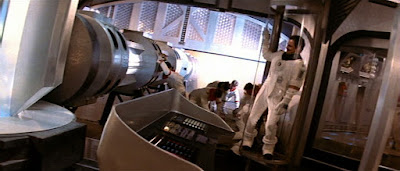
The rules for this -

    What makes this work across multiple franchises is that the procedure of using the Causal Influence Diagram is universal while the tech itself is modular.  For example, If I were playing a Star Trek style game, I'd want a CID of a warp drive.  It would have bubbles like Matter/Antimatter containment, Warp Core, Plasma Conduits and Warp Coils.  My Engineer character would use that to troubleshoot damage and tell the captain that She cannae take much more o' this.
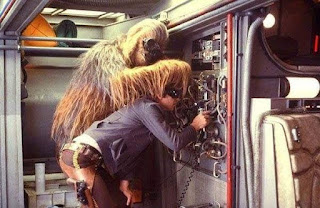
- are the same as the rules for this.
    If I'm playing a smuggler in a Star Wars style game, I'd want my CID to have Hypermatter Coaxium Magic bottles, a Fusion Reactor, Hyperdrive Motivator and Field Guides.  I may not know what any of that stuff means but they're on the diagram and I can use them because the procedure of using the diagram is the same no matter what SF tech I'm modelling.

    So when folks on Twitter ask me if the work I'm doing on space travel and combat can apply to their favorite game, I can say with confidence that yes, yes it will. 

    Using the Analog Database makes this work even better.   Any ship system, from any franchise can not only be diagrammed, but the cards stored in the same stacks and simply filtered by search term.  Packaged and sold individually, a deckof cards inspired by a given franshise could contain the tech, character backgrounds, and unique rules required to fully use the setting without needing an entirely new game.

BEYOND TECH

    I found another article on Project Rho that brings home to me the potential of this idea.  Ron Edward's The Sorcerer's Soul was also praised for it's use of relationship maps.   I got a copy of the book and perused that section - it didn't take me long to realize that Relationship Maps and Causal Influence Diagrams can be considered the same thing.

    So if CIDs can be used for physical objects and networks, and also for social relationships and people, could it also be used for ideas or intellectual pursuits?  Justin Alexander has pretty much proven it can - and provided excellent advice on how to use them as well.

    For me this means that not only can the conflict rules in SACRIFICES be used for physical, mental and social conflicts, CIDs can be used for physical, mental and social networks as well

    The system would be unified across all three attributes - which means it's unified across the entire game.  Across any game I want to make.

Still know what it means.
    More to come next week.


Wednesday, February 2, 2022

Crew as Damage Conrol II: Acronyms & Anarchy

    Last week we started to address the problem with space travel and combat in RPGs by addressing the "tactical mini-game" sequence most TTPRGs seem to use.   The reasons for the mini-game approach as I see it are as follows: 


  • First you have the hobby’s wargame origins, which can be exacerbated by RPGs with board game tie-ins. 
  • SF games that are licensed from or inspired by movies and television. These games attempt to model the epic eye-candy of space battles on the macro-scale. 
  • A simulationist approach to the game that requires specialized rules to resolve a spacecraft in a vacuum (or any vehicle) as a different system from characters in a dungeon (or whatever).
    I have a hard time avoiding those last two as I am very much inspired by SF media and am a spaceship nerd that wants to show off.  I resist these urges by keeping in mind that RPGs are Different. 


A Unicorn, if you will.

   
RPGs are a special animal in ways that are hard to define. After years of playing (and decades of not playing),  I can't say that I'm any closer to determining what set of traits make specific games or campaigns fun in general,but I remember the legendary ones I've run or played in.  The ones that I still think about. They had two things in common:
 

  • The plot was a situation - either by design or as the supposed plot disintegrated. 
  • Players' were allowed to plan, discuss and engage with the world and one another.
  • Player's took initiative.

    That's what I want in Project NEPTUNE.  My friends, family and fellow players gathered around discussing the situation and what they can do about it. I have seen genius there, and engagement. I wanna encourage that.

    In my proposal that all characters are Damage Control on a starship creates that situation. The anticipation of an upcoming combat or hazard provides opportunities for planning and engagement, even if the characters don’t have space-faring skills. Player Characters have an entire spacecraft's worth of resources to utilize in their planning.  

    Now we have to get organized.

ACRONYMS & ANARCHY

    In my Damage control model, I'm using a few arbitrary assumptions:

  • Consideration for a game group's average size of 2-4 players
  • Finally finally dealing with my unresolved love-hate relationship with the Frigate design in Starships & Spacemen 2nd Edition which assigns a crew of ten to a starship.
  • No built-in Hierarchy that puts one PC or NPC in charge. 
     The first two are the easy ones.
 
    The first starship officially designed for Project NEPTUNE is the Ultra Light Cruiser.  It has a crew of twelve and is the smallest (reusable) starship fitted with a warp drive.  
    

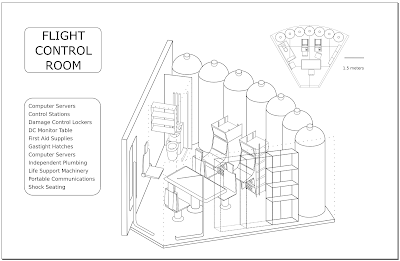
    The crew is divided into three Damage control parties, each with three crew assigned.  These DC parties operate out of three Flight Control Rooms (FCRs) dispersed around the spacecraft. These are called FCRs instead of DC central(s) because they also house the computers that fly and fight the ship in the same armored compartment. I chose three at first as an arbitrary reference back to Northshield's Triumvirate but kept it when I realized that with three FCRs, no single shot from an enemy could take out all three.

    Now, this only accounts for nine crew.  The other three are two are pilots for the ship's auxiliary craft and a Medic.  There are jump seats in the FCRs for these three, bringing their normal capacity to four crew.

   This arraignment was chosen to maximize choices.  Do the PCs all occupy a single FCR, or should they spread out?  Part of the procedures I'm developing will make where you are on the ship as its attacked important. All PC eggs in one basket may not be a good idea.
     
   So, that's the first two down, now for the hard part.  How do you run a starship unless someone's in charge?

    Turns out we have a template for this in the way pirate crews in the Caribbean operated during the 'golden age' of piracy.

    Before we move forward, lets set fire to some strawman arguments and get them out of the way:

  • I am fully aware that actually pirates were ruthless and amoral at best and sadistic psychopaths at worst.  They were declared hostis humani generis for a reason. That said, I figure that any system of governance that can keep The Enemies of All Mankind organized and effective will work even better for regular people.
  • Forget what you've seen in Pirates of the CaribbeanA Pirate Captain served at the sufferance of their crew and could be replaced at any time by a vote of no-confidence - no mutiny required.  The only time a Pirate Captain had absolute authority was during an actual battle. This is clearly laid out in the Ship's Articles.
    The 'Pirate' Model in Practice


What follows is a flight of fancy to give an idea of what I'm thinking of; a setting that supports the play style of TTRPGs, is functionally plausible, and keeps the focus of the Player Characters. 
 
    A group of starting PCs are on Mars.  They don't have a ship but may want one someday.  There's lots to do on Mars but our PCs want to get into space - there are other star systems out there and in the aftermath of the Alien Invasion and the Devastation of Earth we want our PCs to go out there and Aventure.
 
    There is no Academy or Government program for training spacers because there is no government per se - The Martian Consensus doesn't work that way.  That's fine though, because anyone who can live on Mars can live in space.  That's rapidly becoming Humanity's niche/stereotype in the galactic community - the people who live in space as opposed to a habitable planet.
 
    Anyway, there are ships in port and looking for crew and our PCs are at least marginally qualified.  The ships needing spacers will post their Articles for perusal online. These Articles may look similar but the devil is in the details.  The PCs choose which ships they want to consider based on these details.  

    Getting on a ship will involve some sort of interview and the signing of the Articles. This is a time when Friends can help, Favors can be called in, and all sorts of social interactions ensue. If a given ship is between cruises, the Articles may be up for amendment by the ship's company and any new crew, with all the back-and-forth, negotiations and intrigue that can entail.
 
    Once the PCs sign the Articles and are accepted as part of the ship's company, they would go through a process of learning similar to what NUBs on submarines go through earning their Dolphins.  The PCs will need to learn how the systems work and get qualified on each and every system before being fully accepted into the ship's company.  This doesn't have to be role-played or necessarily even rolled - in can be represented by learning the game's procedures for space travel, combat and damage control.
 
    As member's of the ship's company, the PCs have all the rights and responsibilities thereof. They can vote on all 'matters of the moment', get shares of profits, be consulted on what improvements to the ship they want, and what sort of jobs and missions the ship undertakes.  

    Perhaps most importantly to this topic of this post, the PCs will have the following rights as well:
  • They may call for a vote of no-confidence in the Captain's leadership at anytime the ship is not in direct or immanent danger.
  • They have a Mission Abort option, where the PCs my at anytime elect to call for a bug-out in battle to save the ship.  They may have to answer to the ship's company for using this option, but that will be after the fact.
  • They may stand for election to Caption or Quartermaster at any time the incumbents lose a vote of no-confidence. 
    I see these three rights as what will preserve player agency during space travel and combat.  
 
    The above Pirate Model relies heavily on social interactions at all levels by  adding NPC crew and removing the command hierarchy present in most if not all other models of space travel. Now persuasion, negotiation, and other social interactions are options for getting the ship to do what the PCs want. Railroading becomes a less viable option when the Captain can be voted out and a PC party forms a third of the crew.
 
    For a model that uses so many social interactions, we'll need a robust set of rules or procedures to accommodate them.  We'll discuss options for that in our next How you Play is What you Win post. 
 
    After that, we'll get down to some concrete game design.  Stay tuned.
 

Wednesday, January 26, 2022

Project NEPTUNE Part II: Crew as Damage Control

 
Made with Daz 3d, Bryce and GIMP
  
As we said last week, space combat in RPGs is generally a pain.
This is one of the reasons I started designing my own SF RPG as soon as I discovered my favorite rules system was now OGL.

     Part of that effort, the Black Desert Project, led to my series of blog posts about Crew as Mission Control. The premise being that given the way computers have advanced, the crew of a realistic spacecraft will not be occupied by actually flying or fighting the ship - they will be there to monitor, manage, and direct the various Computer networks. It became the most popular series of posts in this blog's history and has stood as my humble contribution to Hard Science FictionTM.

    I stand by that series. I am convinced that it's the best way to include people on spacecraft in Hard Science Fiction. I would love to see the Mission Control model used in novels, television and movies.

     I'm equally convinced that as far as Role-Playing Games are concerned, the Mission Control Model does not work.

    As much as I like the idea of Crew as Mission Control, it still does not address the necessity of a Tactical Mini-game to resolve space travel and combat at the table.  The players are still locked into using a different set of rules and different skills and are still robbed of agency by putting them all in a tin can with few chances to make meaningful decisions.    

    What I’ve come to desire is a space travel and combat system that keeps the focus 100% on the Player Character scale. PCs - their goals, skills and opportunities, and most importantly agency - should always be the focus of a role-playing game. This is what inspired my take on the idea of “Starship as Dungeon”.

    Starship as Dungeon”, however, runs into problems with the types of scenarios it can support. The classic “Bug Hunt” trope exemplified in the movie Aliens is perfect for Starship as Dungeon, but what about other tropes? How can Starship as Dungeon be used in a free-trader campaign? Or what if you want to actually have space combat between Fleets- how do you keep the rules for that type of scenario from taking the focus away from the Player Characters?

    Like the title says, Crew as Damage Control.

  This is far from a new idea, as we see examples dating back at least to the 70s in stories such as Northshield’s Triumvirate. In this concept, the computers on a spacecraft do all the actual flying and fighting, since they can do so faster and more accurately that people can. Organic crews exist to maintain and repair the various systems of a spacecraft. We also see it used the classic The Mote in God's Eye.


This wasn't a game.
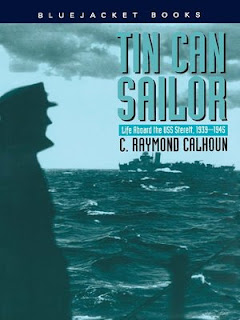
 In studying first-person accounts of naval battles, particularly memoirs from the Pacific theater of WWII, we see some great examples of the "player focused" perspective. The sailors, soldiers and marines who recall those iconic battles do not do so the way we're shown in films or other fiction - which is the point of view most licensed RPGs try to capture. As much as I like to watch SF media, the cinematic spectacle is not best seen from the table top.

    The people who actually fought and survived major naval actions in the bowels of their ships recall their own personal viewpoints which are focused on their immediate situation. Often, this can be just trying to keep their ship afloat. They usually didn’t know what is going on with the battle, whether they are winning or losing, or how much damage the ship had sustained. 

    In other words, the ships these people are on became a hostile environment of rupturing steam pipes, flooding compartments, shrapnel, and darkness. A Dungeon.

    This point of view, the completely personal perspective, is one that can be used in a Player Character-focused RPG.

    At first blush, this may sound like a railroad waiting to happen. Without command level decisions to make, can the Players truly be masters of their own destiny? To this as ask a question in return: Can players whose characters are optimized for non-space travel skills be said to have any more control over the ship that they are on? 

    This is a big complaint about space travel and combat systems I have heard at my tables; that there’s nothing for most characters to do. In the Crew as Damage Control concept, everyone has something to do, even if Character’s actions revolve around survival while the ship they’re on falls apart around them. Survival in a hostile environment may be stressful, but it's still PC-focused, which is the goal.

       With Crew as Damage Control, the aftermath of a space battle is where Characters really get to shine. Their ship is now a dungeon in fact, full of hazards like decompression, ruptured tanks, radiation leaks, boarding hostiles, and more. Navigating this kind of environment is challenging enough; repairing the damage is even more so. One thing I’d love to see is a party of PCs scavenging the wrecks of other spacecraft or nearby asteroids for supplies to repair their ship. 

    That's Character focused play.

    Admittedly, this perspective is still focused on combat, which is only one small facet of space travel. Other character-focused scenarios are possible. Space is full of hazards that must be overcome, from debris strikes to solar flares to mechanical failures. There can also be passengers, mysteries, and more in a space-faring location. As long as the action is focused on the Players and their Characters, the focus is where it should be.

    More to come on this topic.


Google+