Showing posts with label Sci-Fi. Show all posts

Wednesday, March 9, 2022

More on Anti-Canon: Ways to Imply a Setting

    The other day on Twitter the question was asked: "When world building, what do you start with?"  My answer was probably obvious to anyone who has read my blog.

    I start with a spaceship. I am a spaceship nerd. 
Pictured: My Spirit animal


   Then I start thinking about how it would work, the technology it'd need and what that implies for population and education and what else that technology would be used for beside spaceships and how many people must live in space for spaceships to be this common or rare and how long it'd take to develop that technology -

    Spaceships may operate in a vacuum but they aren't designed, built or maintained in one. Even if they were, every aspect of their being is dependent on a cascade of technological assumptions.  Last week we discussed how this makes designing rules for more than one franchise difficult. This week, we'll take advantage of this to imply setting in an anti-canonical game.

    One idea I'm using to imply my idea of a setting but not making it canon is stolen borrowed once again from Electric Bastionland. A large section of that game involves Failed Careers - what your character was doing before losing it all, getting in debt and becoming a treasure hunter.
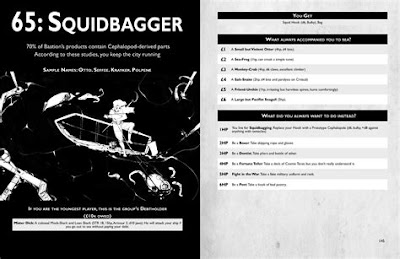
 

What does "Squidbagger" say about a setting?
     

    I am not including d100 failed careers but I am using a similar concept in Character Pasts.  In our Project NEPTUNE rules set a Character Past will be include a Character card (3x5) a resource card (2.5x3.5 trading card) and condition card (also trading card).  Let's look at one of the cards and see how it helps imply a setting:
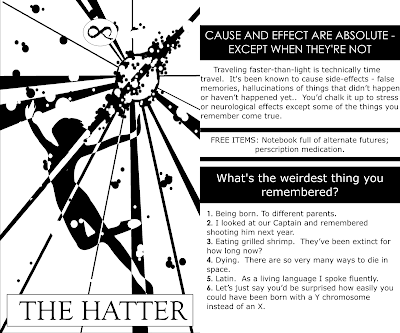
     

Front and back, with room for notches.

      If you'll open the image above and read the card, you'll find quite a bit of implied setting:

  • There's the name itself: This is a setting that includes Earth and Alice's Adventures in Wonderland is still a known IP.
  • The setting is Hard SF. FTL = Time travel is the understanding of current physics.  Actually using that as a potential plot point says that implications normally ignored in science fiction will be explored - or at least played with.
  • The setting is going to deal with mental issues. And they are still somewhat stigmatized. False memories, hallucinations, or actual memories?  You get prescription meds either way. 
  • This setting can get dark. Remembering killing someone? Remembering dying? Shrimp are extinct?

     Some of the other Pasts I'm working on include:

  • THE RELATOR: Psychiatrists for Artificial Intelligences.
  • THE CHRONOI: People from Saturn - complete with wind chimes. 
  • SANTA'S HELPER: means the setting has Santa Claus Machines
  • THE WALKER: The Rainbow Road of Mars is marked with the multi-colored spacesuits of those that died walking it.  It's become something of a religion.


   So there are a lot of setting elements here, but only if they interest you.  This is all on a single index card.  Use it if you want and if not, put it back into the stack and forget about it.  And even if you choose to use a Past card, it's not a wall-of-text info-dump because there's a finite amount of space on the card, and that's all I get to sell you on the concept.

    Using spaceships to imply a setting is a bit different.  Space travel and combat is the sin qua non of Project NEPTUNE and the kind of spacecraft available will have an impact that cannot be ignored.  Fortunately, our use of Causal Influence Diagrams let us take the technology of a spaceship can be mixed-and matched to a certain extent. And again, you the tech you don't want to use can go in the stack and be safely ignored.

    I'm not sure if of the reason I feel compelled to use a rule or item that's in a game's rules or setting is because I can see it on the page when I open the book, but the edge-notched card will keep them safely out of sight and out of mind either way.

Wednesday, January 26, 2022

Project NEPTUNE Part II: Crew as Damage Control

 
Made with Daz 3d, Bryce and GIMP
  
As we said last week, space combat in RPGs is generally a pain.
This is one of the reasons I started designing my own SF RPG as soon as I discovered my favorite rules system was now OGL.

     Part of that effort, the Black Desert Project, led to my series of blog posts about Crew as Mission Control. The premise being that given the way computers have advanced, the crew of a realistic spacecraft will not be occupied by actually flying or fighting the ship - they will be there to monitor, manage, and direct the various Computer networks. It became the most popular series of posts in this blog's history and has stood as my humble contribution to Hard Science FictionTM.

    I stand by that series. I am convinced that it's the best way to include people on spacecraft in Hard Science Fiction. I would love to see the Mission Control model used in novels, television and movies.

     I'm equally convinced that as far as Role-Playing Games are concerned, the Mission Control Model does not work.

    As much as I like the idea of Crew as Mission Control, it still does not address the necessity of a Tactical Mini-game to resolve space travel and combat at the table.  The players are still locked into using a different set of rules and different skills and are still robbed of agency by putting them all in a tin can with few chances to make meaningful decisions.    

    What I’ve come to desire is a space travel and combat system that keeps the focus 100% on the Player Character scale. PCs - their goals, skills and opportunities, and most importantly agency - should always be the focus of a role-playing game. This is what inspired my take on the idea of “Starship as Dungeon”.

    Starship as Dungeon”, however, runs into problems with the types of scenarios it can support. The classic “Bug Hunt” trope exemplified in the movie Aliens is perfect for Starship as Dungeon, but what about other tropes? How can Starship as Dungeon be used in a free-trader campaign? Or what if you want to actually have space combat between Fleets- how do you keep the rules for that type of scenario from taking the focus away from the Player Characters?

    Like the title says, Crew as Damage Control.

  This is far from a new idea, as we see examples dating back at least to the 70s in stories such as Northshield’s Triumvirate. In this concept, the computers on a spacecraft do all the actual flying and fighting, since they can do so faster and more accurately that people can. Organic crews exist to maintain and repair the various systems of a spacecraft. We also see it used the classic The Mote in God's Eye.


This wasn't a game.
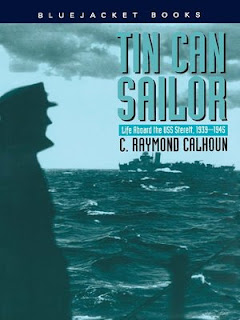
 In studying first-person accounts of naval battles, particularly memoirs from the Pacific theater of WWII, we see some great examples of the "player focused" perspective. The sailors, soldiers and marines who recall those iconic battles do not do so the way we're shown in films or other fiction - which is the point of view most licensed RPGs try to capture. As much as I like to watch SF media, the cinematic spectacle is not best seen from the table top.

    The people who actually fought and survived major naval actions in the bowels of their ships recall their own personal viewpoints which are focused on their immediate situation. Often, this can be just trying to keep their ship afloat. They usually didn’t know what is going on with the battle, whether they are winning or losing, or how much damage the ship had sustained. 

    In other words, the ships these people are on became a hostile environment of rupturing steam pipes, flooding compartments, shrapnel, and darkness. A Dungeon.

    This point of view, the completely personal perspective, is one that can be used in a Player Character-focused RPG.

    At first blush, this may sound like a railroad waiting to happen. Without command level decisions to make, can the Players truly be masters of their own destiny? To this as ask a question in return: Can players whose characters are optimized for non-space travel skills be said to have any more control over the ship that they are on? 

    This is a big complaint about space travel and combat systems I have heard at my tables; that there’s nothing for most characters to do. In the Crew as Damage Control concept, everyone has something to do, even if Character’s actions revolve around survival while the ship they’re on falls apart around them. Survival in a hostile environment may be stressful, but it's still PC-focused, which is the goal.

       With Crew as Damage Control, the aftermath of a space battle is where Characters really get to shine. Their ship is now a dungeon in fact, full of hazards like decompression, ruptured tanks, radiation leaks, boarding hostiles, and more. Navigating this kind of environment is challenging enough; repairing the damage is even more so. One thing I’d love to see is a party of PCs scavenging the wrecks of other spacecraft or nearby asteroids for supplies to repair their ship. 

    That's Character focused play.

    Admittedly, this perspective is still focused on combat, which is only one small facet of space travel. Other character-focused scenarios are possible. Space is full of hazards that must be overcome, from debris strikes to solar flares to mechanical failures. There can also be passengers, mysteries, and more in a space-faring location. As long as the action is focused on the Players and their Characters, the focus is where it should be.

    More to come on this topic.


Google+