Showing posts with label Deckplans. Show all posts

Wednesday, February 2, 2022

Crew as Damage Conrol II: Acronyms & Anarchy

    Last week we started to address the problem with space travel and combat in RPGs by addressing the "tactical mini-game" sequence most TTPRGs seem to use.   The reasons for the mini-game approach as I see it are as follows: 


  • First you have the hobby’s wargame origins, which can be exacerbated by RPGs with board game tie-ins. 
  • SF games that are licensed from or inspired by movies and television. These games attempt to model the epic eye-candy of space battles on the macro-scale. 
  • A simulationist approach to the game that requires specialized rules to resolve a spacecraft in a vacuum (or any vehicle) as a different system from characters in a dungeon (or whatever).
    I have a hard time avoiding those last two as I am very much inspired by SF media and am a spaceship nerd that wants to show off.  I resist these urges by keeping in mind that RPGs are Different. 


A Unicorn, if you will.

   
RPGs are a special animal in ways that are hard to define. After years of playing (and decades of not playing),  I can't say that I'm any closer to determining what set of traits make specific games or campaigns fun in general,but I remember the legendary ones I've run or played in.  The ones that I still think about. They had two things in common:
 

  • The plot was a situation - either by design or as the supposed plot disintegrated. 
  • Players' were allowed to plan, discuss and engage with the world and one another.
  • Player's took initiative.

    That's what I want in Project NEPTUNE.  My friends, family and fellow players gathered around discussing the situation and what they can do about it. I have seen genius there, and engagement. I wanna encourage that.

    In my proposal that all characters are Damage Control on a starship creates that situation. The anticipation of an upcoming combat or hazard provides opportunities for planning and engagement, even if the characters don’t have space-faring skills. Player Characters have an entire spacecraft's worth of resources to utilize in their planning.  

    Now we have to get organized.

ACRONYMS & ANARCHY

    In my Damage control model, I'm using a few arbitrary assumptions:

  • Consideration for a game group's average size of 2-4 players
  • Finally finally dealing with my unresolved love-hate relationship with the Frigate design in Starships & Spacemen 2nd Edition which assigns a crew of ten to a starship.
  • No built-in Hierarchy that puts one PC or NPC in charge. 
     The first two are the easy ones.
 
    The first starship officially designed for Project NEPTUNE is the Ultra Light Cruiser.  It has a crew of twelve and is the smallest (reusable) starship fitted with a warp drive.  
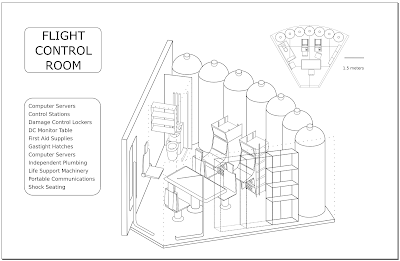
    

    The crew is divided into three Damage control parties, each with three crew assigned.  These DC parties operate out of three Flight Control Rooms (FCRs) dispersed around the spacecraft. These are called FCRs instead of DC central(s) because they also house the computers that fly and fight the ship in the same armored compartment. I chose three at first as an arbitrary reference back to Northshield's Triumvirate but kept it when I realized that with three FCRs, no single shot from an enemy could take out all three.

    Now, this only accounts for nine crew.  The other three are two are pilots for the ship's auxiliary craft and a Medic.  There are jump seats in the FCRs for these three, bringing their normal capacity to four crew.

   This arraignment was chosen to maximize choices.  Do the PCs all occupy a single FCR, or should they spread out?  Part of the procedures I'm developing will make where you are on the ship as its attacked important. All PC eggs in one basket may not be a good idea.
     
   So, that's the first two down, now for the hard part.  How do you run a starship unless someone's in charge?

    Turns out we have a template for this in the way pirate crews in the Caribbean operated during the 'golden age' of piracy.

    Before we move forward, lets set fire to some strawman arguments and get them out of the way:

  • I am fully aware that actually pirates were ruthless and amoral at best and sadistic psychopaths at worst.  They were declared hostis humani generis for a reason. That said, I figure that any system of governance that can keep The Enemies of All Mankind organized and effective will work even better for regular people.
  • Forget what you've seen in Pirates of the CaribbeanA Pirate Captain served at the sufferance of their crew and could be replaced at any time by a vote of no-confidence - no mutiny required.  The only time a Pirate Captain had absolute authority was during an actual battle. This is clearly laid out in the Ship's Articles.
    The 'Pirate' Model in Practice


What follows is a flight of fancy to give an idea of what I'm thinking of; a setting that supports the play style of TTRPGs, is functionally plausible, and keeps the focus of the Player Characters. 
 
    A group of starting PCs are on Mars.  They don't have a ship but may want one someday.  There's lots to do on Mars but our PCs want to get into space - there are other star systems out there and in the aftermath of the Alien Invasion and the Devastation of Earth we want our PCs to go out there and Aventure.
 
    There is no Academy or Government program for training spacers because there is no government per se - The Martian Consensus doesn't work that way.  That's fine though, because anyone who can live on Mars can live in space.  That's rapidly becoming Humanity's niche/stereotype in the galactic community - the people who live in space as opposed to a habitable planet.
 
    Anyway, there are ships in port and looking for crew and our PCs are at least marginally qualified.  The ships needing spacers will post their Articles for perusal online. These Articles may look similar but the devil is in the details.  The PCs choose which ships they want to consider based on these details.  

    Getting on a ship will involve some sort of interview and the signing of the Articles. This is a time when Friends can help, Favors can be called in, and all sorts of social interactions ensue. If a given ship is between cruises, the Articles may be up for amendment by the ship's company and any new crew, with all the back-and-forth, negotiations and intrigue that can entail.
 
    Once the PCs sign the Articles and are accepted as part of the ship's company, they would go through a process of learning similar to what NUBs on submarines go through earning their Dolphins.  The PCs will need to learn how the systems work and get qualified on each and every system before being fully accepted into the ship's company.  This doesn't have to be role-played or necessarily even rolled - in can be represented by learning the game's procedures for space travel, combat and damage control.
 
    As member's of the ship's company, the PCs have all the rights and responsibilities thereof. They can vote on all 'matters of the moment', get shares of profits, be consulted on what improvements to the ship they want, and what sort of jobs and missions the ship undertakes.  

    Perhaps most importantly to this topic of this post, the PCs will have the following rights as well:
  • They may call for a vote of no-confidence in the Captain's leadership at anytime the ship is not in direct or immanent danger.
  • They have a Mission Abort option, where the PCs my at anytime elect to call for a bug-out in battle to save the ship.  They may have to answer to the ship's company for using this option, but that will be after the fact.
  • They may stand for election to Caption or Quartermaster at any time the incumbents lose a vote of no-confidence. 
    I see these three rights as what will preserve player agency during space travel and combat.  
 
    The above Pirate Model relies heavily on social interactions at all levels by  adding NPC crew and removing the command hierarchy present in most if not all other models of space travel. Now persuasion, negotiation, and other social interactions are options for getting the ship to do what the PCs want. Railroading becomes a less viable option when the Captain can be voted out and a PC party forms a third of the crew.
 
    For a model that uses so many social interactions, we'll need a robust set of rules or procedures to accommodate them.  We'll discuss options for that in our next How you Play is What you Win post. 
 
    After that, we'll get down to some concrete game design.  Stay tuned.
 

Monday, March 13, 2017

Blame it on Rob-o

     Specifically, Rob Garitta, friend and sometime collaborator here at Blue Max Studios.  He mentioned our previous work on the Starships& Spacemen game and I rather woefully lamented not having completed any of the projects I wanted to for that game.

  It was a rather lengthy list. I was going to make variants of all the major ship classes for the game, from Frigate to Dreadnought, make enemy spacecraft - even an adventure/setting.  I never did anything with it, in part because I got bogged down in tying to make a spacecraft design that made sense in light of the games rules on Energy Units and their distribution.

    I will respectfully decline to discuss the Shuttle Ship situation at this time.

    Once again, Ilove the game Starships & Spacemen OSR Star Trek? Sign me up!  Nevertheless, the Power Pile Base system gave me pause when trying to design spacecraft.  And so did the Teleporter.  And the way the decks are laid out like boats and not rockets.  And the dang shuttle ships.

    This was about a week ago now, when I was talking to Rob.  Since then, I've been thinking about these problems with the focus and intensity of...well, of a middle-aged autistic man who likes spaceships.  I have therefore managed, thanks to past experience, the Atomic Rockets website, and lots of graph paper, to resolve of these issues to my own satisfaction.  Over this week (at the least) I will outline my findings and developments.  Some of this takes the form of deckplans or schematics.  some will take the form on nano-fic set in my own private S&S universe.  All will be awesome.  Please stay tuned...

Friday, March 10, 2017

A Town on the Road to Nowhere

     The River- class transports are big.
     At four hundred and fifty meters in length, these colossal spacecraft can carry a lot of folks from here to Titan, some of which are actual passengers.  Most of the company and crew of a River, however, are part of the civilian or UN crew.  In order to make sense of what we needed in terms of staff and whatnot, we must first make a couple of assumptions about how the crew will be composed, selected, and distributed.
     First, the crew of the Rivers follow the Mission Control model. The individuals are not actually running the spacecraft, they are the managers of computers and automation and robotic drones.
     Second, the River- class is a civilian owned and operated spacecraft.  The UN pays the transport company a subsidy to insure regular service and to pay for transporting UN spacecraft and crew.  Also, naturally, the UN are present to provide the inspection team required on all spacecraft boasting a nuclear-powered drive.
      Third, There are not only three watches on the crew, there are two entire crews for each spacecraft and associated vessel.  Once the River leaves orbit, the people aboard won't see open skies again for a minimum of 2 years.  So, like submarines in today's American Navy, there are two crews for each spacecraft.
     With all of that in mind, here is a preliminary table of crew and passenger positions on a River-class transport.  The numbers in bold are the total number for that given division:

Crew Division
Crew Section
Number
Total
UN Command
Mission Support
10
(Dept Heads x2)
10

Mission Commanders
4
MCOM/DMCOM x2
14
UN Patrol
Patrol Craft Crews
62
(5 positions x 3 watches +1 Flight x2 crews/craft x2 craft)
76
Espaciers
Shipboard
5
(1 Captain, 1 Leutentant, 3 Staff)
81

Patrol
24
(6/squad x2 squads/craft x2 craft)
105
Civ Crew
Command Crew
31
(15 Mission Control x2 Crews +1 CIVMCOM
31
(136)

Stewards
38
(1/Pod x3 watches +1 Chief x2 crews)
69
(174)

Life Support
72
(2/Pod x3 watches x2 crews
141
(246)

Hangar Crew
16
(8x 2 crews)
157
(262)

Small craft Pilots
26
(3/Cygnus x 4 Cygnus + 4/Tug +1 AUXCOM x 2 crews)
183
(288)
Candidate Training
Candidates
60
60
(348)

Faculty
5
(1 Commandant + Class Supervisor x1/year)
65
(353)
Passengers

100
100
(453)

Tuesday, March 7, 2017

Ezekiel's Wheel: The Escher of Habitats

     I described the type of centrifuge habitat used by the River-class transports as being a species of Winchell Chung's Ezekiel's Wheel.  I also described it as a maintenance nightmare, as anything that must hold pressure and spin is already a nightmare, and anything that spins on two axes is a nightmare squared.  Be that as it may, I also posited that when shaping an orbit that takes two years to reach your destination, high maintenance is not necessarily a bad thing - it gives your intrepid Astros and Espos something to do during that long trip in the black besides stare at the wall and go mad.
    Besides, It looks cool.
Observe the coolness.,
    The twin hab rings float in a gigantic globe of water.  This is for a few reasons.  First, the water is the "Fleet Reserve" tank of propellant for the Patrol Rockets, tugs, service modules and any other spaceraft requiring chemfuels.  Second, the water is a cracker-jack protection against ionizing radiation, including the cosmic rays that vex long-term space travel.  Now, this diagram shows that the globular water tank provides excellent protection fore and aft, but is lacking in the lateral direction.  We'll have to supplement the water tanks with some magnetic shielding - which is fine, as the forward hanger, conning tower and command module need such shielding anyway.  Still, it is to our benefit to put the habs in the water tank, for even more reasons.  How about thermal insulation?  The water tank will act as an enormous heat sink that provides even temperatures to the habitat sections throughout the long voyage to Saturn.  Then there's vacuum insulation.  Let's face it, RocketFans, while John Campbell was wrong about using the Dean drive to turn subs into spaceships, he was right about one thing - we know a heck of a lot more about building subs for long-term habitation than space habitats. And the habs we have on the River are actually easier to design than subs - they don't have to be insulated against sound, since in space, no one can hear you scream.  But in all seriousness, it is easier to plug a leak in a water vessel with a wedge of soft wood than it is in a rocket with a specially designed polymer that won't boil off or become brittle when exposed to vacuum.
     There is one other thing I wanted to speculate upon with the design of the Zekes for a space habitat.  I am, for various reasons, in favor of hub-less torus centrifuges - or at the very least, a torus that does not derive its spin from the hub.  The sheer size of these habitats, for example, would put enormous torque on the hub and whatever spokes connect the hub with the torus.  My usual dodge is to put wheels on the torus and have it trundle along some sort of track - As I've mentioned here and here.  But the Ezekiel's Wheel design, alas, makes this impossible, as the pods rotate in two axes.  My solution, I am happy to say, involves the clever use of another piece of nautical tech:  Azmuth thrusters.
 
IN SPAAAACE!
The simple inclusion of these thrusters solves the torque issue by giving each pod its own propulsion.  The advantages don't stop there, however.  The propellers will stir up the water in the tank so as to keep the temperature even.  The propellers can generate thrust using only electricity, and lack the mass penalty of a flywheel. The direction of the thrust can be easily changed, which means that the Azmuth units may be useful in changing the orientation of the hab pods during the transition from rocket thrust to freefall.  And again, there is a certain cool factor.
     Speaking of cool factors, just what kind of crew would such a habitat benefit from? Astronauts, or Submariners?  The question is moot, as you'd need a little of both, but some of the culture of Submariners is sure to become part of the Astros' traditions in service among the River -class spacecraft and their militarized equivalents.
    But back to spaceships and deckplans.
    To the right are a couple of views of the habitat pods that will be inside our globe of water in our spaceship going to Saturn.  These are not small pods, as you can see - each deck is over twenty-five meters long and the smallest is twelve meters wide.  That is a lot of habitable volume.  And there are twelve of these pods; six per wheel, arranged in two counter-rotating wheels.  There are flexible tubular walkways connecting the pods to their rotating hubs, which in turn connect to the central hub.
     Even postulating that half the volume (six pods) will be taken up by hydroponics and plant gardens, There is a lot of space for a lot of people.  But who are they?  What do they do?  That, my dear RocketFans, will be the topic of Friday's post.

Thursday, January 5, 2017

Starcruiser: Basic Assumptions

     Happy New Year, RocketFans!  Work on Issue 02 of LAUNCH WINDOW is going along at a good pace, and so is the rules update for Issue 01.  It feels good to be on a sustainable schedule.  Part of that goodness is the ability to indulge in some blogging, and working on one of my favorite projects: Ship design!
   
Basic Assumptions
     Just so we're all on the same page, the Starcruiser is a design for a setting that mimics that of either the Far Future, or a Galaxy Far, Far Away. But really, I design in my own head-cannon type setting, so these assumptions won't necessarily fit completely into a setting you're familiar with.  The important thing is that this Starcruiser can be statted easily in D6 and 2D6 systems - you can go from there on your own.
     From a purely world-building perspective, these are the basic assumptions involved with the design of this starcruiser:

  • The Starcruiser is designed in a setting where organics will always be superior to robots for combat purposes, because organics are all attuned to "Fate". This is why we have people crew, pilots, gunners, sensor operators etc.
  • Anti-grav and Paragrav tech allows huge ships to land on planets and get away with absurd mass ratios.
  • Shield technology is advanced enough that capital ships have to get to near point-blank range and batter away at one another with broadsides, Lord Nelson-style
  • Tractor beams are used to slow down missiles and enemy fighters flying around capital ships to WWII dog fighting speeds, and organic gunners can take pot-shots at them with a reasonable chance at success.
  • There is FTL.  Obviously.
     So that's generic to the Setting - any ship in the Setting would follow those assumptions.  The starcruiser will also have a few assumptions unique to it's class and type:
  • Capable of independent, long-range cruises.  It is a cruiser, after all...  This not only means having fuel for long cruises, but supplies, food, ammunition, spares, and everything else you need to fly and fight a ship in space. 
  • Multi-role design.  The starcruiser has to be capable in many mission types. So it has a a wing of Starfighters, a battalion of Espaciers, and a big gun capable of shore/planetary bombardment
  • Fleet capability.  A starcruiser must be able to hold it's own in a fleet formation.  It will have to have a primary armament capible of hurting a Capital ship, and secondary armament fast enough to track and deal with lighter elements and fighters.  The starcruiser will sometimes operate in a cruiser squadron, or as the flagship of another type of squadron.  It must have facilities for flag officers and their staff. 
     Now that the assumptions are out of the way, lets briefly touch on the steps needed to actually design and build the craft.  I'm not talking about the game mechanics of stating a ship or design sequences or anything - I mean, how does one actually go about designing a warship?
 
   Step Zero:  Meta-considerations: I added this pre-step because not only does each SF setting have it's own design aesthetics, the Starcruiser in particular is made to look a a certain class of starship.  Therefore, all other design considerations must conform to the classic spearhead design.
   
 Step One: Weapons: Since Henry VIII commisioned the Mary Rose, Warships are designed in terms of their primary weapons systems first and formost.  For Battleships, that big honking gun turrets, for carriers, its a flight deck, and hangar. For starships, it can mean a Spinal Mounted BFG.  OUr starcruiser happens to have all of these, as a multi-role ship.  these systems take up the most amount of space in the hull.

Step Two: Propulsion:  The point of a mobile weapons platform is that it's mobile. This requires large engines, larger reactors, and huge amount of fuel.  Next to the weapons, these systems take up the most space.


Step Three: Sensors, and Cargo: These two don't have anything to do with each other, but both are important. Cargo spaces are pretty much a measure how long you can cruise in space without re-supply.  Sensors, obviously tell you where you are and where you're going, but perhaps less obviously, are the most important part of the weapons systems that don't involve guns.  Sensors are how the CIC knows what to shoot, and how the gun directors figure out the angles, ranges and intensities needed to hit those targets.
    
     As you can see, the space inside even the largest hulls fills up fast.  This is just big machinery and the minimum crew compartments to fly and fight the ship.  There are as yet no barracks, no mess halls, not gyms or sickbays - this is just the fighting spaces. 
     But I'm in love with it already.  

Monday, December 19, 2016

Star Destroyer Map? To SCALE!?

     So after getting LAUNCH WINDOW up an running (finally) my tired brain needed a break.  As a sort of palate cleanser, I went trawling around Ye Olde Interwebs looking at Star Destroyers.
 Some of the images I came across were from Geoffry Mandel's blueprints.  These are so old, they pre-date the scaling up of the Blockade Runner and SD made late in production and show us a Star Destroyer less than five hundred meters long.  The weapon mix and compliment is also interesting - the Mandel SD only has a crew of 750 (280 of which are Stormtroopers) but still carries a full wing of 72 TIE fighters.  No AT-AT or chicken walkers, though.  The SD was either too small to carry planetary assault equipment, was optimized for space combat, or, most likely, these were omitted because George and ILM hadn't invented them yet.
    Anyway, for fun, I started sketching star cruiser whose size was inspired by Mandel's SD, and blended featured of all different Star Destroyers we see from Episode II on.  I couldn't get the tiny inch long sketches I drew scale up, so I fired up Wings 3D and simply built a model in that.  Because my "Pocket SD" star cruiser was only about 600 meters long, I could build it out to scale.  The scale I chose was one grid square = 15 meters, because my Star Morph capital ship map tiles are 15 x 30 meters, so it made sense.  I also though about texturing the beast, but this was just a palate cleanser, so why bother?
     That's when the muse descended.
     I can texture blocks in Wings.  I have twenty-six star morphs laying around.  Hmmm...

      Sure enough, I not only could put my Starmorphs on 1x2x0.2 tiles to represent 15x30x3 meter deck segments, the resolution of the images was sharp enough to really see the detail.
    I was shocked as the implications set in.  By using my existing tiles, maybe a few new ones, and Wings 3D, I had the tools to fully map a Star Destroyer to scale.
    At first I thought it was crazy - after all, my Starphin project proved to be too much work to do in a timely manner - and that ship was a third of the size of my Mandel SD.  But in reality, the SD is a lot simpler a project, because the large pieces like engines and main guns are computer models and the deckplans have already been drawn.
     The results so far have been encouraging...

Tuesday, December 13, 2016

It's coming together... (T-MINUS 4 DAYS)

     Rescheduling of family functions and the normal psychotic pace of the so-called "Holidays" has made getting the magazine finished a marathon of endurance. It coming together, however.  Stargosy Part 1 and both articles are finished, as well as a lot of the art. I'm especially loving the cover for the Stargosy story:
    Modelling that cruiser was an exercise in endurance as well.
    Anyway, I got the first round of character art in from Chris Ford, who did the portraits in the previous Issue.  He arts a comic on Comic Fury called "The Accidental Witch" as well as a Harry-Potter-meets-Speampunk-Oz Patreon exculsive called "Soleil & Selene".  You should check them out.
    I like using Ford's character portraits because they a never what I expect.  His take on the characters from Stargosy, for example - I would never have thought of that!  Check it out:

    And I've also been hard at work drawing the bonus Isometric map for Issue 1:


    I hope you all are as excited about the upcoming issue as I am!  Now, if you'll excuse me, I've got a doctor's appointment that was rescheduled for...now!  Gotta go!

Friday, December 9, 2016

Art Previews! (T-MINUS 6 DAYS)

   That's right, RocketFans - Issue 1 is only six days away!  While we're all waiting in breathless anticipation, here's a look at some of the art in the upcoming issue:
Our Glorious Cover!

One of the big tasks this month has been designing and modelling Varangian, the diplomatic cruiser from the Stargosy series.  It's still a work in progress.


And I just cannot be a Blue Max Studios product without some deckplans somewhere, now can it?


  Hope you all enjoy!  I gotta get back to work...
 

Saturday, October 8, 2016

Here we are: a Rec Room....in...SPAAAACE

    I finished coloring this very very detailed little compartment today.  I even added a little person keeping fit in micro gravity.  I hope some of the details are more apparant now - like the ping-pong table!  I will be releasing an annotated version (without the watermark) for may Patreons probably Monday.  Anyway, I hope you enjoy!


Thursday, October 6, 2016

Common Compartments: A "Rec Room" in Space (WIP)

     I had this idea, inspired by the incredible artwork of spacecraft interiors in the Jovian Chronicles RPG books, to do some isometric spacecraft interiors.  Not full spacecraft, not part of Conjunction, or The Black Desert or anything, just spacecraft interiors.  This first one was actually a dare suggestion of +Rob Garitta: a Rec Room on a spaceship.  The clincher was when he said I must add a ping-pong table.  I thought to myself, "Impossible!  A ping-pong table in zero-gee!?"  But the idea had been planted, and I couldn't leave it alone until this happened:

You have no idea how hard it was to draw all those tiny little logos...

     I've also started on the first of the Intra-Fleet Tug isos - which is a bear.  Just the shot of the tug being assembled, from the upper left of the sketch I showed the other day, will take six different fully inked and colored images assembled into a composite picture for me to achieve the effect I want.
    Fortunately, I really really love working on isos.
    Anyway, enjoy, and if you like the compartment above and want to see more, let me know in the comments.  See you later!

Wednesday, September 28, 2016

Intra-Fleet Tug WIP

     Got some work our the ole' GIMP last night, and the beginnings of our Intra-Fleet Tug can be seen.  Let me assure all of you who have practice designing spacecraft: This is not remotely an optimized design.  This is a Frankenstein rocket, built out of available components for a unique purpose that became a de facto design more or less by default.  The story behind this craft's inception is part of the story of the Conjunction War, and by exploring its design, we will learn more about the fateful last voyage of the Mekong and the Jovian Blockade.
     Interested?


Thursday, September 15, 2016

Vegas-class Freighter out Now!

On Sale Now!

 A Vegas Freighter is a sure bet! Unlike smaller vessels the Vegas can haul enough cargo and passengers to easily pay its way and then there's the chance of doing your own trading.
In a small ship universe the Vegas freighter is ideal for large corporations that need an express shipment or as the dependable workhorse of middle sized companies and many successful free traders.
The Vegas Freighter is Blue Max Studio's latest offering for a small ship universe and adaptable to 2d6 systems.  Your purchase includes the 21-page guide to the Vegas-class Freighter, and an additional 11-page booklet of deck plans! Get yours today!
Google+