Showing posts with label The Force. Show all posts

Thursday, January 5, 2017

Starcruiser: Basic Assumptions

     Happy New Year, RocketFans!  Work on Issue 02 of LAUNCH WINDOW is going along at a good pace, and so is the rules update for Issue 01.  It feels good to be on a sustainable schedule.  Part of that goodness is the ability to indulge in some blogging, and working on one of my favorite projects: Ship design!
   
Basic Assumptions
     Just so we're all on the same page, the Starcruiser is a design for a setting that mimics that of either the Far Future, or a Galaxy Far, Far Away. But really, I design in my own head-cannon type setting, so these assumptions won't necessarily fit completely into a setting you're familiar with.  The important thing is that this Starcruiser can be statted easily in D6 and 2D6 systems - you can go from there on your own.
     From a purely world-building perspective, these are the basic assumptions involved with the design of this starcruiser:

  • The Starcruiser is designed in a setting where organics will always be superior to robots for combat purposes, because organics are all attuned to "Fate". This is why we have people crew, pilots, gunners, sensor operators etc.
  • Anti-grav and Paragrav tech allows huge ships to land on planets and get away with absurd mass ratios.
  • Shield technology is advanced enough that capital ships have to get to near point-blank range and batter away at one another with broadsides, Lord Nelson-style
  • Tractor beams are used to slow down missiles and enemy fighters flying around capital ships to WWII dog fighting speeds, and organic gunners can take pot-shots at them with a reasonable chance at success.
  • There is FTL.  Obviously.
     So that's generic to the Setting - any ship in the Setting would follow those assumptions.  The starcruiser will also have a few assumptions unique to it's class and type:
  • Capable of independent, long-range cruises.  It is a cruiser, after all...  This not only means having fuel for long cruises, but supplies, food, ammunition, spares, and everything else you need to fly and fight a ship in space. 
  • Multi-role design.  The starcruiser has to be capable in many mission types. So it has a a wing of Starfighters, a battalion of Espaciers, and a big gun capable of shore/planetary bombardment
  • Fleet capability.  A starcruiser must be able to hold it's own in a fleet formation.  It will have to have a primary armament capible of hurting a Capital ship, and secondary armament fast enough to track and deal with lighter elements and fighters.  The starcruiser will sometimes operate in a cruiser squadron, or as the flagship of another type of squadron.  It must have facilities for flag officers and their staff. 
     Now that the assumptions are out of the way, lets briefly touch on the steps needed to actually design and build the craft.  I'm not talking about the game mechanics of stating a ship or design sequences or anything - I mean, how does one actually go about designing a warship?
 
   Step Zero:  Meta-considerations: I added this pre-step because not only does each SF setting have it's own design aesthetics, the Starcruiser in particular is made to look a a certain class of starship.  Therefore, all other design considerations must conform to the classic spearhead design.
   
 Step One: Weapons: Since Henry VIII commisioned the Mary Rose, Warships are designed in terms of their primary weapons systems first and formost.  For Battleships, that big honking gun turrets, for carriers, its a flight deck, and hangar. For starships, it can mean a Spinal Mounted BFG.  OUr starcruiser happens to have all of these, as a multi-role ship.  these systems take up the most amount of space in the hull.

Step Two: Propulsion:  The point of a mobile weapons platform is that it's mobile. This requires large engines, larger reactors, and huge amount of fuel.  Next to the weapons, these systems take up the most space.


Step Three: Sensors, and Cargo: These two don't have anything to do with each other, but both are important. Cargo spaces are pretty much a measure how long you can cruise in space without re-supply.  Sensors, obviously tell you where you are and where you're going, but perhaps less obviously, are the most important part of the weapons systems that don't involve guns.  Sensors are how the CIC knows what to shoot, and how the gun directors figure out the angles, ranges and intensities needed to hit those targets.
    
     As you can see, the space inside even the largest hulls fills up fast.  This is just big machinery and the minimum crew compartments to fly and fight the ship.  There are as yet no barracks, no mess halls, not gyms or sickbays - this is just the fighting spaces. 
     But I'm in love with it already.  

Friday, October 14, 2016

Alternate Metaphysics Mechanics for Open D6 Part IV: Book Outline

     While it's true that I'm occupied primarily with Iso grid maps at the moment and my Hard SF Conjunction setting in the longer term, I haven't abandoned my work on making a new system for the use of Metaphysics in Open D6.  In fact, I've finished up an outline for an entire book!  Have a look-see, and let me know what you think.  I hope to move forward (even if its a paragraph at a time) in the coming months, so any comments would be valuable.  Hope you enjoy!

Opposing Force: Alternate Metaphysics Rules for Open D6


  1. Wielding Fate: Fate Points as the basis of the Metaphysics system
    1. The Big Change: A New Mechanic
      1. Sidebar: Fate binds all living things...
    2. Doing the Impossible: New Difficulty Levels
      1. Impossible: 40+
      2. Setting Difficulties
        1. Sidebar: Difficulty the easy way
      3. Examples
    3. Anything is Possible: Powers without Powers
      1. Powers as extensions of regular Skills
        1. Keeping Fate boosted Skills “Up”
        2. Examples
      2. Sidebar: Can regular people wield Fate?
    4. Wages of Fate: Fate Points in the new system
      1. Not so Different…
        1. Regaining spent Fate Points
      2. Sidebar: Fate and Codes
    5. Children of Fate: New Aliens and Changes to Old Ones
      1. New Stat: Fate Resistance
      2. Sidebar: Free Will versus Fate
  2. Wielders of Fate: New Organizations and Codes
    1. The House of Norn
      1. History of House Norn
      2. The Code of Norn
      3. Prominent Figures
    2. The Astartian Grenadiers
      1. History of the Grenadiers
      2. The Code of Astartia
      3. Prominent Figures
    3. Creating your own Wielders of Fate
      1. Concept
      2. Code
      3. Template
  3. Dueling Fates: New Weapons and Equipment
    1. Combat Spheres
    2. Grenadier Armor
    3. StarBlades
    4. The Boem
  4. Winged Fate: Starships and vehicles
    1. Racing Capsule
    2. Class-8 Astartian-Starfighter
    3. Arrowback Surveyor
  5. Pawns of Fate: New Metaphysical Templates
    1. Scion of Norn
    2. Astartian Grenadier
    3. Bladesmith of Solace
    4. Fate-Favored

Help make all our work possible.

Thursday, July 21, 2016

Alternate Metaphysics Mechanics for Open D6 III: More Ideas

DEX + Blaster + Force Point
     Welcome back, RocketFans, to another in our series on Alternate Metaphysics Rules for Open D6.  Of course, it may seem like I'm spending an inordinate amount of time on examples and rules specific to Star Wars, but since the Metaphysics rules in Open D6 were an evolution of the SW rules for the Force, what can you expect?
     The last two posts on this topic have generated lots of observations and suggestions on how to take my basic idea (i.e.: ditch the Metaphysics Attribute, all of the Force Skills and Force Powers, and just use Force Points) and make it work more smoothly with what we've seen in past movies and game materials.  When going through all of the comments, I tried to give all the ideas a fair look but keep true to the central goals I have for making a new system in the first place.  To re-cap, those are:

  • To reduce/eliminate the "Linear Warrior, Quadratic Wizard" syndrome.  Force Users shouldn't be so powerful that they punish the other players for choosing normal Characters.
  • To reduce/eliminate the inevitable complexity bloat, so the game can be played with a minimum of book-flipping.  As I've said before, the genius of D6 is that it can be played with only the Difficulty Chart and the Standard Skill Chart.  I want to still do that with Force Users.
  • Account for what seems like Force use among non-Force sensitives like we see in the movies.  Because, especially in Episode VII, we see it all the time.
      That last point is especially evident in the Battle of Takodana in The Force Awakens.  Poe Dameron makes ten kills in like, fifteen seconds.  A double ace in fifteen seconds.  Beat that, Anakin!

    But I put the above points in order of priority - I really don't want Force Users to have more Attributes/Skills available than other Characters.  It slows the game down so much when you have to take into account all the special rules and tables for Force Powers.  Many of you suggested Force Powers without Skills, Skills without Powers and other permutations involving taking one level of complexity off of the system while still leaving Force users more complex overall than their non-sensitive counterparts.  In the end I decided I didn't want that.  I've taken for granted for thirty years of gaming  that magic users would have more power and complexity than fighters, and having the opportunity to use rules where that isn't the case is just too tempting to resist.  So, I decided against using any suggestions that involved Force users having more Attributes, Skills or Powers than other characters.  
Also DEX Blaster + Force Point
      
     But that doesn't mean I have it all figured out.  One of the most common concerns I saw in the comments dealt with the comparative rarity of Force Points in the RAW.  As I said in the second post on this topic, we would need to modify how Force Points are gained, spent, and regained in order to depend on Force Points as our primary mechanic.  One of the ideas I already mentioned was automatically regaining spent Force Points at the end of a session, unless the use of the Force Point would grant a Dark Side Point. We also briefly discussed making it easier to gain new Force Points.  For one thing, we may need to establish a way to buy Force Points with Character Points, but frankly I haven't figured that one out yet.  The most deal-breaking complaint about how my alternate system would work is that lightsaber duels would burn through Force Points every round until they ran out, so pretty much whomever had the most Force Points at the beginning of the duel would win. 

KNO + Willpower = Extra use of Force Points.
          After re-watching Episode VII (What? It was only the fourth time - I saw the original Star Wars that many times before I was six months old.) I was struck by the final duel between Kylo Ren and Finn/Rey.  It was a textbook example of Force users calling upon the Force during a fight to augment their abilities.  The obvious example is Rey, near the end of the fight when Kylo Ren offers to teach her and she puts the smack down on him.  But Ren calls upon the Dark Side several times in the fight, when he punches his bowcaster wound in order to increase his anger and suffering.  Anyway, this gave me the idea to make it possible to use the Force when out of Force Points.  But after talking to Debra, who has an intuitive grasp of Star Wars all my years of trivia-memorization can't match, we came up with a way to get through things like lightsaber duels without having to burn a Force Point every round which - let's be honest - would get old real fast.

     So, Force Points activate a skill combination, like lightsaber combat.  Just like in the current Force Mechanics, this skill may now be "kept up" until the end of the encounter.  You may use one Force Point per encounter for free.  After that, like if you want to use telekinesis, You have to make a Willpower roll at Difficult to use a second Force Point in the same encounter.  The Difficulty on the Willpower roll will increase with every additional Force Point You attempt to use.

     This would mean you could make multiple doubled Dice Pool rolls with the use of a single Force Point, and that may seem over-powered to some.  If this is the way we go, then Force Points will probably remain as difficult to gain as they are in the RAW, but still be regained at the end of a session.  Also, there's a lot of room to tweak this mechanic - Should you lose 1D off of your doubled Die Pool every round the boosted Skill is kept up? Or lose one pip per round?  If you fail your Willpower check, is the Force point still spent? Should there be a hard limit on how many times you can summon the Force this way per encounter? And it also has implications for Force Ghosts - perhaps by succeeding in Willpower rolls, a Force spirit could manifest after using their supply of Force Points?

 
Because Star Wars!
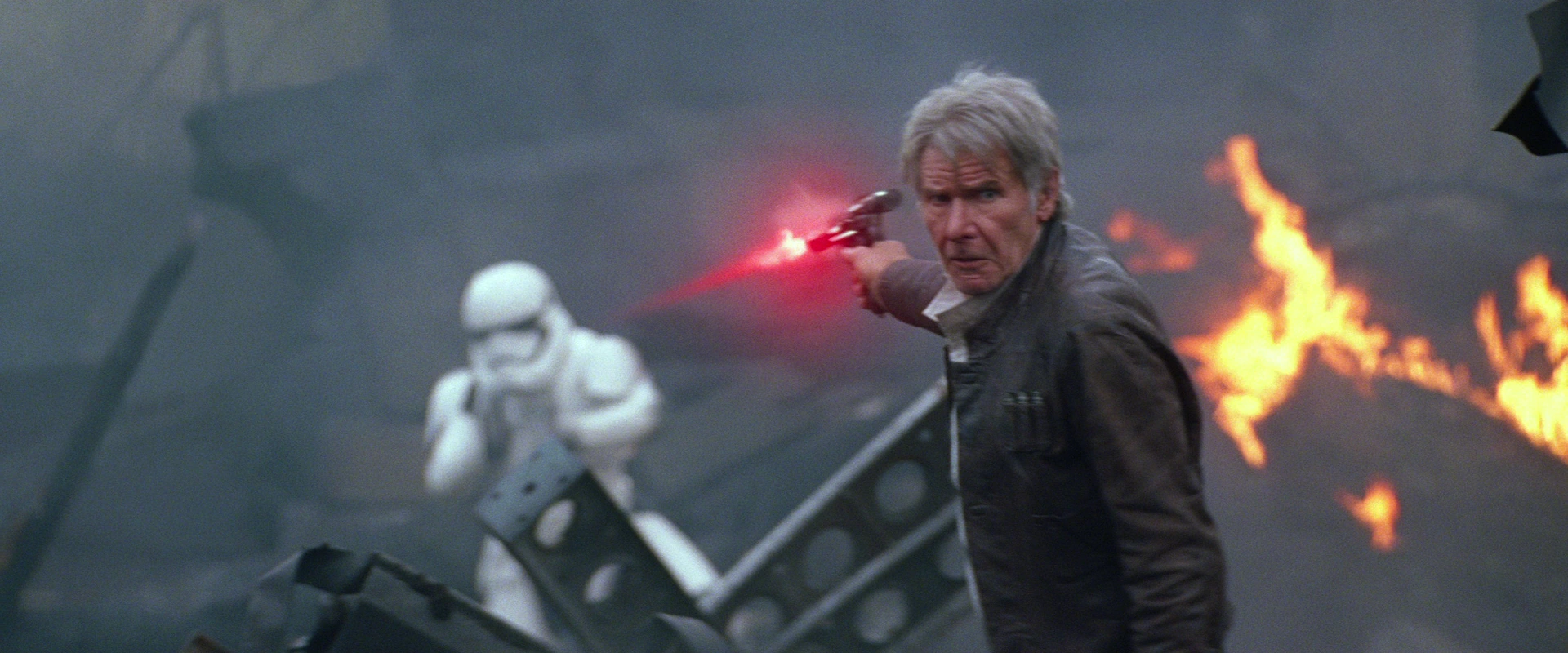
   I'm also interested in situations where using the Force is outside of a Player's control.  There seem to be instances, like the two pictured above, where the Character's don't seem to be using the Force, the Force seems to be using them. When Rey shot the Stormtrooper, for example, she first left the safety on, then dodged a blaster shot without trying while taking the safety off.  Then, her first shot went way wide, while the second hit dead on target.  This is fine as far as it goes, but I swear it looked more like the blaster was moving her arm than Rey was aiming the blaster.  And then there was the way she looked at the blaster after shooting the Stormtrooper, like it had a life of its own.  Its the exact look we see Han give his trusty DL-44 after shooting a Stormtrooper behind him without looking.  His arm jerked around seemingly without volition before the shot, and Han looks at the gun like it was alive afterward  What do you think?  Does the Force, like Luke asked in A New Hope, control your actions as well as obey your commands?  If so, how would we make a mechanic for that?  As always, leave your comments below or on G+.  

     Until next time, RocketFans, May the Force be with you!  


Tuesday, July 12, 2016

Alternate Metaphysics Rules for Open D6 II: The How


   Back to gutting the Force System out of D6, RocketFans!  I've gotten a lot of feedback about Part I of this series, some positive, some negative, but all curious.  Some of you have even guessed what I had in mind from my final statement on what I would replace force Skills and Powers with.

     Nothing.

     And nothing is exactly what I meant.  Get rid of theMetaphysics Attribute, ditch the associated skills from Open D6 and Star Wars, and forget about all of those Powers. Let Jedi characters be as easy and simple to play as all the other templates.

      In this alternate (lack of) Metaphysics/Force system, the only difference between Force sensitive and non-Force sensitive Characters is the five-point limit "normal" Characters have on accumulating Fate/Force Points.  All "powers" used by Fate/Force Users are combinations of regular Attribute/Skill Dice Pools with the addition of a Fate/Force Point to boost the Pool up into impossible levels of Difficulty.  Using these "powers" does not require training - Jedi and other Force training is what allows Force Sensitives to gain more Force Points.  Used Fate/Force Points would be automatically returned at the end of the game day for Force Users, possibly not until the end of a session or adventure for non-Force Users.  I personally am in favor of non-users getting their points back as fast as Force Users, but that would allow a lot of doubled dice pools and some GMs may not like how that changes the game.  I had a gambler Character win a celebrity sabacc tournament against, Solo, Calrissian, and Karrde by using a Force Point on the last hand.  Do you know what a PC party can do to your campaign with the sudden infusion of a hundred thousand credits in the first game?

     So, how exactly can we recreate Force Powers using the regular old Skill list?  It's pretty easy, actually.  Lightsaber Combat is simple, for example - DEX + lightsaber  + Force Point.  Those awesome flips? DEX + Acrobatics Force Point.  Mind Trick?  PER + Persuasion + Force Point.  Telekinesis?  Ah...
Explain this can you?  Hmmmmm?

     Out-and-out "magical powers", of which Telekinesis is the most obvious, seem to require a magical system to govern them.  This is the traditional way of dealing with the supernatural, paranormal, and super powered, because these type of powers exist outside the realm of the possible.  But it is not required that we treat magical powers as magical in the Star Wars universe.  We're already going on the assumption that the Force is everywhere and that all living beings can touch it to a certain extent.  In the Star Wars Legends Knights of the Old Republic Media blitzkrieg, we are told that the hyperdrive was used in the modern galaxy was originally created though and powered by the Force.  So, in Star Wars, the Force is a part of the fabric of reality and is perfectly natural.  STR + Lifting + Force Point for Telekinesis.

     That is not to say it should be easy to move stuff with the Force.  The virtue of having Force Points, and their double Dice Pools, in charge of Force Powers is that you can rule some truly insane difficulties on a given roll.  This preserves the feeling of the impossibility of the task, while still giving the Force User a chance to succeed.  A new level, possibly several levels of Difficulty above Heroic/Legendary will have to be added for use with Force powered tasks.  

     When considering this radical Powers-ectomy as a viable option to treat the illness of complexity bloat, I tried to think of some objections that could be leveled in opposition.  Below I've tried to address some concerns I and a few others have already come up with.  These are not meant to be staw man arguments - if you can think of a problem I haven't, please leave a comment below.

     Some problems I see include:


  • Without Force Powers, Force User Characters don't seen that much different from any other template: This is true, but I don't see it as a problem.  Having all  Characters start play with the same number of Dice to allocate implies that they are meant to be balanced with one another. One of the things that makes Force Users hard to play at lower levels is that they must split the same number of Dice up among even more Skills than regular characters.
  • Jedi Characters won't be nearly as powerful under this system: Agreed.  Again, I don't see this as a problem.  Uber-powerful Jedi that skew game balance away from other characters is one of the most prevalent complaints about the D6 System.  This alternate system is trying to solve it.
  • What's to stop non-Force Users from blowing a Force Point and doing Jedi stuff:  This is a more difficult question.  Personally, I don't mind the idea of non-Force Users using the Force every once and awhile.  Look at Han Solo in The Force Awakens.  He jumped to lightspeed from inside another ship, shot a stormtrooper with a pistol at medium range while looking in the opposite direction (He looked almost surprised too, like the gun had a mind of it's own), and, most extreme, made a landing approach on a planet, through shields, at lightspeed.  Han has had fan theories concerning his Force sensitivity around him for years, and Episode VII only provides more evidence.  This alternate system, however, allows Han to simply be an experienced character with five Force Points that uses them on his blaster and astrogation rolls.     That being said, there is nothing in my alternate rules to stop a regular character from using Telekinesis.  If you don't like that, as a GM you'll have to rule that it is not allowed.  
    Admit it, you can't wait to do this in-game.
  • You can't replicate every Force Power with regular skills:  That all depends on your definition of "every" if you go through comic books, novels, and obviously RPG supplements, you'll find a dizzying array of Force Powers available.  But if you look just at the movies, you may be surprised at how little the Force is used. According to The Force Accounted, There are only about ten different distinct uses of the Force shown in the entire Star Wars saga, including Force Spirit.  Most often used is sense, with various tricks such as Force Leap, Choke, Push and Telekinesis filling the bulk of the movies Powers list. Sense, as an active power, I'd roll as PER + Search + Force Point, and passive uses of sense would be given out by the GM to add drama or information to the game.  Force Lightening is more complicated.  On the fly, I'd use KNO + willpower + Dark Side Point.  But if you don't have allow Darksiders in your campaign, you don't have to worry about it as much. New Powers from The Force Awakens fit in to this reasonably well, if you assume that stopping a blaster bolt is a form of telekinesis, and putting Rey to sleep in the woods outside Maz's castle is a form of effect mind.  Kylo Ren's interrogation technique looks like if could be covered with KNO + Intimidation Darkside Point
  • What about Force Spirits: Urrrg....Should've kept my mouth shut.  My current thoughts are that Force Spirits as Player Characters that recently died may interact with the world at the cost of a Force Point until their Force Point Pool is exhausted, then they join the Force.  As an NPC they can last as long and do as much as the GM likes, with the movies and whatever other sources you want as a guide. 
  • If Characters have to use a Force Point every time they use a Jedi Power, they'll run out of Points pretty quickly: That depends on how often Players use Force Points.  If you try to use the Force on every roll, then yes, you'll run out quickly.  But Jedi don't resort to the Force for every problem.  Again, in The Force Accounted, we see that in all 805 minutes of the Star Wars saga, the Force is only used for 34 minutes, or about 4% of the time.  Having Force Powers depend on Force Points also introduces the idea of resource management to the use of the Force, and does so in a way that doesn't add complexity.  For GMs who are frustrated at Players with Force Users running rough shod over their campaigns, the limiting factor of Force Points is a way to regulate Force Powers without being heavy-handed.
     While this is indeed the core of my alternate metaphysics/force system, there is still a lot of work to be done.  Next time, RocketFans, we'll discuss Codes vs the Light/Dark dichotomy, getting and keeping Force Points, and any ideas or consigns you or I come up with.  See you then!

Friday, July 8, 2016

Alternate Metaphysics Mechanics for Open D6 Part I: The Why

WARNING: THE FOLLOWING CONTAINS RAMPANT SPECULATION, FAN THEORIES AND/OR HEAD-CANON.  YOU HAVE BEEN WARNED.

     This project started rather innocently, actually.  I heard about the new AI flight program that is so good that it can beat American fighter aces in the simulators.  Needless to say, Air Force pilots, already pissed about drone pilots getting the same pay, are livid.


As obsolete as his first cellphone...

     You may wonder what that has to do with the Force, or Metaphysics, as it is known in Open D6.  It's like this:  If AI on our primitive, backward planet can beat expert pilots in atmospheric fighter craft, how did a mess of clones beat a mess of droids in starfighters in the Clone Wars? 

     Come to think of it, if it's possible to make AI soldiers, why would you instead clone humans?  We're squishy, need to breathe, and need vast amounts of consumables and cubic space.  And the waste we produce... Logically, if you could avoid the cost, time and extra materials needed to field an army of biological soldiers by instead using battle-droids, why wouldn't you?
Boondoggle and Pork Barreling!

    The meta-answer is of course, that Luke Skywalker mentioned the Clone Wars specifically in Episode IV, and therefore a war using some sort of clones was canon.  In the Prequels, we can observe that the droid army is full of glitchy, bargain-basement technology, and that the clones are kilo-for-kilo better soldiers and pilots.  But in real life, this would not be the case.  Now, before anyone else says it, I am perfectly well aware that Star Wars doesn't work like real life by any far stretch of the imagination.  Still, part of the cognitive dissonance that makes classic science fiction seem out of touch is how dated the computer technology is compared to what we have in the real world.  And then there's the inescapable laws of computing: If you can have something as advanced as C-3PO and R2-D2, you should have had unstoppable computer-piloted fighters for a long time already.  So why are organics better than driods?

     Several pieces of Star Wars literature from that limbo now known as "Legends" indicate that battle-droids and droid-pilots are simply no match for the intuition and imagination of sentient individuals.  There are at least three ways one can interpret such statements:

1. Since it's a proven fact that AI pilots are better in real life, the Legends material is inaccurate so we should ignore it.

2.Since it's a proven fact that AI pilots are better in real life, We can assume that if humans are the same as they are in the real world, for some reason AI in the Star Wars universe are superior to real life AI in terms of personality, but inferior in terms of computational performance. 

3.Since it's a proven fact that AI pilots are better in real life, and we assume that AI in Star Wars are superior to what we have in real life, because they have personalities,  humans and aliens must be  special somehow.

    Pop quiz: What is the definition of the Force?  According to old Ben in the movie that started it all, "It's an energy field created by all living things.  It surrounds us and penetrates us; it binds the galaxy together."  

     Did you catch that?  It's created by all living things. That includes humans, aliens, and even clones.  It does not include droids.  That, RocketFans, is the difference between how droids work in a galaxy far, far away and how AI work here and now.  The Force connects all living things, and therefore all living things can in some way use the Force.  That means that the "normal" person in the Star Wars universe would be uncommonly skilled, lucky and canny compared to a normal person in real life.  It's part of the fabric of the universe that the Star Wars saga is set in.

   Now, in Star Wars: The Role-Playing Game for D6, the ability for all people to touch the Force is governed by the Force Point mechanic.  The difference between normal people and Force-Sensitives is that normal Characters may have a maximum of 5 Force Points, while Force-Sensitives may have any number of Force Points. The function of Force Points for sensitives and non-sensitives is the same:  Spend a Force Point, and you can double the die pool on your next roll.
The weird thing?  I bought this at Disney World!
 
     That 's fine as far as it goes - the problem is that it goes so much further.  I'm taking of course about the Force Powers in the Star Wars RPG.  Like virtually all "magic" systems in RPGs The Force Powers rules in Star Wars are more or less broken. Fist of all, it's a classic example of "linear warrior, quadratic wizard".  In the early adventures of a campaign, the Jedi character is under-powered, having had to put dice into their Force Skills.  This usually leads to not having enough dice in regular skills to compete with normal characters, and not having enough dice in their Force Skills to use their Force Powers reliably.  There will be a couple of sessions in the middle of the campaign where the normal characters and the Force-Sensitives are about even in skill and power - and those are the games you talk about for the rest of your life.  After that, however, the Force users become more and more powerful, with more dice in Control, Sense, and Alter, and access to more and more powers.  And lightsabers.  Eventually, between, telekinesis, lightsaber combat, and effect mind, the Force user can do everything, and usually better than the rest of the party.  No fun.  

     Second of all,  A Force-sensitive Character has, in the classic Star Wars rules, three extra skills; the aforementioned Control, Sense, and Alter.  In Open D6 there is an additional Metaphysics Attribute, and three Metaphysics Skills - Channel, Sense, and Transform.  These Skills are not the Force Powers or Metaphysical Manipulations themselves, however.  Force Powers are a sort of category below Skills, and are simply a list of what you can do with your Force Skills.  You can't use a Force Skill untrained - despite multiple examples of characters in the Canon and Legends Universes doing just that.  You gain training in Force Powers by improving one of the three Force Skills one pip, or by spending five Character Points.  That right there is another major headache - it costs the same to learn a Force Power as it does to improve a actual Skill.  While you can learn a new Power when you improve a Force Skill, you can't improve a Force Skill by learning a new Power.  Then there are combination Powers, that require you to add the skill dice from two or all three Force Skills to you pool to use a single Force Power. And all of these Force Powers have their own difficulty tables and special rules as complicated as any Vance-inspired Spell List.  It's no wonder I've heard several GMs admit that they've never run a game with Force Users.  It's just too much extra crap on top of what is by itself an elegantly simple system.

     But what if we could skip all that?

     That is exactly what I propose - a new mechanic for incorporating Force Powers into D6 that incorporates the idea that all being can touch the Force? That all Force Sensitives can attempt to use that connection, even without without formal training? And especially with a mechanic that eliminates all of the complicated, game-breaking, extraneous rules and special circumstances that plague our Force Users?  I believe I have in fact found a perfect replacement, one that will let the game flow with the speed and simplicity that is inherent to the D6 System.  What will I replace the current Force Powers rules with, you may ask?

     Nothing.

Google+