Showing posts with label Star Trek. Show all posts

Wednesday, March 2, 2022

Project NEPTUNE: Making the Procedures Universal

Faci-NOPE.
    More than any other genre I'm aware of, Science Fiction is defined by it's technology.  For example, the difference between Clash of the Titans and Lord of the Rings is to my mind less than the difference between Star Trek and Star Wars.  And both of those have almost nothing in common with The Expanse.

    This is relevant to game design because I could run a game set in Middle Earth or Mythic Greece using D&D with no real problems.  I could not run Star Wars using Star Trek RPG rules or vice versa. Warp Drive, Transporters, Lightsabers, The Force - I would spend enough time in conversions from one system to the other that I may as well just get both games.

    While there are more universal SF RPGs out there (and GURPS, of course) this usually puts the problem on the GM.  Systems such as STAR HERO for example make it possible to build virtually anything you can imagine - at the expense of having to build everything you imagine.  This kind of time sink can be more intensive than actually learning multiple game systems and encourage GMs to purchase multiple games.

    I intend to address both problems.

Yes, I know what it means.
  

    The inspiration for this part of Project NEPTUNE comes from the same place I get most of my inspiration: Winchell Chung's Project Rho.  While most famous among SF aficionados for Atomic Rockets,  Chung's Project Rho has other treasures for those who seek them.  Two of those treasures are going to be the key to making space travel and combat interesting, full of player agency, easy for GMs to prep and run, and useful across multiple franchises.

INFLUENCE DIAGRAMS

    Project Rho has a whole section on cool game mechanics that bares careful study. Among them is a single article by Neel Krishnaswami that can, as of 2022, only be found on Project Rho.  I'll give a high pass of what's important for us here, but the full article is excellent and I lament there was no follow up.

    Seriously, go read it.

    The example in the article addresses Star Trek in particular but the core idea applies to any technology. By breaking down a SF tech like warp drive or what have you into individual systems or components, you can build a causal influence diagram that gives the player details that actually matter.  This can be presented as a handout (or card) to the players and used by character to repair tech, work with tech and generally make the tech more real at the table.

    Since I'm working on the idea of Crew as Damage Control, I'm naturally drawn to this notion.

The rules for this -

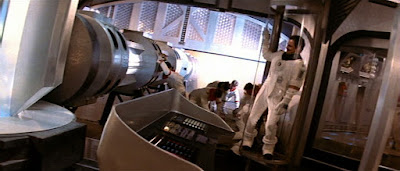
    What makes this work across multiple franchises is that the procedure of using the Causal Influence Diagram is universal while the tech itself is modular.  For example, If I were playing a Star Trek style game, I'd want a CID of a warp drive.  It would have bubbles like Matter/Antimatter containment, Warp Core, Plasma Conduits and Warp Coils.  My Engineer character would use that to troubleshoot damage and tell the captain that She cannae take much more o' this.

- are the same as the rules for this.
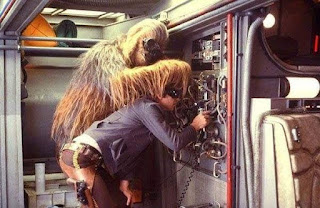
    If I'm playing a smuggler in a Star Wars style game, I'd want my CID to have Hypermatter Coaxium Magic bottles, a Fusion Reactor, Hyperdrive Motivator and Field Guides.  I may not know what any of that stuff means but they're on the diagram and I can use them because the procedure of using the diagram is the same no matter what SF tech I'm modelling.

    So when folks on Twitter ask me if the work I'm doing on space travel and combat can apply to their favorite game, I can say with confidence that yes, yes it will. 

    Using the Analog Database makes this work even better.   Any ship system, from any franchise can not only be diagrammed, but the cards stored in the same stacks and simply filtered by search term.  Packaged and sold individually, a deckof cards inspired by a given franshise could contain the tech, character backgrounds, and unique rules required to fully use the setting without needing an entirely new game.

BEYOND TECH

    I found another article on Project Rho that brings home to me the potential of this idea.  Ron Edward's The Sorcerer's Soul was also praised for it's use of relationship maps.   I got a copy of the book and perused that section - it didn't take me long to realize that Relationship Maps and Causal Influence Diagrams can be considered the same thing.

    So if CIDs can be used for physical objects and networks, and also for social relationships and people, could it also be used for ideas or intellectual pursuits?  Justin Alexander has pretty much proven it can - and provided excellent advice on how to use them as well.

    For me this means that not only can the conflict rules in SACRIFICES be used for physical, mental and social conflicts, CIDs can be used for physical, mental and social networks as well

    The system would be unified across all three attributes - which means it's unified across the entire game.  Across any game I want to make.

Still know what it means.
    More to come next week.


Monday, March 13, 2017

Blame it on Rob-o

     Specifically, Rob Garitta, friend and sometime collaborator here at Blue Max Studios.  He mentioned our previous work on the Starships& Spacemen game and I rather woefully lamented not having completed any of the projects I wanted to for that game.

  It was a rather lengthy list. I was going to make variants of all the major ship classes for the game, from Frigate to Dreadnought, make enemy spacecraft - even an adventure/setting.  I never did anything with it, in part because I got bogged down in tying to make a spacecraft design that made sense in light of the games rules on Energy Units and their distribution.

    I will respectfully decline to discuss the Shuttle Ship situation at this time.

    Once again, Ilove the game Starships & Spacemen OSR Star Trek? Sign me up!  Nevertheless, the Power Pile Base system gave me pause when trying to design spacecraft.  And so did the Teleporter.  And the way the decks are laid out like boats and not rockets.  And the dang shuttle ships.

    This was about a week ago now, when I was talking to Rob.  Since then, I've been thinking about these problems with the focus and intensity of...well, of a middle-aged autistic man who likes spaceships.  I have therefore managed, thanks to past experience, the Atomic Rockets website, and lots of graph paper, to resolve of these issues to my own satisfaction.  Over this week (at the least) I will outline my findings and developments.  Some of this takes the form of deckplans or schematics.  some will take the form on nano-fic set in my own private S&S universe.  All will be awesome.  Please stay tuned...

Monday, December 5, 2016

A Hard (SF) look at Star Trek: Starships!

    Work continues, RocketFans, on the next issue of LAUNCH WINDOW, so my space time is limited.  I'm still climbing the learning curve of making a full sized issue, so you'll have to be patient with me.
    I did want to show some work I did on re-imagined Federation starships as Alcubierre drive spacecraft.  It was a fun, albeit frustrating at times, exercise.  Hope you enjoy.
Exploration Cruiser Colombia (XCC-1701)  


Clockwise from top left: Hubble - class Sensor Frigate, Lee - class
Combat Frigate, Gali - Class Diplomatic cruiser, Argye - class Battle cruiser,
(cernter) Luna - class Destroyer 

Saturday, June 4, 2016

5 Classic Types of Starship-Based Campaigns

     I meant to get to this post earlier in the week, RocketFans, but life happened.  All over the closet next to the master bath.  More I will not say...
    Anyway, last time we discussed gaming on spaceships, we listed five ways to add factions to a starship-based campaign.  Belatedly, I realized that we haven't actually discussed the ways to actually run a starship-based campaign.  Or what that even means.  So, to begin this article, I will provide my own personal, open-to-debate, by no means official set of guidelines on what is and is not a starship-based campaign.
   First of all, IT SHOULD BE SET ALMOST ENTIRELY ON SPACECRAFT.  This sounds obvious, but in fact it is easy to mistake a setting that uses spaceships extensively as one for a spaceship-based campaign.  For example, and it took me years to figure this out, Star Wars as seen in the movies, is not a setting for spaceship-based campaigns.  Yes, there are spaceships, and yes, they are among the most iconic in science fiction and yes, there are cool space fighters and mile-long dreadnoughts and space stations that are not moons.
Top: Space.
Bottom: Not space.
       But how much time do the heroes spend on a ship, verses the amount time on a planet?
     Think about it - among all seven of the movies, most of the time spent was on planets.  Spaceships were plot devices, not environments to explore.  While one could argue that the fights on the Death Stars and Cloud City were spacecraft-centric, I disagree.  The scenes on Starkiller Base in Episode VII demonstrate that the Death Star scenes could have been easily done on a planet with no loss of flavor.  Cloud city and Couruscant are also interchangeable, as far as flavor goes.  That's part of the point - it shouldn't just feel like a spacecraft, it should function like one in ways unique to spacecraft.
This is shown well on the TV series Babylon 5.  What makes the eponymous station a spacecraft and not just a frontier town in space is the preoccupation with life support, the attention to things like gravity.  Another excellent example, The Expanse, takes this up to eleven by showing the Coriolis forces involved in spin habitats.  
Top: Kansas
Bottom: Not Kansas
      Second of all, IT SHOULD BE A CAMPAIGN, NOT JUST AN ADVENTURE. Even if you argue that the Death Star counts as a spaceship- based adventure, it's still not a campaign.  An adventure, depending on the amount of time you spend at the table, will take at most two or three sessions.  A single Star Wars movie is an adventure.  And we all know that only the second act of the original movie was spent on the Death Star.  If you were playing Imperial troops that were stationed on the Death Star and helped build it (or just did sanitation), then you would have a spacecraft-based campaign.  But not a Star Wars movie.
     Thirdly, I MEAN A BALANCED CAMPAIGN, NOT JUST CONSTANT SPACE COMBAT.  There is a difference between a role-playing game campaign and a wargame campaign.  You could easily play in nothing but starships if your game of choice is Starfleet Battles or Attack Vector: Tactical.   Role-playing games, as the name implies, involve incidences of role-playing.  Also, exploration, player cooperation, problem solving, and the like.  You can easily, for example, run a mystery adventure in an RPG campaign based on a starship - look at the first season of TOS Star Trek.  You could not do the same with a handful of ship miniatures and stat cards.
     To more easily and thoroughly demonstrate what is or is not a starship-based campaign, Let us assemble our list of five classic types of starship-based campaigns.

1. Planet of the Week: This is one of the earliest examples of the spaceship-based campaign. We see it in television, at it's best, in Star Trek and it's spin-off series. The Players are part of the crew of a spaceship that travels to new and exciting places every adventure, where they will explore, solve problems or mysteries, or just shoot aliens and take their stuff. Any Star Trek licensed RPG is perfect for this, for obvious reasons, as are OSR hacks such as Starships & Spacemen and Five-Year Mission for White Star. But we see this style of game in other places as well - notably, Classic Traveller's adventure, Leviathan.
To be honest, this type of campaign kinda skirts the edge of what I'd call starship-based. Technically, if we're looking for the Dungeon - that metaphorical play environment where dice and hit points happen at the heart of any game based off D&D - then the "Dungeon" is space itself, because that's where the XP is. The spaceship is more like the town a D&D party goes to at the end of the adventure to rest, heal and get new equipment. This does not mean you can't have adventures on your own ship, but they tend to be roleplay-driven and hardly involve combat. After all, you can't have your cruiser invaded by bad guys every week.

2. The Rag-Tag Fleet: In this scenario, the players are part of a large fleet of spacecraft of many different types, travelling from point A to B, on a trip that will take most if not all of the campaign. That's really all you have to have for this kind of campaign, but there is so much you can do with this framework.
The phrase "rag-tag fleet" comes from the Ur-example of this type of campaign, Battlestar Galactica. The set up of this show, either version, is nearly perfect for the purposes of making a campaign setting. You have hundreds of different ships. You can't go anywhere but one of thise ships, and the ships are full of pretty much any kind of person you could imagine. In BSG they showed the fithy rich hoarding supplies while refugees starved below decks, prostitutes trapped on ships with puritans, crime syndicates taking over flotillas in the fleet and engaging human trafficing, enemy spies, terrorists, political rivals, military rivals - there really isn't much that they didn't cover on BSG. But the "fugitive fleet" isn't the only way to use this framework. Merchant convoys, colonial wagon trains to the stars, or collections of asteroid outpost a billion miles from anywhere are all valid. The basic thing to remember is that the Dungeon is the fleet itself - and it's a Megadungeon. I mean this in the strictest of terms; It has virtually endless new areas to explore, it is intended to be the sole gaming environment for a campaign, the number of players and their level is not restricted, and areas that have been cleared of threats will fill right back up. Best part? I get to map dozens of different spaceships.

3. Casablanca IN SPAAAACE!: The inversion of Planet-of-the-Week, this scenario has the players living on or crewing a large space station, and the adventure coming to them. Examples include the obvious, such as Babylon 5 and Star Trek: Deep Space Nine. There are also not-so-obvious settings that use this trope. From Star Trek's original series, there was Deep Space Station K-7, where a variety of shady characters came and went bearing Tribbles. Vangard Station, from the Trek novel series of the same name is an even better example. If you wanted to set such a campaign in a galaxy far, far, away, you could have a Cloud City type of space station.
Not, however, the Death Star. Despite the moon-sized volume available to set the mother of all Megadungeons, DS-1 and 2 are monotonous, homogeneous, and and as exotic as an Ikea catalog. To be a Casablanca in space, you need to have a preferably neutral location, politically, where sworn enemies can mingle under the banner of truce, spies can spy, smugglers can smuggle, and the station personnel are more concerned with maintaining life-support and the sudden appearance of holes in the hull than they are with micro-regulating every aspect of a stationer's life. Even so, those that like their science like they like their cider may add such things as air taxes, and the spacing of squatters. Whatever details of the setting are decided upon, the amount of exotic variety and laxity in law enforcement are more important than the physical size of the Station.  That being said, the Space Station is your Dungeon, so making it a Megadungeon will keep it from becoming stale.

4. Star-Wrecks & Scavengers: One of the advantages of this type of campaign is that you need not set it in space to have the action available set on a spaceship.    This scenario - exemplified by the planet Jakku in The Force Awakens - has a large starship or fleet of same laied up on the surface of a planet or floating in space and non-functional.  The wreaks are crawling with scavengers, illegal salvage operations, homeless squatters, and feral animals.  And that's just the new people.
     The idea of dungeon crawling a mile-long dreadnought is an old one as far as RPGs go.  It was first featured, as far as I know, in the OD&D module Expedition to the Barrier Peaks.   But admit it, the scenes in Episode VII make for the coolest images of this style of campaign.
     The Dungeon in this type of campaign is, obviously, the wrecked starships.  This gives one the ability to explore a Star Destroyer or Battlestar without all those rude stormtroopers or nasty colonials getting in the way of your fun.  It also offers challenges in the way of uneven/hazardous terrain, locked doors, puzzles and malfunctioning equipment, and lots and LOTS of treasure.  But perhaps the biggest draw of using a scavenger type starship-based campaign is that it is easiest type of SF game for traditional fantasy gamers to transition into.  Other than the window dressing and some of the obstacles unique to the environment.  It can be used as just another type of dungeon with elves and orcs,or one with SF characters, or both. It works in any combination, that's the point, so have fun storming the castle starship!

5. Medieval O'Neil: Our final type of classic starship-based campaign is a classic of science fiction, science speculation, and possibly science fact.  The players are the descendants of the original crew on a generation ship bound for parts unknown. The populous of the gigantic starship have, through disaster or calamity lost the knowledge of how to use their technology, repair their starship, or that they are even on a starship.
     This type of story has not only been told everywhere from Heinlein's Orphans in the Sky To the original series of Star Trek, it's the premise of entire games - not just campaigns.  TSR's Metamorphosis Alpha is based on a Medieval O'Neil, as is the brilliantly twisted Axis Mundi.
     In addition to its popularity in fiction, generation ships pose a legitimate concern for the planners of interstellar missions and explorations.  Moral conundrums include everything from dooming  your descendants to being born, growing old and dying on a starship, to the tragic consequences of the 3-generation rule. 
     Keep in mind, those are just the obvious type generation-ship-gone-wrong scenarios.  There are other ways portray a starship full of people that forgot where they were going.  Just look at the society of pampered lotus-eaters in the Pixar classic WALL-E.  Between you an me, I think I'd like to play a robot more than one of the doughboys-and-girls among the crew...
     Anyway, the colony ship is the Dungeon in this type of scenario, obviously.  How "dungeony" it is depends on how low-tech you want your players to be.  The idea of a pre-industrial regression among the crew's descendants has its appeal, but not if the ship's rogue AI is has access to sentry turrets or can turn harvester mecha into meat grinders.  A GM must also decide if fantasy elements will be present, such as psionics, out and out magic, or space-eleves.  

     The above five examples of starship-based campaigns are listed here as reletively "pure" scenarios, with little overlap.  The truth is, however, that there can be a lot of overlap between these classic campaigns.  Star Trek has used every item on this list in at least one episode or another, BSG has it's share of planet-of-the-week explorations, and Babylon 5 had lots of other spacecraft coming and going for players to crew.   You could even conceivably make a campaign featuring all five.  In fact, next time on on this blog, I'll be doing just that - introducing a campaign idea that has elements of all of the above types of starship-based campaigns.  See you then!


P.S.: Out latest offering, Species Spotlight: Myrmidoni is just about wrapped up.  It should be available for sale Monday, barring any unforeseen problems.
    

Monday, May 30, 2016

A Hard (SF) Look at Star Trek: Scope III, The Search for Plots

From Orion's Arm:  SF world building turned up to eleven
Welcome back RocketFans, to another look at the Star Trek universe re-imagined through the lens of Hard(er) Science Fiction.  For those of you just joining us, you can read the previous posts starting here.
In our last look at the subject of Star Trek’s epic scope being able to fit in a much smaller setting,  I proposed the idea that our solar system, all by itself, was the perfect size in which to tell tales from the final frontier, provided we added a couple of suns and maybe cleared away two or so gas giants cluttering up the outer system.  Because stellar engineering is less fantastic than faster-than-light travel or artificial gravity.


No, really.
The thing is, it may very well be less fantastic.  According our favorite wizard/mad scientist, Dr. Robert Forward, shooting Jupiter with a stream of muons would theoretically increase its density enough to collapse into a star.  Where you get the stream of muons is left as an exercise for the student.  I haven’t really given the muon thing a lot of thought, having heard of it not too long prior to post-time, and because I had already worked out a good sounding solution for myself, using a substance the setting already required.
I am speaking of one of Dr. Forward’s other favorite supplies of unobtanium: Negative Matter.
NegMat will be necessary to the setting already, so we can assume it exists for purposes of stellar engineering.  According to Dr. Luke Campbell, who was kind enough to explain to me just how Lovecraftian an existential threat the stuff is, one could describe the effects of Negative Matter the way Ipa Sam did in my short story, A Gentleman’s Duty:


When pure negative matter is exposed to an electrical field - any field, so much as a single photon, it will cause a runaway reaction where the energy is amplified continually until it vaporizes the ship and everything within direct contact.  Then the individual particles will repel each other in the direction of the purest vacuum at the speed of light - maybe faster.  And each of those individual, subatomic particles will amplify any energy they come into contact with.”


So...what if a sort of negative matter bomb was dropped into Jupiter’s atmosphere? Designed to lose containment once the terrible pressure of the giant’s interior crushes it?  I propose that the runaway reaction would be enough to turn the protostar into a true stellar object.  It wouldn’t be very bright, it wouldn’t be all that long lived, but for a species like ours, it would be more than enough to make terraforming the multitude of moons around old Jove worthwhile.  
You may need to modify people to live there, however.  Jupiter is famously radioactive and unshielded humans tend to wither under such conditions.  Perhaps modifying baseline humanity into a species with enhanced protections - say, metallic plates around the brain and spinal column?  They’d look different.  Probably have pronounced brows and forehead ridges.  What - that sounds familiar, doesn’t it?
Pictured:  A Klingon Jovian
Anyway, if you repeat the process at Saturn, you’ll end up with a nice trinary system with dozens of moons-cum-planets to terraform.  Instant setting.  I’ve mentioned a few times before that The Jovian system could become it’s own nation and how that would work out, so seeing Jove as the birthplace of a Hard SF analogue of the Klingon Empire is not that much further a jump.
As for Saturn, logically I’d use that system for my Not-Romulan Empire.  In regular Trek, the Romulans are ethnic Vulcans who left their homeworld because they didn’t want to convert to the teachings of Surak.  With not too much trouble I can come up with a reasonable facsimile of this schism for my setting, This is a cultural thing, however, so it will be discussed in later post.
Sufficed to say, If we’re turning planets into stars, terraform Mars and Venus will be a cinch.  The inner planets will be the core of the UFP.
The last thing we need to establish in order to define the scope of our Hard SF Trek setting is warp drive.  Yes, there will still be warp drive - despite not having faster-than-light travel.
It’s like this:  The Alcubierre Drive, which if you already have Negative Matter lying around from solar injections is not that hard to develop, has been lambasted as impossible, impractical and generally a bad idea because all of the particles of interstellar media that get pushed along the bow-wave of the warp bubble will do a fair imitation of the Death Star once you reach your destination.


Wrong universe...
But you’ll never be able to stop at your destination because once enclosed inside the warp bubble you cannot turn it off.  Moving FTL, the electronic signal to stop will never catch up to the receiver.  But you won’t care, because the bubble will fill with lethal amounts of Hawking radiation and cook you alive.  Sounds fun, right?
The thing is, if you use the Alcubierre Drive to travel slower than light, most of those problems go away.
Most, not all.  The radiation is still an issue, requiring frequent stops to let the stuff disperse.  But you’ll be able to stop, you won’t destroy your destination, and most importantly for us, you’ll have interplanetary travel times comparable to the interstellar travel times seen in Star Trek.  Even better, good ‘ole fashioned radio can be used to communicate with starfleet command, which will send messages and rarely, if ever talk in real time.  Just like on TOS.
So now we’ve established our scope, RocketFans.  We have a setting that meets our initial criteria of travel time, communication times, three multi-world polities, and lots of empty space.  Also we have rubber-forehead "alien" species that can interbreed with humans!  Bonus!
Next time, will start tackling the timeline of this setting, and see how we can add classic Star Trek touches like the Eugenics Wars, Zephram Cochrane, and the Earth-Romulan War.  Good times.  See you then!

Friday, May 27, 2016

5 Ways you can Add Factions to your Starship Campaign

     And now for something completely different, an article that is actually on Science Fiction Gaming!

     One of my dreams is to be able to run a mega-dungeon based on a gigantic starship, such as the classic mile-long dreadnought .  The allure is obvious - Starships are inherently awesome, and mega-dungeons IN SPAAACE! are even more so.  What's not to love, right?

     In practice, running an adventure that takes place inside a starship for more than a session or to can get monotonous in a hurry.  There are many reasons for this.  The compartments can be too similar to provide exciting exploration, for one thing.  A look at the standing set for the original starship Enterprise is a perfect example - the entire ship could shown by building a single stateroom, corridor, and briefing room. Another problem with Starship-as-Dungeon is the enemy-to-ally ratio.  Basically, either you're an invading force on the ship, in which case everyone is against you, or you're part of the ship's crew, in which case everyone is on your side.  Many of the classic scenarios for big-ship dungeon crawls involve boarding actions, with results ranging from the heroically unrealistic to the suicidally plausible.  And neither add that secret ingredient to the dungeon that spices up multi-session play:  Factions.

     From the Caves of Chaos in one of the earliest B/X modules to the most recent mega-delves of the OSR, big dungeons have multiple factions for the players to interact with.  These faction are often uneasy allies at best, and openly at war often enough for enterprising parties to pit against one another.  the concept of factions breathes life into a dungeon by introducing multiple agendas, points of view, and - most importantly - multiple varieties of reactions to strangers.

An example:  Say you're playing a fantasy game and are ass-deep in some dungeon and run into a pair of Orcs.  If you're playing in a dynamic setting with multiple factions you don't know what the Orcs will do. Sure, they'll probably attack, but it's possible you can bargain with them, bribe them, trade with them make a deal to gang up on the Drow in the next level - much, much more than just hit-with-sword and repeat.  When you run into a pair of Stormtroopers on Deck forty-seven, they will probably react the same way as the troopers on deck twelve.

For obvious reasons...

    With all this in mind, I have assembled a list of five suggestions to add extra factions to an otherwise monotonous starship crawl:

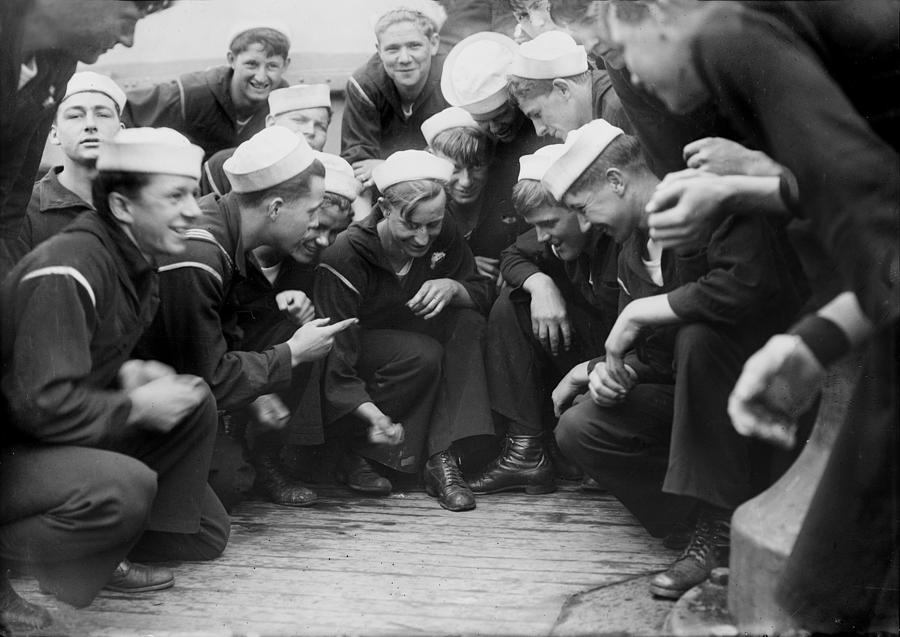
How much extra duty for beating the XO at craps?
1. "Criminal" Elements: This could be as benign as a floating craps game played by lowly ratings, to the production of engine room hooch, to the guy on deck nine that can get anything you need, even after months in space.  This faction is not anti-establishment per se, but  they are motivated by a strong desire to not get caught, and this can be use to a party's advantage.  The criminal element are also useful for getting one's hands on illicit items - anything form pin-up holos to the contents of the captain's safe, depending on how corrupt the system is.  Likewise, the criminal element may be restricted to that one rating that get busted down to able spacer for smuggling contraband every time they get a promotion , to the ships supply officer, to the CO.


Clockwise from top: plain-crazy actor, diplomat/assassin,
military-hating scientist family member, military-hating scientist
space hippy, and rescued con-man.
2. Passengers: Star Trek has used this faction to great effect since the first season of the Original series.  Actors, foreign dignitaries, scientist that despise the military, and space hippies all give GMs an opportunity to introduce conflict on their otherwise well running starships. Such visitors outside of the chain of command allow for interactions not normally permitted in military or quasi-military organizations, namely fraternization.  If your party is more into violence than sex, the introduction of any unknown group allows for the injection of spies, saboteurs, assassins and the just plain crazy.  Family members of the crew - especially PCs, make for interesting visitors.  Finally, rescued spacers have any of a number of different backgrounds, from honest folks to con men.  The nice thing about bringing groups of new people aboard your ship is that the PCs never know what they're going to get.  The disadvantage is that the PCs will automatically assume - quite reasonably - that the new people are where the plot/adventure is. 


Pictured:  The Death Star's
Political Officer
3. The Political Officer:  The Political Officer is a real-world crew position used in the naval forces of totalitarian forces to insure that the military is firmly under civilian control.  They make sure that the captain toes the party line, the officers are shining examples of party orthodoxy, and the crew isn't poisoned by such toxic memes as "sense of adventure" and "fun".  Obviously, the Political Officer is almost universally hated by all aboard.  Many depictions of Polits show the frustration of Naval personnel with advanced tactical training having to justify their actions to a bureaucrat with little or no military training.  This is not always the case, however.
    The advantage of there being a Political Officer on a ship you're infiltrating is that pretty much everyone hate them, from the Captain on down. Their fear of the Political Officer is probably strong enough to counteract that hate.  A well connected Political Officer can have you arrested court-marshaled, imprisoned, executed, and could even go after your family.  The biggest obstacle for a party when faced with a Political Officer is that they are pretty much exactly the people the Polit is trying to ferret out.  They are as a general rule as suspicious as they are arrogant, and when you have one like the guy on the left, they may be able to read the treason in your mind.


But IN SPAAACE!
4.Mutineers: This is arguably the easiest way to introduce different factions into a starship-based campaign, because it...introduces factions into a starship.  It kinda really is that simple - a faction of the crew, often led by a senior officer but not always, is engaged in a conspiracy to take over the ship.  They may wish to kill or maroon the loyalists, they may be switching side in a civil war, taking sides in a coup, or turning pirate or privateer.       Campaigns have already been built out of the idea of having mutineers aboard ship, but the sheer variety of ways you can use this idea in new ways warrants inclusion on this list.  For example, what if a part of the crew were possessed by alien parasites? A religious conversion of a senior officer to a sect that is against the established political system could lead to a mutiny.  The instability of the commanding officer, who is a high-ranking noble, could require drastic measure to contain.  I could go on, but I'm sure all of you could too.  A mutiny could lead the ship dead in space, unable to call for help - and then the game become one of survival as the warring factions fight over the engineers need to repair the ship, even going so far was to kill them and sabotage the repairs in order to prevent the vessel from falling into the wrong hands.
     One final thought about mutinies.  In setting where many if not most of the crew are conscripts, expect a third faction of spacers who will sit out the mutiny, waiting to see who prevails.  While they may not enjoy life in the Navy, the punishment for mutiny - death - is enough of a deterrent to prevent many from joining the mutineers.  Getting the support of this "swing vote" could be the key to a mutiny's success or failure.

Pictured right:  Admiral Rittenh -uh, Marcus
5. Coup: Our final way of adding new and interesting factions into a starship-based campaign is to stage a coup.  Similar to the mutiny, a coup is when the ship's commander, or someone possibly higher up, decides to overthrow the entire government or possibly strike out on their own to form a new star nation with a sizable portion of the Fleet.  Realistically, a military junta taking over a civilian government is the number one danger facing most nations with a strong military in the world today.  Unlike mutinies, which are often bottom-up affairs, many of which are spontaneous, a coup attempt is usually the result of long term conspiracy and is instigated be senior and command officers.  These officers have an advantage on their assigned ships - being in charge, their orders are often unquestioned and their rank affords a level of privacy that crew do not enjoy.
    An excellent example of the coup used in a science fiction setting is the Star Trek novel Dreadnaut! In this novel, Starfleet Admiral Rittenhouse is in charge of the construction of the titular ship class, which he and a small fleet of co-conspirators intend to use to start a war with the Klingon Empire and take control of the Federation "for the duration of the emergency". If this sounds familiar, it was shameless ripped off to for half of the Frankenstein plot of Star Trek: Into Darkness. The movie borrowed so heavily form the novel, that the crew of the USS Vengence even have their own uniforms instead of Starfleet ones, just like in the book.
     Don't get me started.

     While it is certainly possible to run a mega-dungeon in an O'Neil Cylinder or a large passenger ship (I'll cover both in a future post).  Not all of us want that.  For myself, I wanna run a campaign in an actual, military starship, the bigger the better.  I have plans on how to map one, and I intend to map smaller capital ships as well.  It's been an axiom of strategic thinking since the dawn of dawning that knowing your terrain is key to victory.  That's one of the reasons why I want to see starships become more than plot devices or abstract locations.  I want to see them become more real. See them come alive.

      Anyway, RocketFans, I hope you enjoys this list, and I look foward to writing more game-based articles in the future.  Enjoy!


Tuesday, May 24, 2016

New Feature: Mini Maps

I started drawing these on a lark and the response has been more enthusiastic that I could have imagined.  So, for the benefit of everyone not following me on Google + (and really, why aren't you :)) I decided to put these on the blog.  These are sci-fi geomorphs, inspired by our Star Trek discussions of the last few days, and there are more to come.  There will even be, due to popular demand, versions for sale that include colored maps, blank maps (walls and doors only) and battle-damaged maps.  Enjoy!
Bridge and surrounds

First color pass of a B&W map.
I usually start and finish in color, so this in encouraging.

Block of Crew Quarters, two single staterooms share a central bath.

Deck one of our Jovian-class frigate for Starships and Spacemen

Labs, for to do SCIENCE!

People guessed that these were anything from nightclub dancefloors
to power stations to brigs before I filled in all the details.
But no, it's a pair of Teleporter rooms with attached Decon chambers.

Wednesday, May 18, 2016

A Hard (SF) Look at Star Trek: Scope II, The Wrath of Sol

Welcome back, RocketFans! I'm thrilled at the response so far We've had new visitors, new Paetrons, new comments - it's been gratifying to see so much interest in the stuff we put out. Thank you!
Image here

In my last post, I ended on something of a cliffhanger - namely, saying I could re-create the essentials of the Star Trek universe using Hard SF elements in our own little solar system.  I meant it, too.  It will take a bit of doing, I admit.  But on a project such as this, world building is half the fun.

In that post, I suggested that Star Trek’s United Federation of Planets didn’t need to be as big as it is to tell the stories Star Trek tells.   To start us off today, I want to show why the Federation can’t be as big as it is.  To do so, I am going to have to inject some actual science into the situation.  Please forgive me.

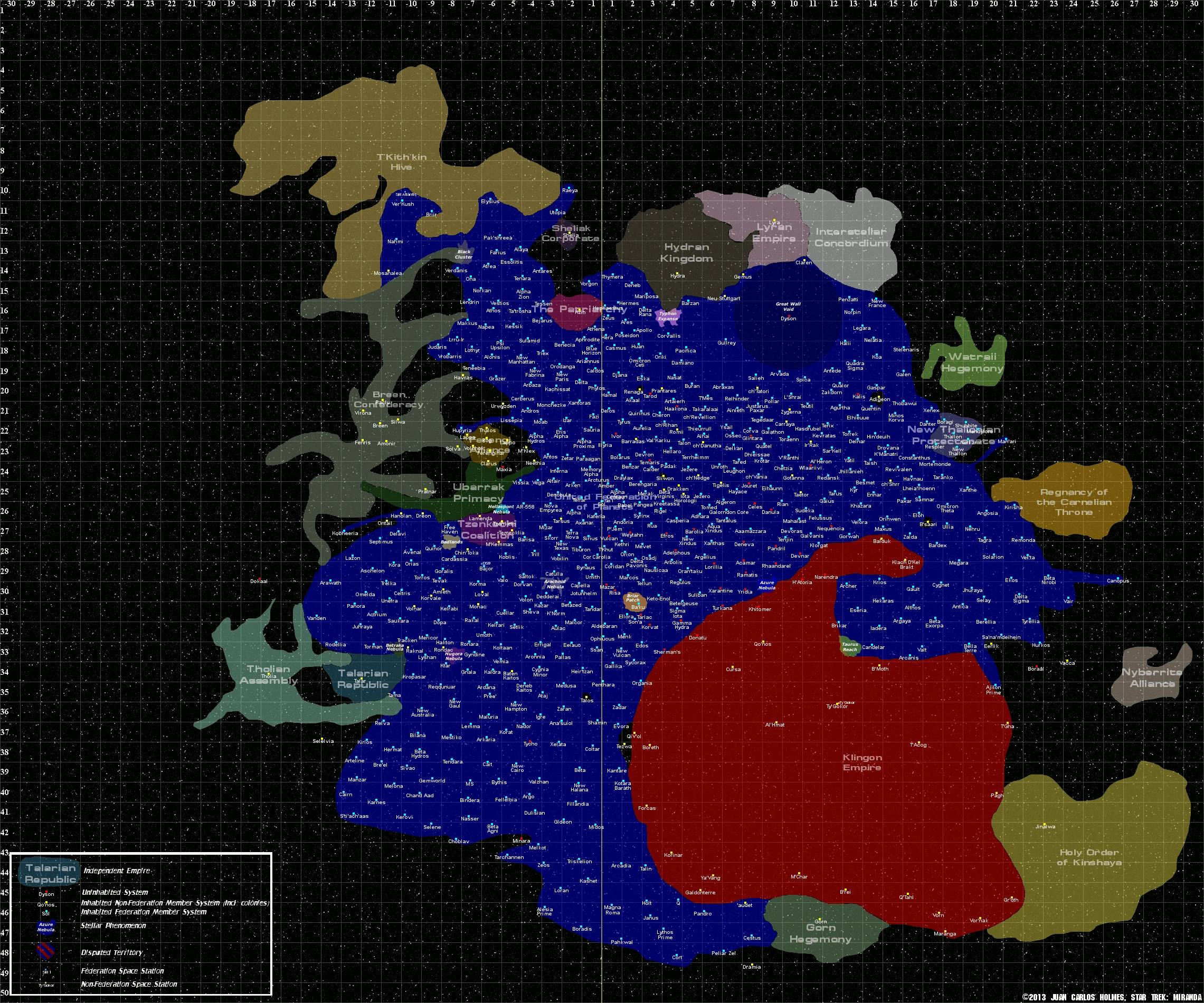
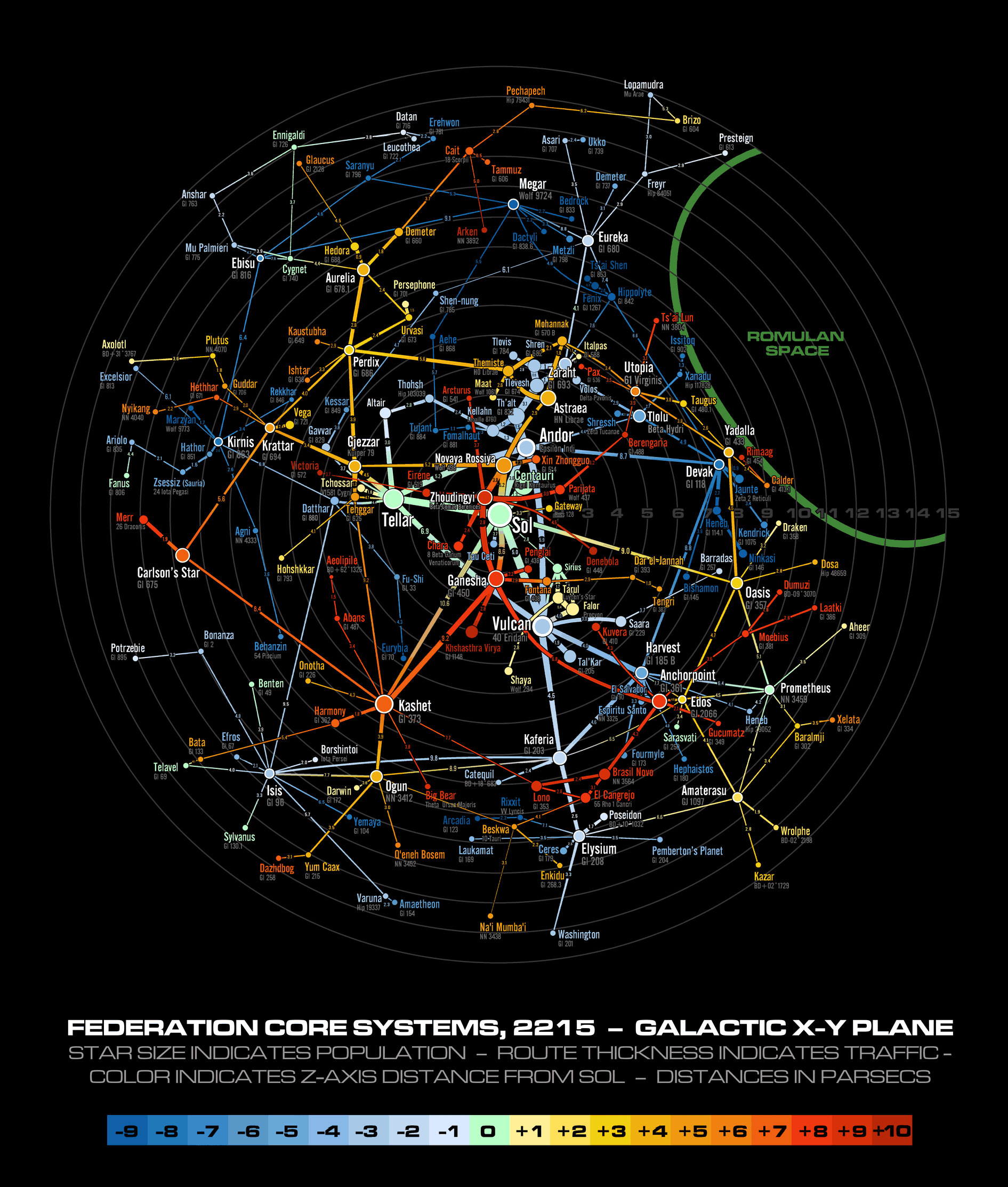
First of all, the size of the Federation:  According to dialogue in the movie Star Trek: First Contact, the UFP is over 8,000 light years across and has a hundred and fifty member worlds. Bernd Schneider, who I've mentioned before, tells us why that’s unlikely in terms of Star Trek’s own warp drive and it's established capabilities.  The only way such a vast amount of territory could be traversed by a spacecraft is at the speed of plot.

Make no mistake RocketFans, 8,000 light years is big.  Assuming Sol is in the center of this, a starship patrolling the border that happens to spot our home star in a telescope is looking at the same light that shown on China at the start of the Bronze Age.  This is the same time that the Egyptians were experimenting  with a new substance known as leavened bread.  And this is not a flat plane of territory either.  Though never mentioned, it is understood that the polities in Star Trek occupy most if not all the space above and below their colored blobs on the map.  That’s a thousand light-years on average, right there.  A 4,000ly radius and a thousand ly depth gives us a cylinder of space roughly fifty billion cubic light years in volume.

With a hundred and fifty member planets.  

I feel ya, bra.
After consulting that most valuable of resources, Atomic Rockets, we find that such a volume of space should contain about thirty-five million stars with human habitable planets.  This suggest that the Federation should actually have many, many more member planets than it does.  Even if we assume there are a hundred colonies per member world, they’re only using 0.04% of the real estate available - without terraforming.  Star Trek II: The Wrath of Khan, seems to indicate a need for quick and easy terraforming, considering the resources spent on Project Genesis.

All of these points are moot, in light of the equations on colonization, which at their most optimistic - meaning huge birth rates on colony worlds and forced emigration - the volume of space  we could occupy between now and the time of the movie First Contact is only a hundred light years in radius and .  That’s 0.06% if the supposed volume of the Federation.  That volume would contain 2200 habitable systems, with a colony-to-member ratio of  14.6 to 1.

That’s...wait, that’s actually reasonable.  Have we found a happy medium?  Is this smaller size just right without resorting to my radical solution of confining our setting to the solar system? In the old system of reckoning warp speeds (WF= x*c³), you can traverse that entire space, core to rim, in about two and a half months at Warp 9.  In TNG reckoning,you could make it in a couple of weeks at the max cruising speed of the Intrepid-class explorers.  Again, that’s pretty reasonable.  Has anyone else thought of making the Federation this size?  Am I the first?!

Oh.

But, I’m still committed to making a Hard SF Star Trek setting the size of our solar system.  Wh, you may ask?  Because I'm making Hard SF:  You can’t travel faster than light. Silly.

Anyway. Solar System.

The two main objections to putting a setting as epic in scope in a place as...local as the Solar System are that the it's too small and there's only one decent planet in the bunch. Fair enough - or is it? I admit that there are no aliens in our star system...for now...and only one habitable planet...at the moment. But is the Solar System too small? After all, it is our backyard, right?

If this is your backyard, maybe.
The Solar System, from star to Oort Cloud, is 1.87 light years. The heliopause, the point where solar wind is canceled out by interstellar gasses, is a thousand times closer, but still a hundred AU away, which is 9.3 billion miles from Sol. That's just size - the number of planetary bodies is also suitably enormous. While there are only eight planets in our system - half of which are gas giants and lack real estate all together - There are a whopping 182 moons, nineteen of which are large enough to be planets or dwarf planets in their own right. That's comparable to the size of the Federation in terms of numbers. Granted most of those locations lack certain amenities, like atmosphere and water and heat. But that is actually a solvable problem in a couple of different ways.

Remember we mentioned terraforming earlier? I'm sure you all figured out that terraforming would play a big part in my setting, but perhaps not to the extent I'm thinking about. However, this post is long enough already, so we'll discuss how terraforming will give us a large enough Star Trek setting next time. As a bonus, we'll have rubber forehead aliens that can interbreed with humans presented in a way that is not only plausible, but likely.

For now, RocketFans, we'll leave you with this: Wouldn't our system be a lot more habitable if we had three suns instead of just one?

*Thanks again to Bernd Schneider for making his site, Ex Astris Scientia. Also, shout-outs to Masao Okazaki at The Starfleet Museum, and as always to Winchell Chung, Jr. at Atomic Rockets and, as we mentioned today, 3-D Starmaps. I stand on the shoulders of giants.


Google+