Showing posts with label How you play/What you win. Show all posts

Wednesday, February 9, 2022

How you Play is What you WIn II: Overruling Over-Rule-ing

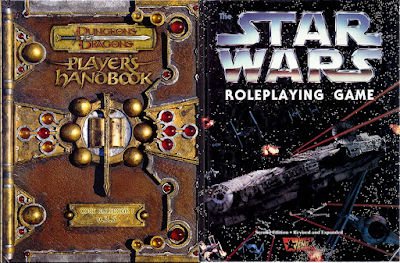
    My wife Debra is my favorite gamer.  Obvious and unapologetic bias aside, she makes the best characters.  Once she grasped the rules for multi-classing in D&D 3rd edition (much faster than I did) she never created the same kind of character twice.  She had one, a Bard/Rogue/Fighter/One-of-the-exotic-Prestige-Classes that looked like a half-elf David Bowie and I remember them fondly. 

Half-elf is almost redundant.

    But they were all fun.  Debra played Changelings, Shaman, Classes and Races from obscure 3rd parties books and a few home-brew Races and Classes as well.

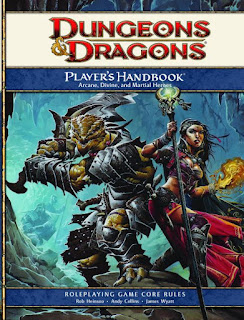
    I've mentioned before that one of the reasons I didn't enjoy playing 4th edition D&D was the difficulty in making multi-class or home-brew content.  I felt like we couldn't make the game our own.  With 3rd edition the issues were different:

  • It was hell to prep for. Every monster and NPC used the Player Character format and that format was neither simple nor short.  The stat blocks in the Monster Manual were difficult to use at the table on the fly.
  • Experience.  The XP rules - actually, I don't think I ever used the XP rules.  I just let everyone level up after each session.
  • NPC Spellcasters.  Remember NPCs used PCs format?  So I'd need the MM and DMG and the Player's Handbook unless I wanted to write out every spell discription. 

 IMPLICIT RESTRICTIONS

  These were the obvious issues.  The more insidious issues, the ones I had to have pointed out to me, are the issues implicit in the design.  Skill lists for example.

    Without spending the remainder of this post breaking down the rules for getting skills, increasing skills and using skills, let us focus instead on the affects of having a skill list at all:  

  • A skill list implies that there is a finite number of possible actions.  If as a player you've ever looked at your sheet to see what you can do, you know what I mean. If the system has more skills that favor a certain kind of play (like combat) or forces Players to spend a limited number of points on specific skills to make the character viable, then that is what the game is about. How you Play is What you Win.
  • A skill list implies that you must roll for any action in which there is a skill.  Ever play a modern/near-future campaign and fail a Drive check going to your apartment?
  • A skill list implies your character concepts are limited. This is really bad in systems that have Class-based character builds, with limited lists of skills one can gain without penalty, but it's also present in any system with skill lists.  One of the reasons I'm making Project NEPTUNE is because it's impossible to make a character that's viable in both regular and space combat.  The available skill points are spread too thinly.

    This last point is a particular peeve because it opens up the Munchkin-Min/Max-Can-Of-Worms that is Character Build Optimization.  I personally am not interested in gaming the rules for advantage when rolling dice.  I do not want to make a game that rewards or, if possible, allows that sort of meta-gaming.

    I'm Diabetic - I already can't eat without doing complex math.

Skill Chapters are 26 and 30 pages respectively.
    

SKILL ROLLS WITHOUT SKILL LISTS?

    Years ago now, I read a post from Tales to Astound that has stuck with me ever since.  The TL;DR version is that during a con-game, the author wrote the character generation rules out on-the-fly and included a game gem so lustrous it's stuck with me ever since:

"Give yourself a profession and write that on the top of the card. 
Your character can do all the things that that profession can do. 
Then add three more skills, the things you are really good at, which might tie to your profession or be something else."  

    That. Right. There.  Your character can do all the things that profession can do. 

    That simple sentence implies so much more freedom than the most comprehensive chapter on skills is able to.  Let's unpack it a bit:

  • The less you define a skill list, the more potential a Character has. Say your profession is Butcher.  This immediately conjures up images of someone who is strong and good with knives.  I'd easily believe they are intimidating as well.  But there's so much more - Butchers are business people! They would know about taxes, sales, bookkeeping, and (depending on your setting) how to Drive.
  • You don't have to roll for every action. It's baked in - your Character can do these things.  There's no risk of failure unless there's a special circumstance.
  • An undefined skill list allows for creative interpretation. You can make a case a Butcher would know how to stitch someone up. They work with knives all the time, may not have money for the village barber or may lack health insurance - A case can be made that the particular Butcher you are playing can stitch up a wound.  And if a fellow PC is bleeding out you'd make that case.  Likewise, you could make the case a Butcher that works with the public daily would know how to flirt.  The GM may not agree with either case but the implication of the system is you have permission to try a creative interpretation of your Character.
    Encouraging a character's potential and player's creativity is what I want to win when I play, so you can expect as Project NEPTUNE and other ideas are developed, Skill Lists and their minutia will not be a large part of them.


Wednesday, December 29, 2021

When Murdering Empires, How you Play is What you Win

     Bonus points to those who recognize the quote.

Yes, even the Skill Challenges.

     I have a confession:  The 4th edition of D&D is the only set of rules - for any rpg - that i've run Rules As Written.  The system was, as far as it intentions went, perfect.  The XP notation, monster blocs, the unified leveling mechanic, the treasure parcels, the encounter design tools - I even used skill challenges as written.  The 4e rules made it so easy to design and run an adventure that it was a pleasure to use at the table.

     So much so that it took me years to realize I didn't really like the game.

     Trying to adapt  the 3rd edition material to a 4th edition game by myself was a path down which lay madness.  The mechanics that were exquisitely simple on the front end seemed to hide furiously opaque math on the back end. This also made 4th edition terrible for those among us that like to make their own character classes or to multi-class ad infinitum.  The interlocking obligations of Balance between PC/encounter/monster/treasure level made such experiments not only difficult to develop, but impossible under the rules as written.  

Making unique classes and adapting your own material wasn't what the game was about.

     Put simply, the games I ran ended up being walks from set-piece encounter to set-piece encounter to fight monsters and grab a treasure parcel.  The "perfect" balance of the system made the encounters feel bland and much the same. Since they were balanced for your party's size and level, a fight against four goblins at first level had the same stakes and difficulty as a fight against four Sorrowsworn at twenty-fifth - but takes a lot longer because of feature creep.

    I understand that there is nothing in the rules forbidding more open and interesting play, there also nothing in the RAW rewarding different play.  You get XP from killing monsters.  You get treasure from killing monsters - either directly as loot or indirectly as quest rewards.  The special powers and class features you earn are overwhelmingly mechanics to allow Characters to kill more monsters.  The goal is to level up you Character and collect treasure to get new powers and equipment to...kill more monsters.

    Its a game about killing monsters.  How you play is what you win.

    D&D wasn't always about killing monsters.  One of the pillars of the modern OSR movement is the idea of rewarding XP for gold spent - no matter how you got it.  This opens up a lot more options for play that don't have to involve killing monsters.  It also allows one to de-emphasize balance, since you are under no obligation to tangle with a monster that in order to get XP.  Far more prolific Bloggers than I have covered the nature of OSR play and how rewarding for gold spent is important to the aesthetic of Conan-type characters who hunt treasure, spend it all on insane carousing and magic items until they're broke again and need more treasure.

    Again, how you play is what you win.

    Before I get too serious about developing Murdering Empire as a game system and associated support content, I need to decide what kind of play I want to reward.  What is a game of adventuring through a collapsing galactic empire actually about?  What do you do?

    Keeping with the philosophy of anti-cannon, I don't want to create a meta-plot.  I'm really leaning into the idea that people not only don't know what happened to the Empire, many people don't even know what the Empire was.

    I once again refer to Space Skimmer for the game's general mood:

    "The Empire itself was neither just nor unjust. It existed simply to fulfill a purpose—communication between all men; but whenever action was taken in its name, that action reflected the men directing it. If they were just, then so was the Empire. If they were unjust—"

-Gerrold, David. Space Skimmer

    GOLD.

    It's too good an idea to let go.  I want to see starships enter a new system with great caution, never knowing what they can expect. Part of this comes from Space Viking, which for all it's faults has a sense of consistent scale when discussing the plot's man-hunt: 

    "We'll hear where he was a year ago, and by the time we get there, he'll be gone for a year and a half to two years. We've been raiding the Old Federation for over three hundred years, Lord Trask. At present, I'd say there are at least two hundred Space Viking ships in operation. Why haven't we raided it bare long ago? Well, that's the answer: distance and voyage-time. You know, Dunnan could die of old age—which is not a usual cause of death among Space Vikings—before you caught up with him. And your youngest ship's-boy could die of old age before he found out about it."

-Piper, H. Beam.  Space Viking

    With these two passages as dim guide-posts, I can see I want to reward traveling into the unknown with little more than rumors third-hand accounts. I also want to play with the idea that civilization and Empire are not synonymous. 

      And I want there to be Spaceships.  I want to have travel from world to world incentivized. 

That dome? Spaceship.


         The ideas of what you reward, what you want a game to be about, and game design in general grow tangents like hydra.  In the time it's taken to write this much, I've thought of:

  • The core game loop, or what you Players can do when they don't know what to do.
  • Currency and Economic and how much I don't want a game about that.
  • How to evoke a sense of wonder in a game using such well known tropes, and
  • All the stuff about what was great about 3rd edition D&D that I had to cut for this post. 

    I don't think I'll be doing all of these in order, because I already had a few ideas for blog posts I wanted to explore.  But that's good - having ideas to write about makes me confident I will keep writing.

    Look for the How you play/What you win tag for more posts in this series.


Google+